
AA Quiz
How the Scales are Structured
Who Usually Takes This Test?
See How You Compare
Below is a preview of how scores are typically distributed across each scale.
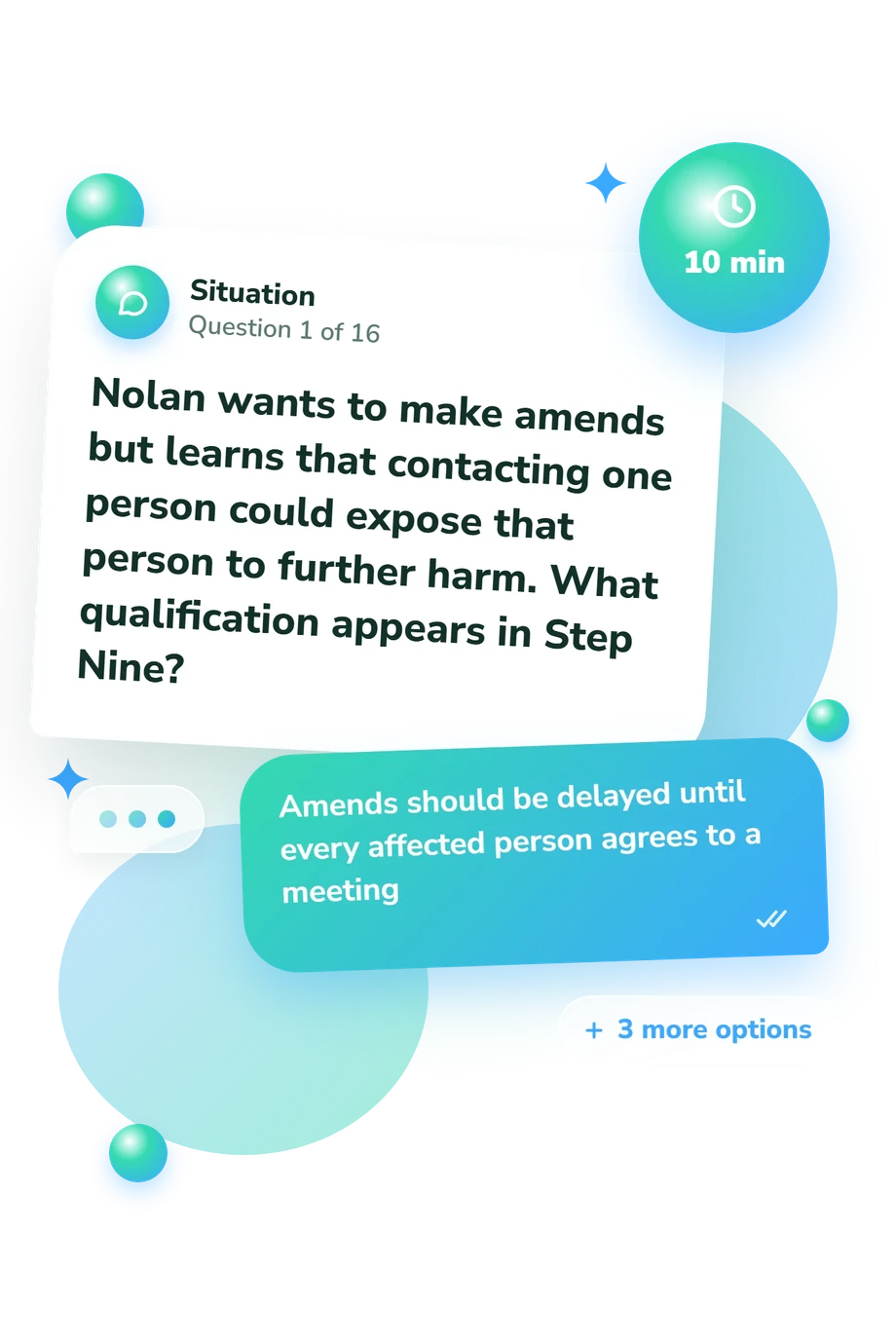
Example Questions From the Test
- Only people who have already completed all Twelve Steps
- AA members or people who have a desire to stop drinking
- Anyone interested in alcohol education or community services
- AA members and any relatives who want to accompany them
- Turning group decisions over to a central AA authority
- Listing everyone harmed and immediately contacting each person
- Sharing the recovery message with another person
- Making a searching and fearless moral inventory of oneself
- A written commitment to lifelong abstinence
- A desire to stop drinking
- Completion of the first three Steps
- A referral from a treatment professional
AA Quiz - Description and methodology of the test
People seeking a clear introduction to Alcoholics Anonymous can use the AA Quiz to check their grasp of the fellowship’s language, practices, and boundaries. For newcomers, supporters, students, and curious readers, this test of AA knowledge offers a focused way to identify familiar concepts and topics worth reviewing. Its result describes knowledge of AA rather than drinking status, recovery progress, or treatment needs.
What This Assessment Explores
The questionnaire measures knowledge of Alcoholics Anonymous: how its Twelve Steps guide recovery, how the Twelve Traditions support group unity, and where fellowship support differs from professional treatment. Its scenarios ask about amends, anonymity, sponsorship, meeting access, the Higher Power concept, self-support, and an AA group’s primary purpose.
As an AA alcoholic quiz, it examines understanding of the fellowship’s principles and boundaries, not whether someone has an alcohol problem. It also distinguishes AA from Al-Anon and from urgent medical care. The result appears on the Alcoholics Anonymous Knowledge scale (0-16), with three bands:
- Foundations to build (0-6) shows recognition of some AA concepts while pointing to areas for learning.
- Developing knowledge (7-12) indicates familiarity with many core principles, with details still worth reviewing.
- Strong knowledge (13-16) reflects a well-rounded understanding of AA’s structure, practices, and limits.
Methodology and Scientific Basis
Each item presents a short situation or knowledge question with four answer choices. The respondent selects the option that best fits AA’s principles, and the questionnaire assigns one point for each correct answer. The total reflects recognition and application of information rather than symptoms, personal history, or self-reported drinking.
The content is conceptually consistent with the TSG knowledge scale (Vederhus et al., 2009), but this online questionnaire has its own item set and is not presented as that published measure. Its reference framework is the AA literature on Steps, Traditions, meetings, sponsorship, anonymity, and fellowship boundaries. Used as an Alcoholics Anonymous knowledge quiz, it can support learning about how AA works, while its score should be read as performance on this set of questions.
Interpretation depends on prior exposure to AA vocabulary, reading of scenarios, memory, guessing, and current perspective. The knowledge score is unvalidated, has no established standardization or diagnostic cutoff, and does not establish drinking, recovery, or treatment needs; AA provides peer support rather than medical care, so severe withdrawal symptoms require urgent medical help.
- Vederhus, John-Kåre, Øistein Kristensen, Alexandre Laudet, and Thomas Clausen. "Attitudes towards 12-step groups and referral practices in a 12-step naive treatment culture: a survey of addiction professionals in Norway." BMC Health Services Research 9 (2009): 147. 10.1186/1472-6963-9-147
- Alcoholics Anonymous. Twelve Steps and Twelve Traditions. New York: Alcoholics Anonymous World Services, 1953.
- Alcoholics Anonymous. Alcoholics Anonymous. 4th ed. New York: Alcoholics Anonymous World Services, 2001.
Updated: