
Science and Nature Quiz
How the Scales are Structured
Who Usually Takes This Test?
See How You Compare
Below is a preview of how scores are typically distributed across each scale.
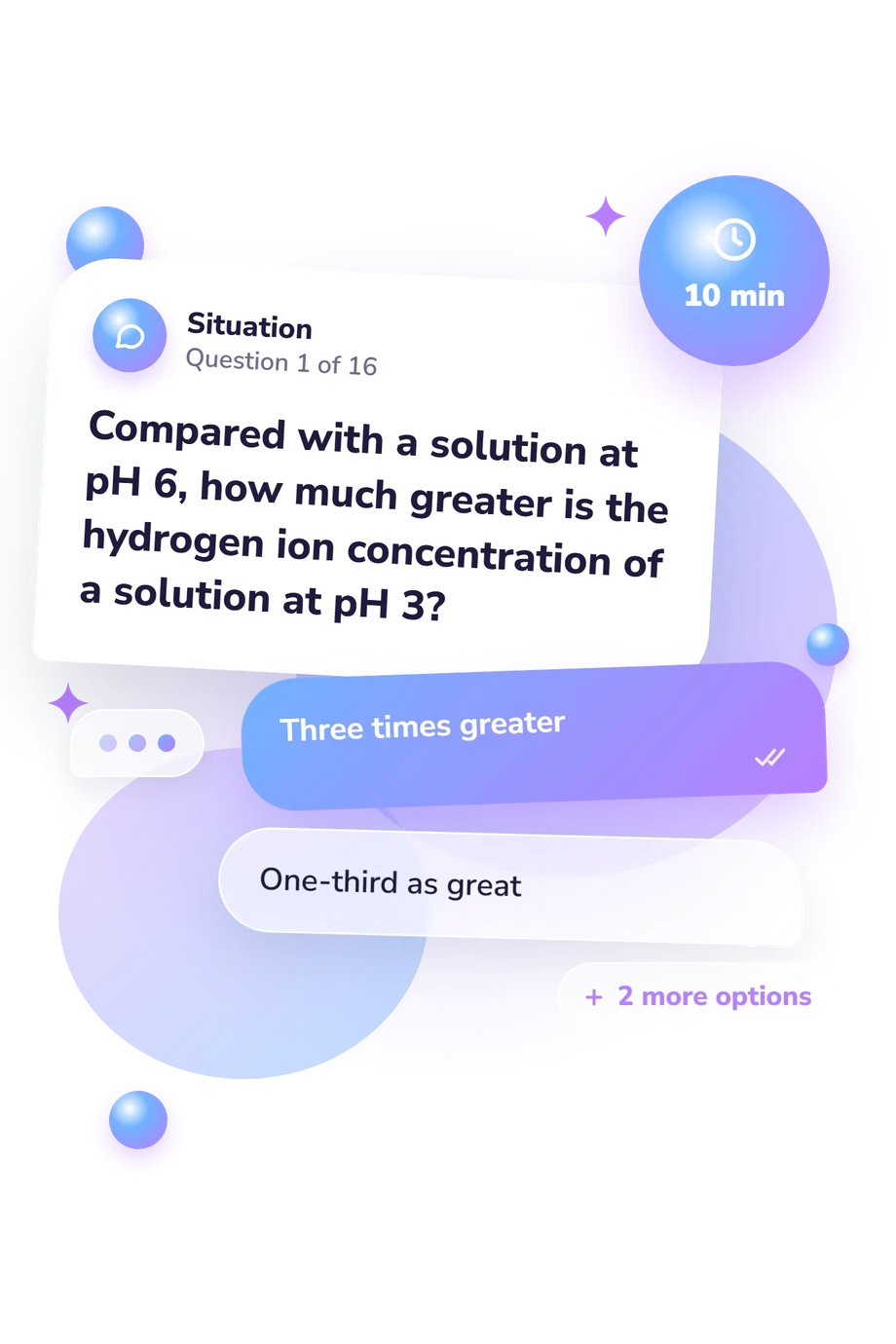
Example Questions From the Test
- Three times greater
- One-third as great
- One hundred times greater
- One thousand times greater
- The vacuum prevents electricity from reaching the bell.
- The bell stops vibrating when air pressure decreases.
- Sound needs particles through which its vibrations can travel.
- Light inside the jar absorbs the sound energy.
- The red star must be closer to Earth.
- The blue star has the higher surface temperature.
- The red star produces no visible light.
- The blue star must be smaller than the red star.
Science and Nature Quiz - Description and methodology of the test
People who enjoy broad general knowledge can use this assessment to explore scientific principles and everyday natural phenomena across a wide range of fields. Working through science and nature quiz questions takes respondents on a structured tour across several fields rather than a specialist assessment. It also suits anyone preparing for a science and nature pub quiz and wanting to identify topics worth revisiting.
What This Assessment Explores
This assessment measures broad scientific knowledge in practical situations. Items span physical and chemical processes, life science, ecology, Earth and space, and health, asking respondents to recall facts and apply relationships or principles across these subject areas. It suits curious learners and general-knowledge players seeking a cross-topic check.
The questions fall into three broad thematic groups:
- Physical and chemical principles test understanding of pH, sound, density, insulation, and condensation.
- Life science and ecology examine genes, decomposers, food webs, plant adaptations, and disease agents.
- Earth, space, and applied reasoning connect seasons, stars, tectonic boundaries, lunar phases, and everyday predictions.
In this assessment, science and nature pub quiz questions check accurate application as well as recall. The result is reported as Science and Nature Knowledge: 0-16. Foundations to Build (0-6) means core ideas to revisit; Developing Knowledge (7-12) reflects a useful foundation with some gaps; Strong Command (13-16) indicates consistent recall and application across the sampled subjects.
Methodology and Scientific Basis
Each item has a short stem and four answer choices, asking for the best explanation, prediction, calculation, or factual conclusion. The format includes tasks such as interpreting pH, calculating density, and linking a biological change to its ecological consequence. The result is one overall knowledge score; because the questionnaire does not specify how many points each response contributes, no finer scoring rule should be inferred from the range.
The questionnaire is conceptually consistent with the Test of Basic Scientific Literacy (Laugksch & Spargo, 1996), not an adaptation of that published instrument. That work organized items around AAAS Project 2061 literacy goals and linked scientific literacy with understanding key concepts and using scientific ideas in everyday contexts. This quiz samples related domains in a shorter online format.
This science and nature quiz can support learning-oriented self-reflection when its score guides review of the sampled topics. Its bands are descriptive levels rather than population norms or clinical cutoffs, and performance may be affected by guessing, prior study, concentration, or familiarity with test-style questions. Treat the score as a snapshot of these sampled topics.
- Laugksch, Rüdiger C., & Spargo, Peter E. (1996). Development of a pool of scientific literacy test-items based on selected AAAS literacy goals. Science Education, 80(2), 121-143. 10.1002/%28SICI%291098-237X%28199604%2980%3A2%3C121%3A%3AAID-SCE1%3E3.0.CO%3B2-I
- Laugksch, Rüdiger C., & Spargo, Peter E. (1996). Construction of a paper-and-pencil Test of Basic Scientific Literacy based on selected literacy goals recommended by the American Association for the Advancement of Science. Public Understanding of Science, 5(4), 331-359. 10.1088/0963-6625/5/4/003
- American Association for the Advancement of Science. (1989). Science for All Americans: A Project 2061 Report on Literacy Goals in Science, Mathematics, and Technology. Washington, DC: AAAS.
Updated: