
Halloween Picture Quiz
How the Scales are Structured
Who Usually Takes This Test?
See How You Compare
Below is a preview of how scores are typically distributed across each scale.
Example Questions From the Test
- Spirited Away
- Monster House
- Coraline
- The Boxtrolls
- Halloween
- The Burning
- Friday the 13th
- Sleepaway Camp
- Poltergeist
- Killer Klowns from Outer Space
- The Babadook
- It
Halloween Picture Quiz - Description and methodology of the test
For movie fans checking how well they recognize iconic spooky cinema, the halloween picture quiz offers a focused recall challenge built around memorable characters, scenes, props, and settings. It suits readers who enjoy seasonal viewing and want to distinguish durable recognition from general familiarity with film titles. This free quiz about Halloween pictures keeps the emphasis on identifying what a scene represents, not judging taste or critical knowledge.
What This Assessment Explores
The questions ask you to connect a film with visual or story clues: a costume, creature, location, prop, character, or memorable scene. Coverage spans horror, supernatural fiction, dark comedy, family fantasy, animation, and established franchises. The task examines accessible recognition across seasonal cinema rather than viewing quality or specialist expertise. As a halloween photo quiz, it suits anyone exploring which screen details remain easiest to recall.
The result uses the Halloween Film Knowledge scale (0-16), with three performance bands that describe the following outcomes:
- Emerging Viewer (0-6) indicates that major Halloween-film imagery is familiar, but characters, props, and settings can still be confused.
- Developing Film Fan (7-12) shows broad familiarity and many successful connections between combined clues and titles, while less familiar films may need revisiting.
- Halloween Film Expert (13-16) reflects consistent recognition of distinctive details across horror, comedy, and animation.
Methodology and Scientific Basis
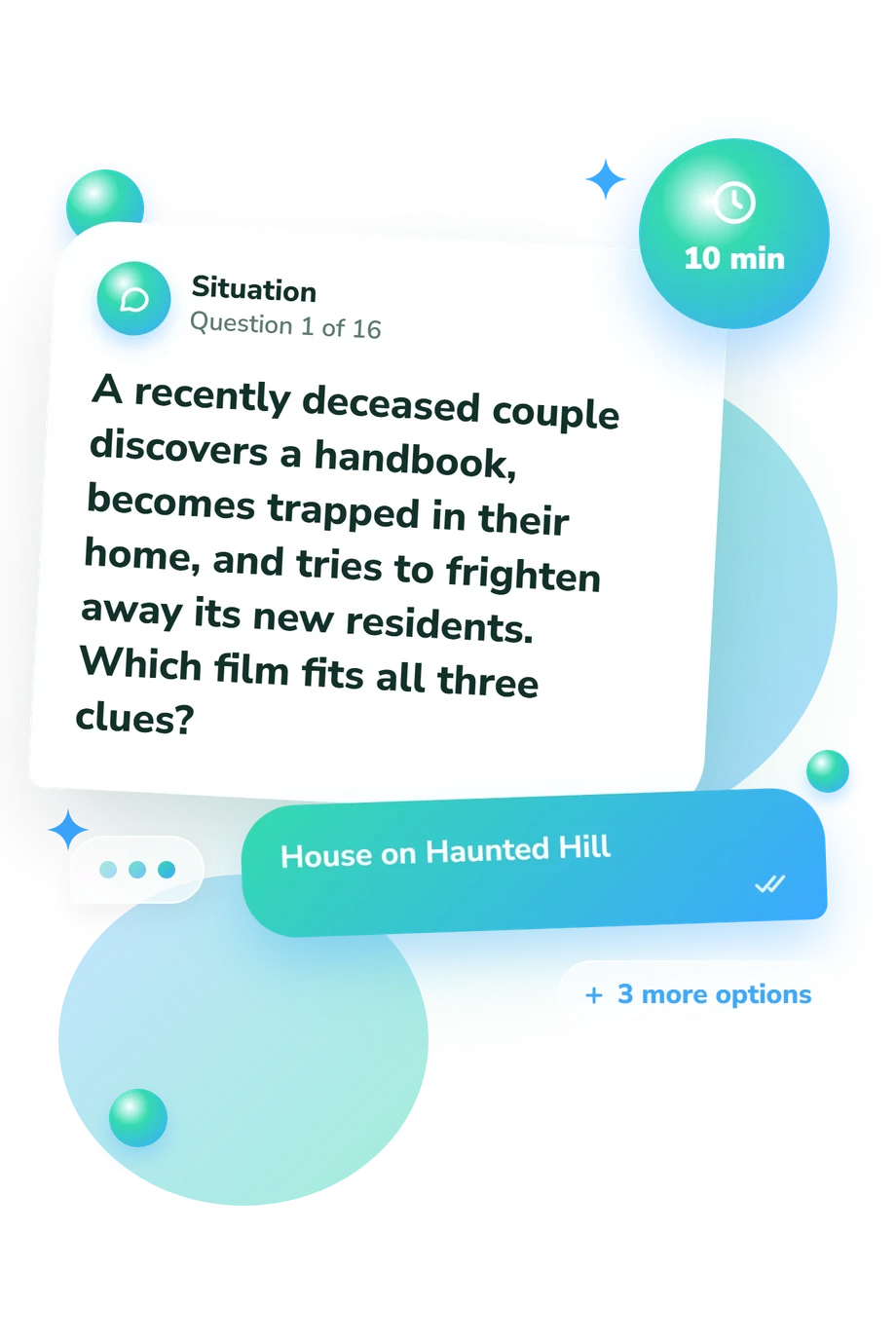
Each item presents a short clue set followed by four film titles, so you select the option that best matches the described image or scene. The format combines recognition with retrieval: familiar details must be connected to the right narrative, franchise, or character. The halloween film quiz therefore captures prompted recall, and the score is the number of correct identifications rather than a weighted estimate of taste or expertise.
Its memory rationale is conceptually consistent with Larzabal et al. (2017), who examined remote recall for television material, Furman et al. (2007), who studied memory for a full-length film, and Potter (2012), who examined recognition and memory for briefly shown scenes. These sources support the use of audiovisual clues for a recognition task; they do not show that this questionnaire is an adaptation, standardized replica, or validated instrument.
Interpret the outcome as a snapshot shaped by recent viewing, cultural familiarity, attention, clue wording, guessing, and current access to memory. Self-report also makes the result dependent on focus and honest selection. The questionnaire has no published reliability estimate, population norm, or clinical threshold, so its bands describe performance on this attempt rather than a permanent level of film knowledge. It is a self-reflection measure, not a diagnostic assessment.
- Larzabal, Christelle, Nadège Bacon-Macé, Sophie Muratot, and Simon J. Thorpe. “Waking Up Buried Memories of Old TV Programs.” Frontiers in Behavioral Neuroscience, vol. 11, 2017, article 60. 10.3389/fnbeh.2017.00060
- Furman, Orit, Nimrod Dorfman, Uri Hasson, Lila Davachi, and Yadin Dudai. “They Saw a Movie: Long-Term Memory for an Extended Audiovisual Narrative.” Learning & Memory, vol. 14, no. 6, 2007, pp. 457-467. 10.1101/lm.550407
- Potter, Mary C. “Recognition and Memory for Briefly Presented Scenes.” Frontiers in Psychology, vol. 3, 2012, article 32. 10.3389/fpsyg.2012.00032
Updated: