
Who Am I Really Quiz
How the Scales are Structured
Who Usually Takes This Test?
See How You Compare
Below is a preview of how scores are typically distributed across each scale.
Example Questions From the Test
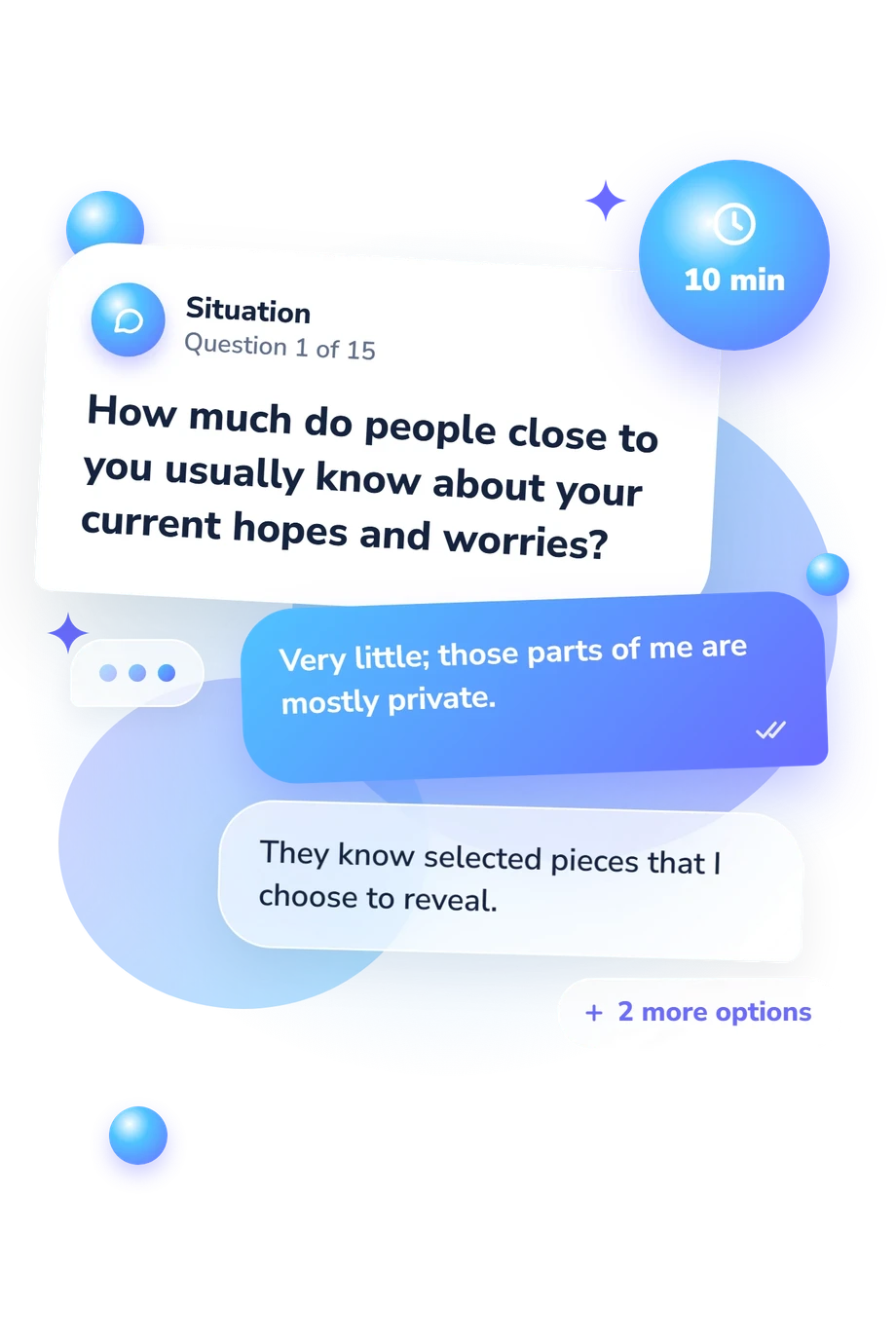
- Very little; those parts of me are mostly private.
- They know selected pieces that I choose to reveal.
- They know a fair amount, though I keep some layers to myself.
- They usually have a clear picture because I talk about both openly.
- I find out what other people are doing and join the most appealing plan.
- I start with existing commitments or what seems expected of me.
- I compare my own wishes with the plans and expectations around me.
- I choose what feels personally worthwhile, even if I do it alone.
- I often understand it only after hearing how others respond.
- I can explain it when a situation makes me think about it.
- I usually know after taking a little time to reflect.
- I generally have a clear sense of the value or feeling behind it.
Who Am I Really Quiz - Description and methodology of the test
For readers who want to examine how they present themselves, revise their self-image, and make choices that feel personally meaningful, the Who Am I Really Quiz offers a focused self-reflection exercise. It suits anyone curious about identity and values. For readers asking who they are really, this questionnaire works as a who are you really quiz, turning broad questions about the self into patterns rather than a fixed label.
What This Assessment Explores
Items treat identity as a lived pattern rather than a fixed category. They ask how openly you share experiences, respond to challenged beliefs or labels, and weigh personal values against outside expectations. Authentic Expression measures expression style, not honesty or health; the profile covers identity exploration and value-guided choice too. The questionnaire functions as a self-discovery quiz that organizes reflection; no band is universally better.
The three displayed dimensions are:
- Authentic Expression (0-15) measures visible sharing: Selectively Private (0-5) discloses carefully; Situationally Open (6-10) varies with context; Readily Expressive (11-15) communicates openly.
- Identity Exploration (0-15) measures willingness to test possibilities: Continuity-Focused (0-5) favors established roles; Selective Explorer (6-10) allows some experimentation; Actively Exploring (11-15) welcomes broader change.
- Inner Compass (0-15) measures guidance by personal meaning: Context-Guided (0-5) leans on outside cues; Balancing Influences (6-10) weighs both; Internally Guided (11-15) follows personal priorities.
Methodology and Scientific Basis
As a self-report format, each item describes a familiar situation and offers four ordered response options. Items cluster around expression, identity revision, and value-guided choice. Responses move across privacy, continuity, openness, revision, and self-direction. Individual point assignments are not provided, so displayed scores summarize patterns rather than produce one identity type.
Conceptually, expression has limited thematic overlap with the 2022 Authentic and Inauthentic Expression Scale associated with Al-Khouja et al., particularly its attention to communicating inner experience, while identity items connect more precisely with Luyckx et al.’s model of identity formation, especially exploration and revision of identity commitments. Alignment between conduct and inner experience also relates to Wood et al.’s Authenticity Scale. These are conceptual parallels, not claims that this questionnaire adapts or standardizes those instruments.
For fuller reading, this personal identity quiz is best interpreted through the displayed bands and the situations represented by the answers. The bands are descriptive rather than universal measures of better or worse. Current circumstances, self-awareness, and response bias can shape answers, making the profile a focused starting point for reflection rather than a complete account of identity.
- Al-Khouja, Maya, Netta Weinstein, William Ryan, and Nicole Legate. "Self-expression can be authentic or inauthentic, with differential outcomes for well-being: Development of the authentic and inauthentic expression scale (AIES)." Journal of Research in Personality, 97, 104191 (2022). 10.1016/j.jrp.2022.104191
- Luyckx, Koen, Seth J. Schwartz, Michael D. Berzonsky, Bart Soenens, Maarten Vansteenkiste, Ilse Smits, and Luc Goossens. "Capturing ruminative exploration: Extending the four-dimensional model of identity formation in late adolescence." Journal of Research in Personality, 42(1), 58-82 (2008). 10.1016/j.jrp.2007.04.004
- Wood, Alex M., P. Alex Linley, John Maltby, Michael Baliousis, and Stephen Joseph. "The authentic personality: A theoretical and empirical conceptualization and the development of the Authenticity Scale." Journal of Counseling Psychology, 55(3), 385-399 (2008). 10.1037/0022-0167.55.3.385
Updated: