
Is Cyber Security Right for Me Quiz
How the Scales are Structured
Who Usually Takes This Test?
See How You Compare
Below is a preview of how scores are typically distributed across each scale.
Example Questions From the Test
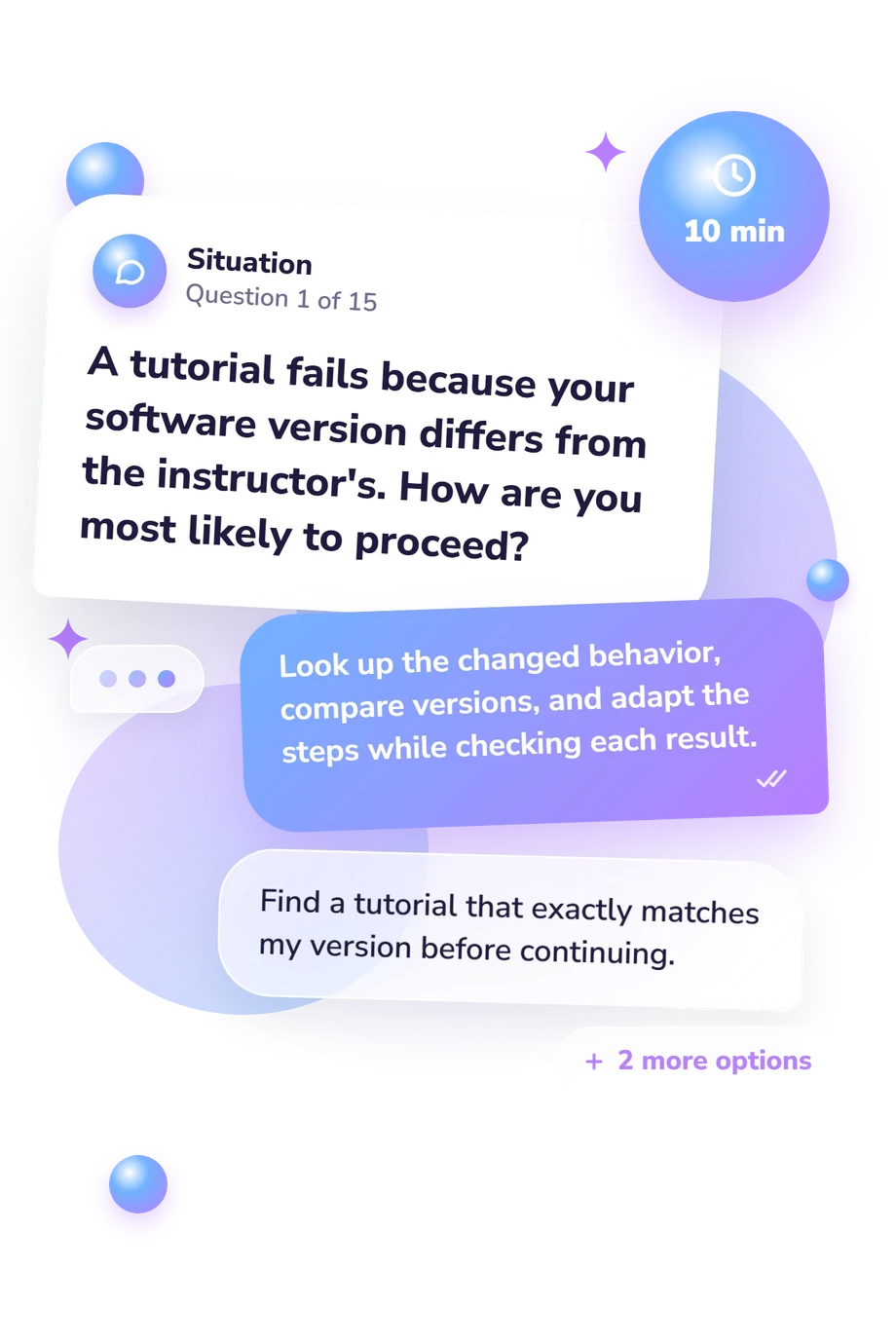
- Look up the changed behavior, compare versions, and adapt the steps while checking each result.
- Find a tutorial that exactly matches my version before continuing.
- Try a few likely adjustments, then seek help if the results remain unclear.
- Pause the project until an updated course or guided solution becomes available.
- Work through a small safe example, consult the documentation, and record what I discover.
- Ask for a walkthrough before using it so I have a reliable starting process.
- Read a quick-start guide and try the core features needed for the task.
- Request that the task be reassigned to someone already familiar with the tool.
- I enjoy forming explanations and narrowing them down as evidence appears.
- I can explore it for a while, especially if I have a clear investigative framework.
- I prefer to gather more direction before investing much time in uncertain possibilities.
- I would rather switch to a task with a defined solution and endpoint.
Is Cyber Security Right for Me Quiz - Description and methodology of the test
People considering a move into security work can use the Is Cyber Security Right for Me Quiz to examine how their current working preferences line up with common demands of the field. The profile helps readers decide whether cyber security is for them and which learning routes, practice projects, and early work experiences deserve closer attention.
What This Assessment Explores
This questionnaire focuses on work preferences rather than memorized technical knowledge. It suits people exploring the field or considering a transition, because the result describes current habits, not a fixed identity. A cyber security career assessment is most useful as a guide to skills worth practising.
The result organizes your responses into three displayed scales:
- Continuous Technical Learning (0-15) shows willingness to keep learning and adapting: 0-5 Structure-Seeking Learner, 6-10 Developing Adaptability, 11-15 Learning-Driven Alignment.
- Investigative Problem-Solving (0-15) shows comfort with anomalies and incomplete evidence: 0-5 Different Working Preference, 6-10 Emerging Investigator, 11-15 Strong Investigative Alignment.
- Operational Discipline and Responsibility (0-15) shows attention to authorization, records, and coordination: 0-5 Defined Support, 6-10 Building Readiness, 11-15 Strong Alignment.
Methodology and Scientific Basis
The items use workplace scenarios with four response options. They cover unfamiliar tools, ambiguous alerts, evidence review, documentation, authorization, incident priorities, and communication with nontechnical stakeholders. The alternatives describe working approaches, while displayed scores summarize responses within each dimension; the questionnaire does not state exact points for individual choices.
The themes are conceptually consistent with Bashir et al. (2017), whose study links cybersecurity interests, self-efficacy, and decision-making with competition performance; this questionnaire is neither an adaptation of that measure nor validated by it. Bell et al. (2015) offer a model for structured quantitative assessment in cybersecurity education, while Wetzel (2023) identifies workforce competency areas involving learning, analysis, and responsible practice; neither source validates these online items.
The displayed bands are descriptive snapshots; a work-preference assessment can use them to identify a useful next step without guaranteeing career fit or job performance.
Self-report is shaped by honesty, self-awareness, current context, and prior exposure to technical work. Compare the profile with hands-on practice, feedback, and broader experience before major training or career decisions.
- Bashir, Masooda, Colin Wee, Nasir Memon, and Boyi Guo. 2017. “Profiling cybersecurity competition participants: Self-efficacy, decision-making and interests predict effectiveness of competitions as a recruitment tool.” Computers and Security, 65, 153-165. 10.1016/j.cose.2016.10.007
- Bell, Richard Scott, Eugene Vasserman, and Eleanor C. Sayre. 2015. “Developing and Piloting a Quantitative Assessment Tool for Cybersecurity Courses.” Proceedings of the 2015 ASEE Annual Conference & Exposition, Seattle, Washington, paper 26.496. 10.18260/p.23835
- Wetzel, Karen. 2023. NICE Framework Competency Areas: Preparing a Job-Ready Cybersecurity Workforce. NIST Interagency/Internal Report 8355, National Institute of Standards and Technology. 10.6028/NIST.IR.8355
Updated: