
Ephesians Quiz
How the Scales are Structured
Who Usually Takes This Test?
See How You Compare
Below is a preview of how scores are typically distributed across each scale.
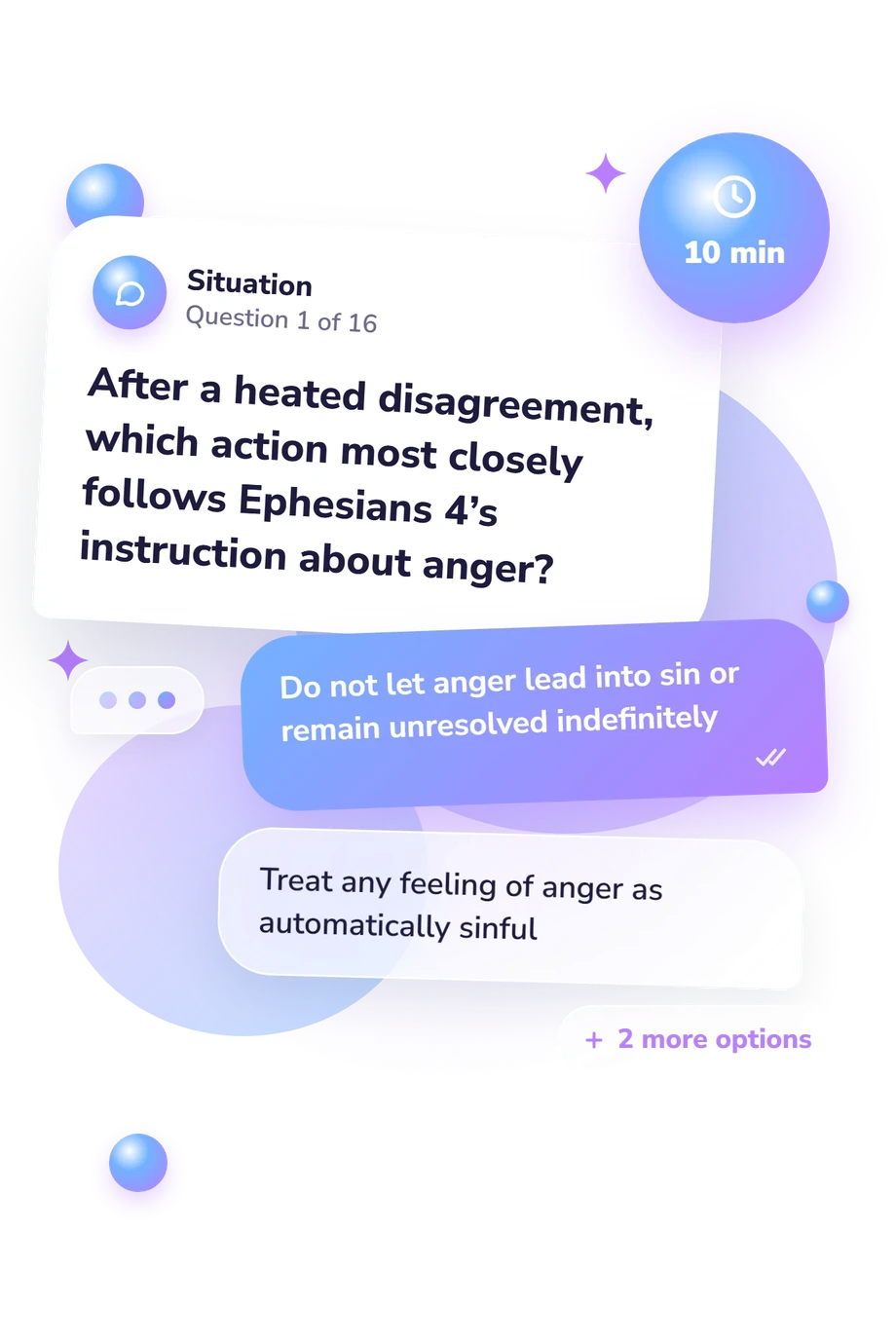
Example Questions From the Test
- Do not let anger lead into sin or remain unresolved indefinitely
- Treat any feeling of anger as automatically sinful
- Continue the conflict until the other person admits defeat
- Pretend not to be angry while quietly planning a response
- Freedom from every form of opposition
- Words and boldness to make known the mystery of the gospel
- Proof that his imprisonment will end immediately
- Authority to govern all the surrounding churches
- Paul, an apostle of Christ Jesus by the will of God
- Paul, a servant appointed by the church in Jerusalem
- Peter, an elder and witness of Christ’s sufferings
- Timothy, a teacher sent to the churches of Asia
Ephesians Quiz - Description and methodology of the test
Readers who want to revisit Paul’s letter can use the Ephesians Quiz to check how well they recognize its central teachings, images, and movement from belief to communal conduct. The focus is comprehension of the text, not a judgment about personal devotion. Designed as a bible quiz on Ephesians, it suits personal study, teaching, group discussion, or review after reading the letter. The result shows your understanding of Ephesians.
What This Assessment Explores
The questionnaire checks whether readers can connect key passages with their meaning, including grace, reconciliation, unity, conduct, ministry, prayer, and spiritual imagery. Reading the letter’s movement from salvation and reconciliation to shared community life is central to this bible quiz on the book of Ephesians.
The result draws on four thematic areas:
- Grace and identity show recognition of salvation, Christ, blessing, and the promised Spirit.
- Unity and reconciliation show understanding of one new humanity and communal peace.
- Conduct and relationships reflect attention to anger, honesty, work, generosity, family, and mutual responsibility.
- Church life and imagery test recognition of ministry roles, prayer, structure, and the armor of God.
Ephesians Knowledge (0-16) reports Foundation to build (0-6), Developing understanding (7-12), or Strong understanding (13-16).
Methodology and Evidence Base
Each item offers several answer choices, with one response best matching Ephesians in wording and context. The questions combine direct recall with brief situations about anger, work, family, unity, salvation, prayer, and spiritual defense.
Scoring is reported as the number of correct answers on the displayed educational scale. The displayed bands describe quiz performance and the letter’s content. The result measures knowledge of Ephesians, not faith or spiritual maturity.
Ephesians (NRSVue) supplies the textual reference. Talbert’s commentary supports reading the letter through its structure, themes, and theological movement, while Porter and Clarke clarify scholarly discussion of Ephesians and Colossians, including their canonical relationship. The questionnaire is conceptually consistent with these sources, not an adaptation of either study. Performance on this Bible knowledge quiz on Ephesians can vary with translation familiarity, prior study, and interpretation of context, so missed areas are best treated as prompts to reread relevant passages and consult a responsible commentary.
- National Council of the Churches of Christ in the United States of America. New Revised Standard Version Updated Edition. National Council of Churches, 2021.
- Talbert, Charles H. Ephesians and Colossians. Paideia: Commentaries on the New Testament. Grand Rapids, MI: Baker Academic, 2007. ISBN 9780801031281.
- Porter, Stanley E., and Kent D. Clarke. "Canonical-Critical Perspective and the Relationship of Colossians and Ephesians." Biblica 78, no. 1 (1997): 57-86. 10.2143/BIB.78.1.3212083.
Updated: