
Guess the Year Quiz
How the Scales are Structured
Who Usually Takes This Test?
See How You Compare
Below is a preview of how scores are typically distributed across each scale.
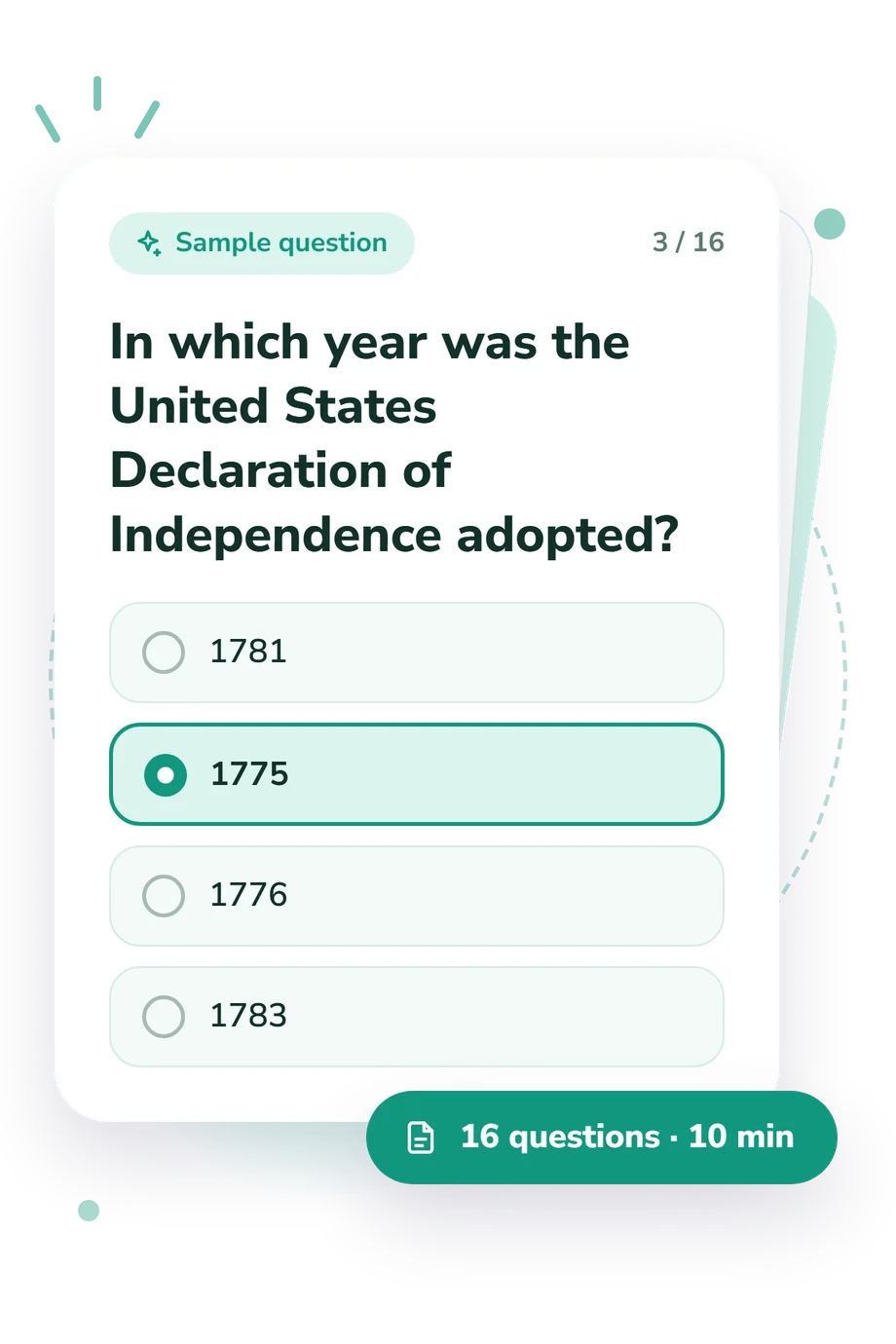
Example Questions From the Test
- 1889
- 1853
- 1871
- 1868
- 1999
- 2002
- 2001
- 2000
- 1781
- 1775
- 1776
- 1783
Guess the Year Quiz - Description and methodology of the test
Readers who enjoy history, classroom revision, or testing their memory can use the Guess the Year Quiz to examine their knowledge of landmark dates. It suits anyone seeking a concise chronology check before deciding whether to revisit historical timelines. The result shows how accurately you answered the year quiz's landmark-date questions across periods and regions, rather than measuring historical expertise as a whole.
What This Assessment Measures
Items present a historical event or clue with four possible years.
Coverage spans politics, rights, religion, science, exploration, war, independence, and cultural history across eras and regions. The result is a focused chronology snapshot.
Questions in this guess-the-year quiz ask whether a familiar event can be linked to the correct date and separated from nearby alternatives.
Three themes are represented in the questions:
- Landmark recall links an event with its year.
- Sequence discrimination requires distinguishing nearby dates.
- Cross-period breadth reflects coverage across eras and regions.
These themes describe content, not separate scores: the result is the total number of correct placements, with Guess the Year Knowledge scored from 0-16. Timeline Foundation 0-6 marks recognition of some milestones; Developing Chronologist 7-12 reflects many correct placements with room to distinguish nearby dates; Historical Timekeeper 13-16 indicates strong command of the tested milestones.
Methodology and Scientific Basis
This online questionnaire uses multiple-choice questions in a historical date quiz format: each scenario or clue is followed by four year options, and a correct answer earns one point. Nearby distractors make the task a comparison of dates rather than recognition of an isolated fact, so the score offers a transparent summary of performance.
This online questionnaire uses descriptive scoring: one overall total summarizes correct answers, and no population norms or independent reliability estimates are reported. Its design is conceptually consistent with Reich (2013), whose work examines the limits of multiple-choice tests for historical knowledge. Smith (2017) is relevant because correct choices may show factual recall without interpretation, causation, or source analysis. Huijgen and colleagues (2014) likewise show why a narrowly defined task is not a complete measure of historical thinking.
Interpret the result as performance on the selected dates, not a norm-based estimate of overall expertise. Schooling, cultural exposure, familiarity with the examples, memory, and current attention can affect performance. The result cannot capture interpretation, causation, or source analysis, so broader conclusions require varied historical tasks.
- Reich, Gabriel A. (2013). Imperfect models, imperfect conclusions: An exploratory study of multiple-choice tests and historical knowledge. The Journal of Social Studies Research, 37(1), 3-16. 10.1016/j.jssr.2012.12.004
- Smith, Mark D. (2017). Cognitive Validity: Can Multiple-Choice Items Tap Historical Thinking Processes? American Educational Research Journal, 54(6), 1256-1287. 10.3102/0002831217717949
- Huijgen, Tim, Carla van Boxtel, Wim van de Grift, and Paul Holthuis. (2014). Testing elementary and secondary school students’ ability to perform historical perspective taking: the constructing of valid and reliable measure instruments. European Journal of Psychology of Education, 29, 653-672. 10.1007/s10212-014-0219-4
Updated: