
Walk Two Moons Quiz
How the Scales are Structured
Who Usually Takes This Test?
See How You Compare
Below is a preview of how scores are typically distributed across each scale.
Example Questions From the Test
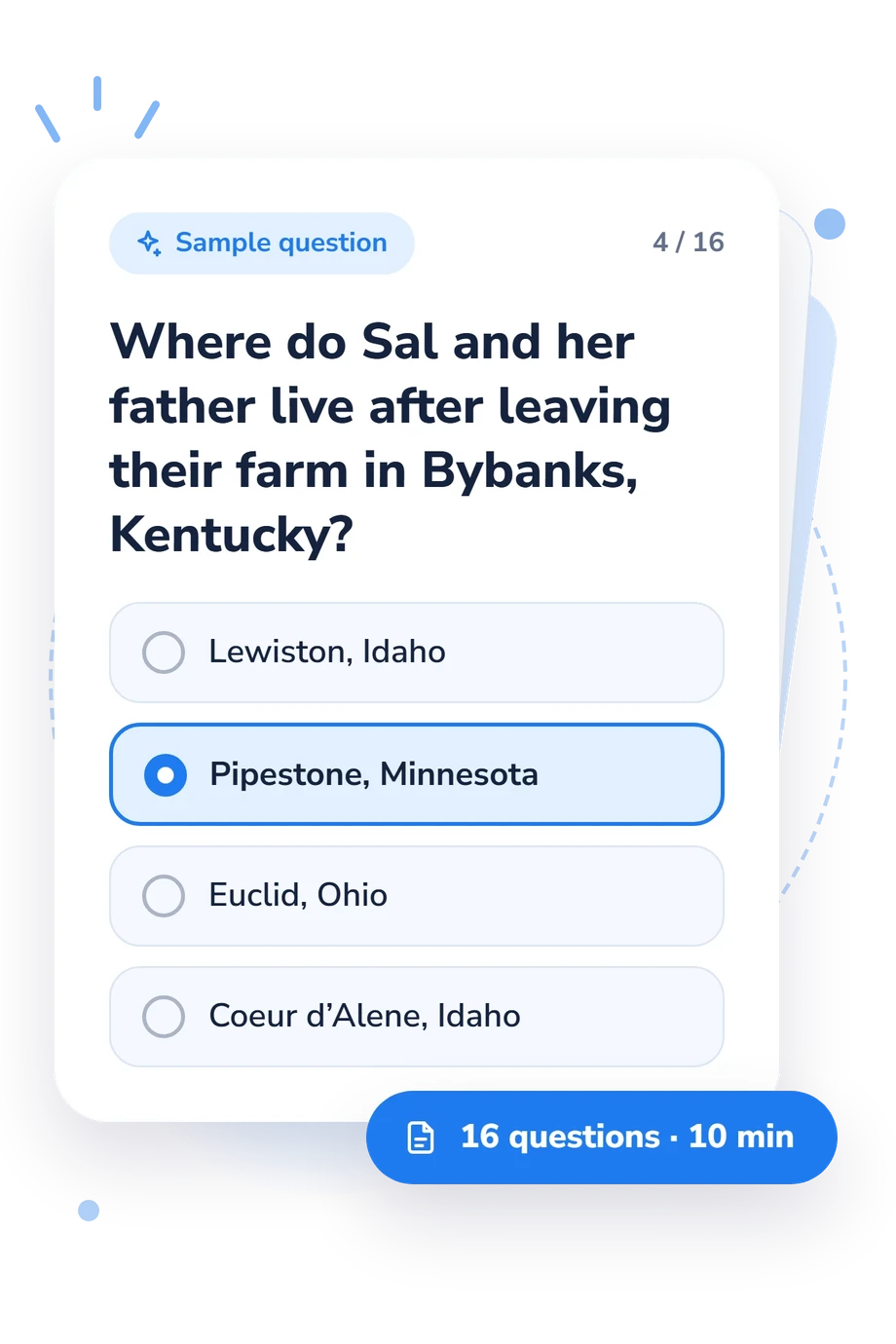
- Lewiston, Idaho
- Pipestone, Minnesota
- Euclid, Ohio
- Coeur d’Alene, Idaho
- Margaret survived the bus crash in which Sal’s mother died
- Margaret attended school with Sal’s mother in Bybanks
- Margaret persuaded Sal’s mother to travel west
- Margaret adopted Mike after his birth
- Mike Bickle
- Margaret Cadaver
- Mr. Birkway
- Mrs. Partridge
Walk Two Moons Quiz - Description and methodology of the test
For readers who have finished Sharon Creech’s novel, the Walk Two Moons Quiz checks whether its plot, relationships, revelations, and themes remain connected in memory. It suits students, book-club members, and independent readers seeking a focused review before discussion or further study. As a Walk Two Moons reading comprehension activity, it can encourage a return to relevant scenes, plot connections, or themes.
What This Assessment Explores
This assessment examines literary comprehension through Sal’s journey, Phoebe’s family, the Winterbottom mystery, personal loss, empathy, and the danger of judging people without context. Readers who have completed the novel can use a Walk Two Moons knowledge test to check connections among events, relationships, revelations, and central ideas.
The Walk Two Moons Knowledge scale is interpreted through these result bands:
- Foundations to Revisit (0-6) indicates that some elements are recognized, while key characters, events, or connections may remain unclear.
- Developing Comprehension (7-12) indicates that much of the journey and nested narrative is understood, with details or thematic links available to strengthen.
- Strong Comprehension (13-16) indicates clear command of the plot, relationships, revelations, and central ideas.
The overall result can encourage a return to relevant scenes, plot connections, or themes rather than treating individual answers as isolated facts.
Methodology and Evidence Base
Each item presents four answer choices and asks the reader to identify the interpretation, event, relationship, destination, or quotation that best fits the novel. Selected answers produce a reported result interpreted through the listed bands; this is a single comprehension outcome rather than a measure of general reading ability.
Sharon Creech’s novel Walk Two Moons is the direct content reference. Its nested narration, grief, family secrets, road journey, and movement toward empathy explain why the items combine plot recall with questions about meaning and perspective. A Walk Two Moons comprehension test of this kind is conceptually consistent with the literary analyses by Lovelace and Howell Smith and by Roberts, but is not an adaptation of either study.
Those sources provide interpretive context; this online questionnaire has no established norms or published psychometric evidence. Its bands describe how securely the reader connects details and themes. Results can shift with recency of reading, memory, familiarity with literary discussion, and plausible guessing, so these results are most useful when they guide a return to relevant scenes and ideas.
- Creech, Sharon. Walk Two Moons. New York: HarperCollins Juvenile Books, 1994.
- Lovelace, James, and Laura Howell Smith. “The Motherless Daughter: An Evolving Archetype of Adolescent Literature.” The ALAN Review, vol. 29, no. 2, 2002, pp. 16-20. 10.21061/alan.v29i2.a.5
- Roberts, Lewis. “Nightmares, Idylls, Mystery, and Hope: Walk Two Moons and the Artifice of Realism in Children’s Fiction.” Children’s Literature in Education, vol. 39, no. 2, 2008, pp. 121-134. 10.1007/s10583-007-9046-4
Updated: