
Am I Jealous of My Friend Quiz
How the Scales are Structured
Who Usually Takes This Test?
See How You Compare
Below is a preview of how scores are typically distributed across each scale.
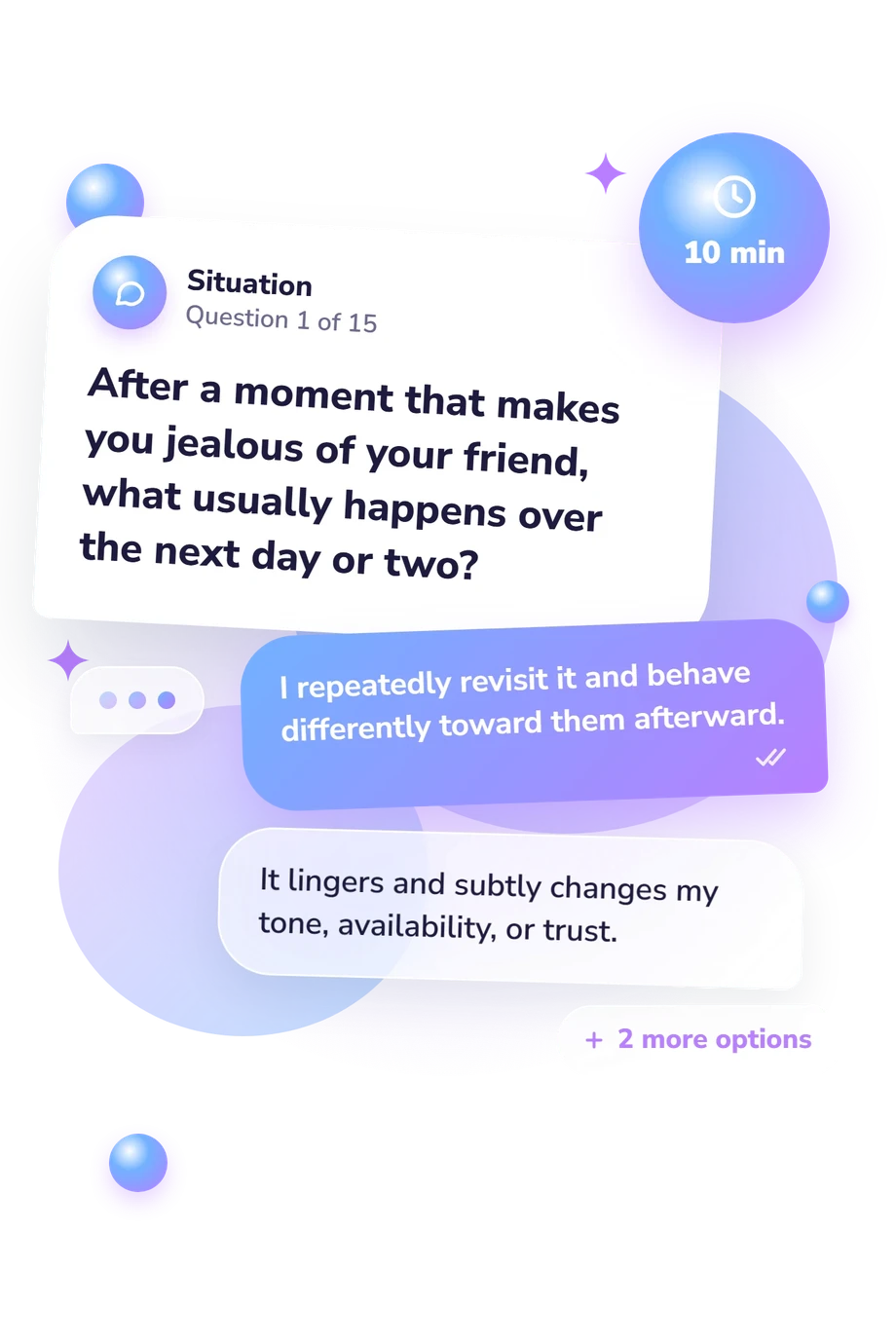
Example Questions From the Test
- I repeatedly revisit it and behave differently toward them afterward.
- It lingers and subtly changes my tone, availability, or trust.
- I think it over, but it rarely alters how I treat them.
- I can name the feeling, consider the context, and let it pass without directing my behavior.
- I assume they are enjoying the conversation unless something more concrete concerns me.
- I notice their chemistry and feel mildly left out.
- I keep watching them and wonder whether either prefers the other’s company.
- I feel strongly threatened, even if nothing clearly inappropriate has happened.
- Join the conversation or connect with someone else without trying to redirect the attention.
- Make a little extra effort to be noticed too.
- Compete by emphasizing my own stories, achievements, or connections.
- Withdraw or become cool toward my friend because being overlooked feels personal.
Am I Jealous of My Friend Quiz - Description and methodology of the test
For readers trying to understand why a friend’s attention, closeness, or success can stir unease, this questionnaire offers a structured way to examine the pattern. The am i jealous of my friend quiz can help you examine whether your reactions feel situational or persistent. Its result organizes friendship jealousy patterns into separate dimensions, so you can consider what you feel, how you interpret events, and what you do next.
What This Assessment Explores
Items cover exclusion, shifting closeness, attention, praise, achievements, online activity, and comparison. They examine feelings and responses such as checking, competing, withdrawing, seeking reassurance, or speaking directly. This suits anyone exploring jealousy in friendship, including reactions involving a partner, a friend’s closeness with someone else, or the possibility that an important person may prefer someone else.
Together, they distinguish fear that a friend or partner may prefer someone else from behavioral spillover and self-worth effects. The result presents three dimensions:
- Fear of Replacement (0-15) reflects exclusion sensitivity, from Secure 0-5 through Situational worry 6-10 to Persistent concern 11-15.
- Jealousy-Driven Responses (0-15) shows whether reactions are Manageable 0-5, show Noticeable Spillover 6-10, or reach Strong Behavioral Influence 11-15.
- Social Comparison (0-15) describes levels of comparison influence: Grounded perspective 0-5, Comparison tension 6-10, or Strong comparison pull 11-15.
Methodology and Scientific Basis
Each scenario offers four response options spanning different interpretations and reactions, including direct communication, threat appraisals, competition, checking, pressure, or withdrawal. The result summarizes patterns across dimensions; unspecified response weights do not support inferring a point-by-point scoring rule.
Conceptually, this online questionnaire is consistent with the Friendship Jealousy Questionnaire, which Parker and colleagues studied in 2005 for friendship jealousy and social adjustment. Krems and colleagues’ 2021 research addresses third-party threats, while Vaillancourt and colleagues’ 2024 research adds context for social-media activity. These sources support the themes, but this questionnaire is not presented as their adaptation or validation.
Bers and Rodin’s 1984 study helps explain social-comparison jealousy in the questionnaire: achievement, popularity, or praise can influence self-evaluation without proving rivalry or intent.
The questionnaire is a structured online self-report; this version provides no stated normative comparisons or reliability estimates, and its displayed bands are not clinical cutoffs. Honest self-report can shift with insecurity, memory, context, or the wish to appear fair, so interpret the bands as prompts for examining patterns and communication rather than as a diagnosis.
- Jeffrey G. Parker, Alisha R. Walker, Christine M. Low, and Bridget K. Gamm (2005). Friendship jealousy in young adolescents: Individual differences and links to sex, self-esteem, aggression, and social adjustment. Developmental Psychology, 41(1), 235-250. 10.1037/0012-1649.41.1.235
- Jaimie Arona Krems, Keelah E. G. Williams, Athena Aktipis, and Douglas T. Kenrick (2021). Friendship jealousy: One tool for maintaining friendships in the face of third-party threats? Journal of Personality and Social Psychology, 120(4), 977-1012. 10.1037/pspi0000311
- Tracy Vaillancourt, Heather Brittain, Mollie Eriksson, Amanda Krygsman, Ann H. Farrell, Adam C. Davis, Anthony A. Volk, and Steven Arnocky (2024). Social Media Friendship Jealousy. Evolutionary Psychology, 22(1), 1-15. 10.1177/14747049231225738
- Susan A. Bers and Judith Rodin (1984). Social-comparison jealousy: A developmental and motivational study. Journal of Personality and Social Psychology, 47(4), 766-779. 10.1037/0022-3514.47.4.766
Updated: