
Which Actress Are You Quiz
How the Scales are Structured
Who Usually Takes This Test?
See How You Compare
Below is a preview of how scores are typically distributed across each scale.
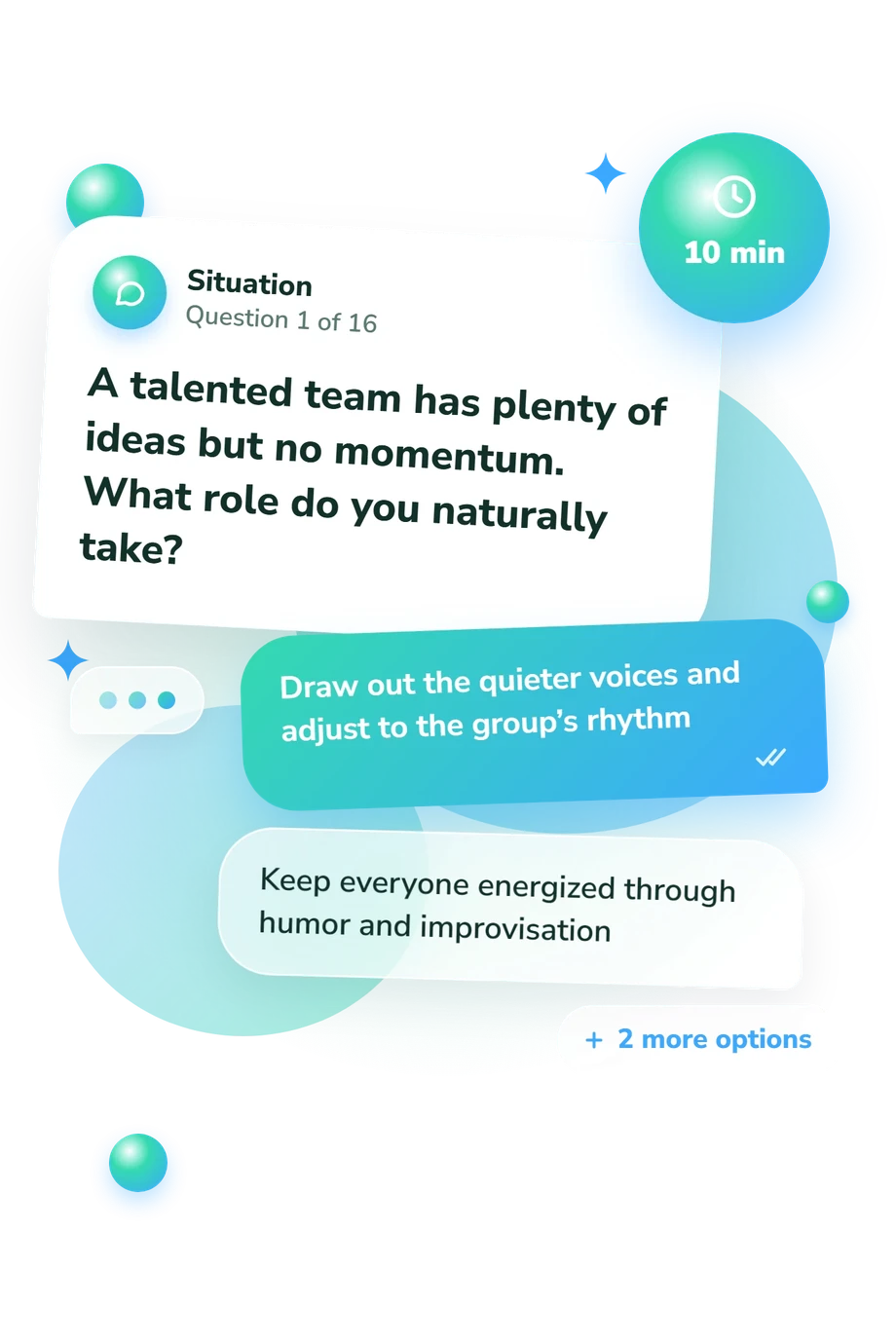
Example Questions From the Test
- Draw out the quieter voices and adjust to the group’s rhythm
- Keep everyone energized through humor and improvisation
- Name the deeper purpose so the work feels meaningful again
- Turn the ideas into decisions, roles, and a workable next move
- Use a light observation to loosen the tension
- State the core issue plainly so it cannot be avoided
- Pause, read the room, and offer a measured point when it can land
- Redirect the group toward a practical decision
- A determined leader taking a daring idea from vision to reality
- A restrained character whose identity keeps evolving
- A powerful survivor confronting a difficult truth
- A flawed, funny outsider with surprising emotional layers
Which Actress Are You Quiz - Description and methodology of the test
People curious about creative instincts may approach the Which Actress Are You Quiz as a self-reflection exercise, not a prediction of celebrity identity. It connects choices about collaboration, risk, emotional expression, and social presence with four contrasting profiles, showing which one has the strongest affinity and where a blended result may appear. This actress affinity quiz suits anyone curious about creative preferences and the approaches they feel drawn to.
What This Assessment Explores
Rather than measuring acting skill, the questionnaire examines qualities guiding creative choices, relationships, and self-expression. Its situations involve teamwork, tension, setbacks, emotional stakes, social entry, and unusual opportunities. The result of this actress quiz identifies the profile with the strongest affinity, while a near tie can show a blended pattern.
The four result dimensions are:
- Emma Stone - Playful Storyteller (0-12) reflects wit, expressive openness, and offbeat storytelling; Different Rhythm 0-4, Shared Notes 5-8, Strong Affinity 9-12.
- Margot Robbie - Bold Builder (0-12) reflects ambitious initiative, calculated risk, and collaborative creation; Different Rhythm 0-4, Shared Notes 5-8, Strong Affinity 9-12.
- Viola Davis - Grounded Powerhouse (0-12) reflects emotional depth, conviction, and resilient presence; Different Rhythm 0-4, Shared Notes 5-8, Strong Affinity 9-12.
- Zendaya - Adaptable Original (0-12) reflects composed experimentation, versatility, and thoughtful self-expression; Different Rhythm 0-4, Shared Notes 5-8, Strong Affinity 9-12.
Methodology and Evidence Context
The questions shown present situations with four response options. Their choices emphasize humor, emotional truth, adaptability, or purposeful building, so you select what feels natural rather than what sounds most impressive. Affinity is compared across all four profiles: the highest score is strongest, and scores within one point create a blended result. The strongest-affinity profile therefore emerges from preference patterns rather than a label.
The questionnaire is an online self-report tool, not a published standardized scale; its four affinity scales and scoring are specific to this form. Hoffner and Buchanan’s wishful-identification research offers conceptual context for perceived similarity and appealing character attributes, while Bandura’s social cognitive account addresses media models and self-efficacy. These works do not establish this questionnaire’s scales, scoring, reliability, or validity, and it is not a published adaptation of either source.
Because this celebrity affinity quiz relies on self-report, responses can reflect mood, memory, current context, and candor. Its bands organize affinity patterns but establish no population norms, reliability coefficients, or clinical thresholds. Read the result as a reflection prompt, especially when leading profiles are close.
- Hoffner, Cynthia, and Martha Buchanan. "Young Adults' Wishful Identification With Television Characters: The Role of Perceived Similarity and Character Attributes." Media Psychology 7, no. 4 (2005): 325-351. 10.1207/S1532785XMEP0704_2
- Bandura, Albert. "Social Cognitive Theory of Mass Communication." Media Psychology 3, no. 3 (2001): 265-299. 10.1207/S1532785XMEP0303_03
Updated: