
Guess the Shoe Quiz
How the Scales are Structured
Who Usually Takes This Test?
See How You Compare
Below is a preview of how scores are typically distributed across each scale.
Example Questions From the Test
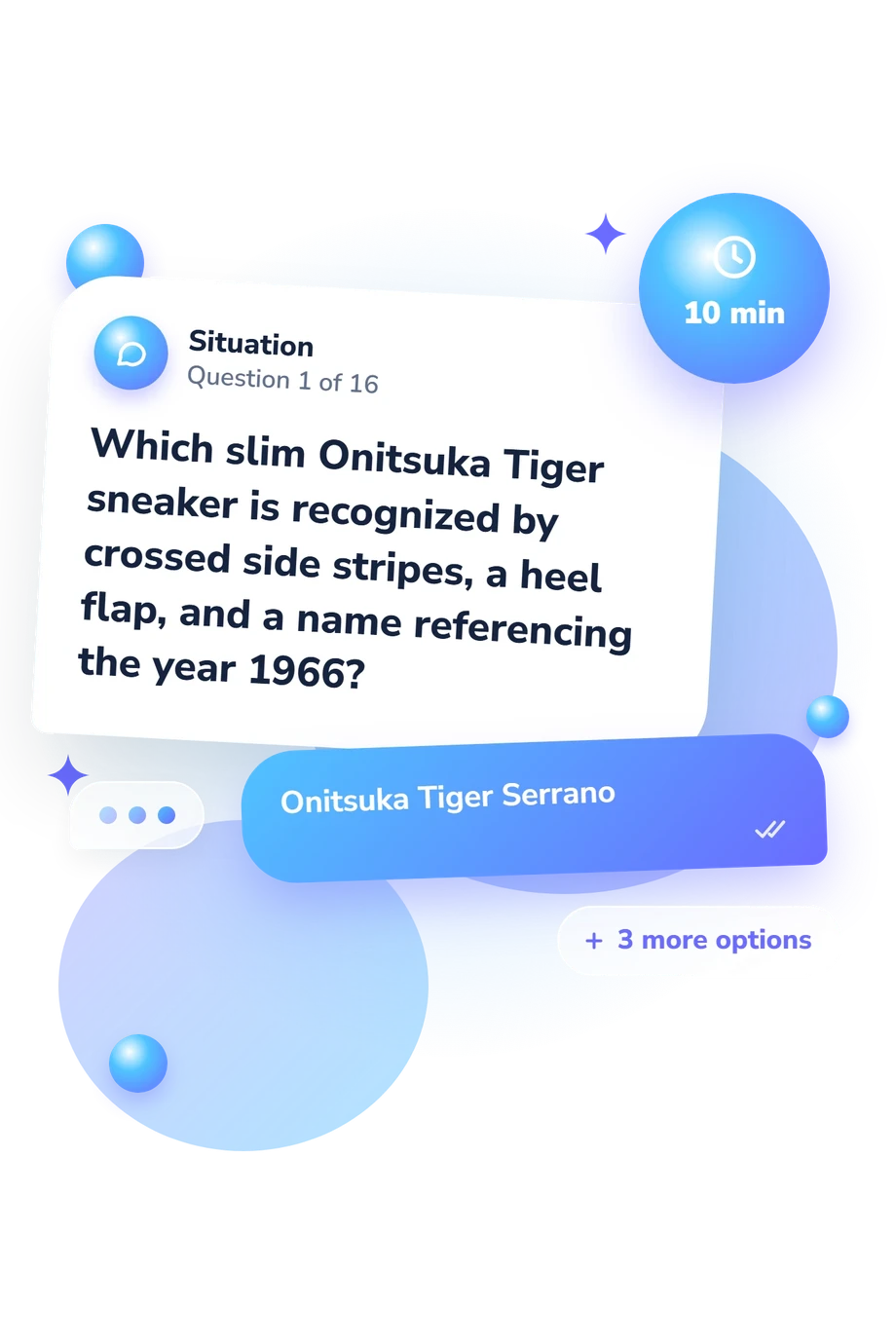
- Onitsuka Tiger Serrano
- Onitsuka Tiger GSM
- Onitsuka Tiger Mexico 66
- Onitsuka Tiger Ultimate 81
- Air Jordan 1
- Nike Dunk High
- Nike Air Ship
- Air Jordan 2
- Adidas Superstar
- Adidas Stan Smith
- Adidas Gazelle
- Adidas Samba
Guess the Shoe Quiz - Description and methodology of the test
For readers who want to connect classic footwear with its history, Guess the Shoe Quiz offers a focused identification exercise. Readers who enjoy shoes quiz games can use its clues to match a model with its brand, era, silhouette, or signature detail. The result can guide further exploration and make a casual interest more structured. It asks for close visual and historical attention rather than broad fashion knowledge.
What This Assessment Explores
Rather than testing broad fashion knowledge, the questionnaire asks readers to identify named sneaker models from specific distinguishing clues. It links visual recognition with footwear history across athletic and lifestyle brands.
The main thematic groups are:
- Brand cues connect logos, stripes, lettering, and emblems with the correct maker.
- Construction details use shapes, overlays, cushioning, materials, and outsoles to separate similar models.
- Historical context links release eras, sporting origins, cultural associations, and technologies to particular shoes.
- Model-family discrimination distinguishes basketball, tennis, running, skate, and lifestyle variants.
The displayed result is Sneaker Identification Knowledge (0-16): Foundation 0-6, Developing Identifier 7-12, and Sneaker Spotter 13-16. It reflects knowledge of iconic models, signature features, and footwear history. In this guess the sneaker quiz, visual and historical clues form the central task, so the result reflects informed identification rather than personal taste.
Methodology and Evidence Base
The questionnaire is an online multiple-choice recognition exercise rather than a self-report measure. Each prompt gives a description and four answer choices and asks the respondent to match clues to a named model. One total appears on the displayed scale; because no point-allocation formula is stated, the score should not be reverse-engineered beyond the shown bands. Rather than measuring taste, this quiz asks readers to name the shoe from clues, so it measures recognition rather than ownership.
No published instrument on sneaker-model identification underlies this online questionnaire, and it has no published validation or standardization. Semmelhack's 2015 work supplies historical context for sneaker design, sport, commerce, and cultural change; it does not establish this exercise's item validity or scoring. The questionnaire is therefore conceptually related to that context, not an adaptation of the source.
Interpret the outcome as a snapshot of recall and clue recognition. Brand familiarity, prior exposure, attention, and guessing can affect performance. Without population norms or reliability estimates, use the result to identify strengths and guide learning rather than make broad judgments about expertise.
- Semmelhack, Elizabeth. Out of the Box: The Rise of Sneaker Culture. New York: Rizzoli, 2015. ISBN 978-0-8478-4660-3.
- Matthews, Delisia, Qiana Cryer-Coupet, and Nimet Degirmencioglu. "I wear, therefore I am: investigating sneakerhead culture, social identity, and brand preference among men." Fashion and Textiles 8, article 1 (2021). 10.1186/s40691-020-00228-3.
- Choi, Jin Woo (Jimmy), and Minjeong Kim. "Sneakerhead brand community netnography: An exploratory research." Fashion, Style & Popular Culture 6, no. 2 (2019): 141-158. 10.1386/fspc.6.2.141_1
Updated: