
Is He Lying to Me Quiz
How the Scales are Structured
Who Usually Takes This Test?
See How You Compare
Below is a preview of how scores are typically distributed across each scale.
Example Questions From the Test
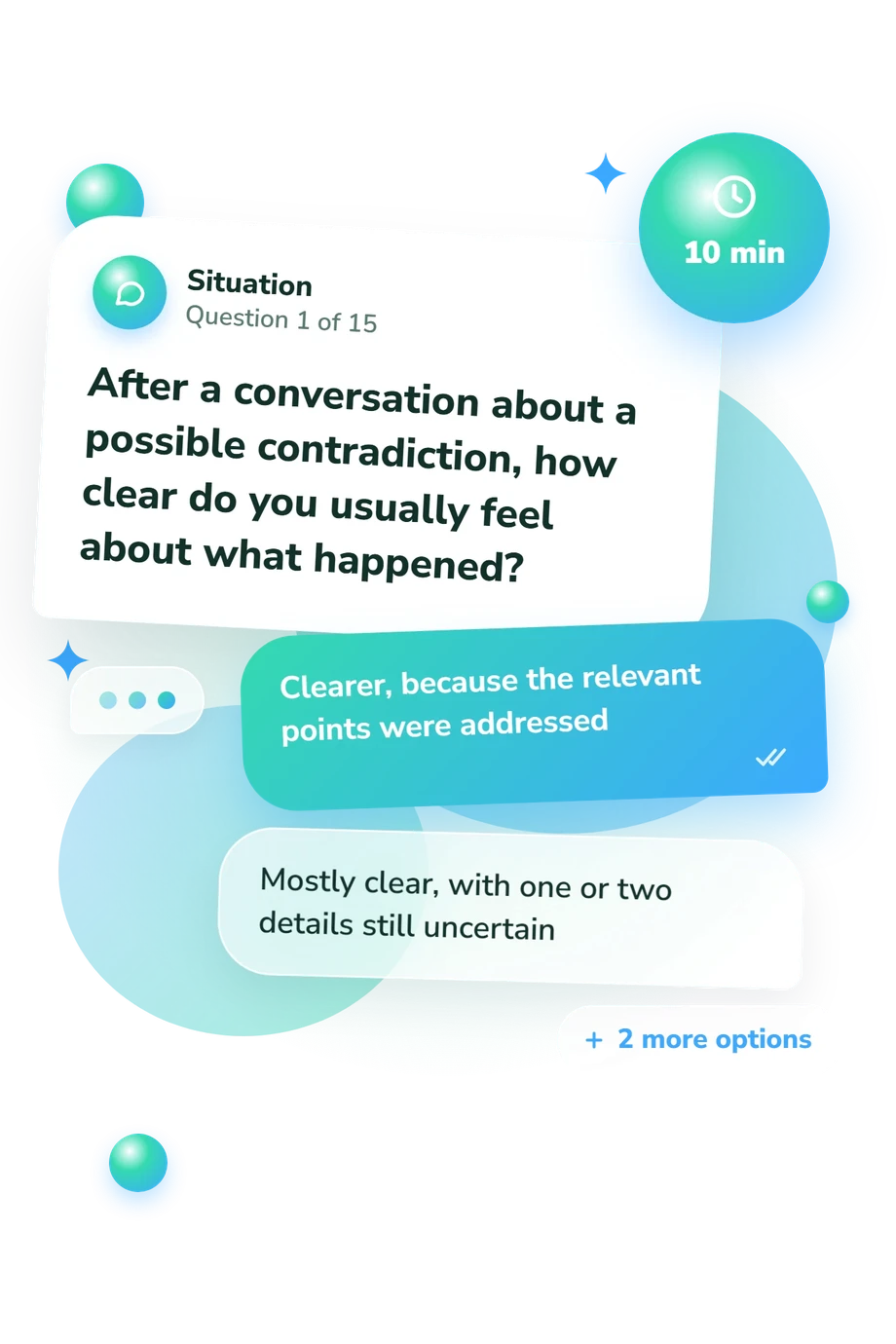
- Clearer, because the relevant points were addressed
- Mostly clear, with one or two details still uncertain
- Still confused because the answers were indirect or incomplete
- More confused because new contradictions or diversions appeared
- The central events and important details remain consistent
- Small, nonessential details sometimes vary
- Important details shift, although the overall story remains similar
- The versions conflict about central events, people, or timing
- He addresses the gap directly, even if he needs time to remember
- He answers but initially misunderstands what I am asking
- He gives a partial answer and redirects the conversation
- He repeatedly avoids the gap and focuses on stopping the question
Is He Lying to Me Quiz - Description and methodology of the test
Relationship uncertainty can make isolated messages, changing timelines, or defensive conversations feel larger than they are. The Is He Lying to Me Quiz is intended for people who want to examine recurring discrepancies and prepare for a calmer discussion. For self-reflection, this relationship trust assessment organizes observations into patterns that can support clearer thinking about trust, clarity, and boundaries.
What This Assessment Explores
Rather than determining whether someone has lied, this assessment examines how reported behavior fits known facts, relationship agreements, and attempts to clarify uncertainty. Its questions cover changing accounts, mismatched timelines, digital activity, online relationship status, and responses that redirect or shut down reasonable questions. Instead of explaining why someone might lie, it is a relationship consistency assessment that examines observable discrepancies and communication patterns, not motives.
The result presents three dimensions:
- Online and Offline Alignment (0-15) shows whether online behavior matches explanations and agreed boundaries: Broad alignment (0-5), Ambiguous signals (6-10), or Repeated misalignment (11-15).
- Responses to Clarification (0-15) indicates whether reasonable questions receive relevant engagement: Discussion possible (0-5), Unresolved communication (6-10), or Persistent shutdown (11-15).
- Story Consistency (0-15) reflects how coherent accounts remain: Mostly coherent (0-5), Mixed consistency (6-10), or Repeated discrepancies (11-15).
Methodology and Scientific Basis
Each self-report item describes a relationship or digital-communication situation and offers four ordered responses, moving from direct explanations toward discrepancies, deflection, or conflict. You select the option that best matches your experience; the choices distinguish isolated uncertainty from recurring discrepancies.
As a communication clarity assessment, the result organizes reported examples for focused discussion rather than turning a score into certainty. Scores describe reported patterns, not proof that deception occurred. This questionnaire does not infer feelings or motives; it evaluates observable consistency and communication.
The framework is conceptually consistent with Cole’s 2001 study of deception in romantic relationships, but this questionnaire is not presented as an adaptation. Roggensack and Sillars (2014) clarify mutually understood honesty rules, while Bond and DePaulo (2006) support caution about deception-judgment accuracy.
The result reports the three displayed scales through descriptive bands. The evidence base does not validate this online profile. Current emotions, memory differences, incomplete context, and privacy expectations can shape answers, so review discrepancies against agreed boundaries and what calm conversation clarifies.
- Cole, T. (2001). Lying to the One you Love: The Use of Deception in Romantic Relationships. Journal of Social and Personal Relationships, 18(1), 107-129. 10.1177/0265407501181005
- Roggensack, K. E., & Sillars, A. (2014). Agreement and understanding about honesty and deception rules in romantic relationships. Journal of Social and Personal Relationships, 31(2), 178-199. 10.1177/0265407513489914
- Bond, C. F., Jr., & DePaulo, B. M. (2006). Accuracy of Deception Judgments. Personality and Social Psychology Review, 10(3), 214-234. 10.1207/s15327957pspr1003_2
Updated: