
Will I Have a Valentine This Year Quiz
How the Scales are Structured
Who Usually Takes This Test?
See How You Compare
Below is a preview of how scores are typically distributed across each scale.
Example Questions From the Test
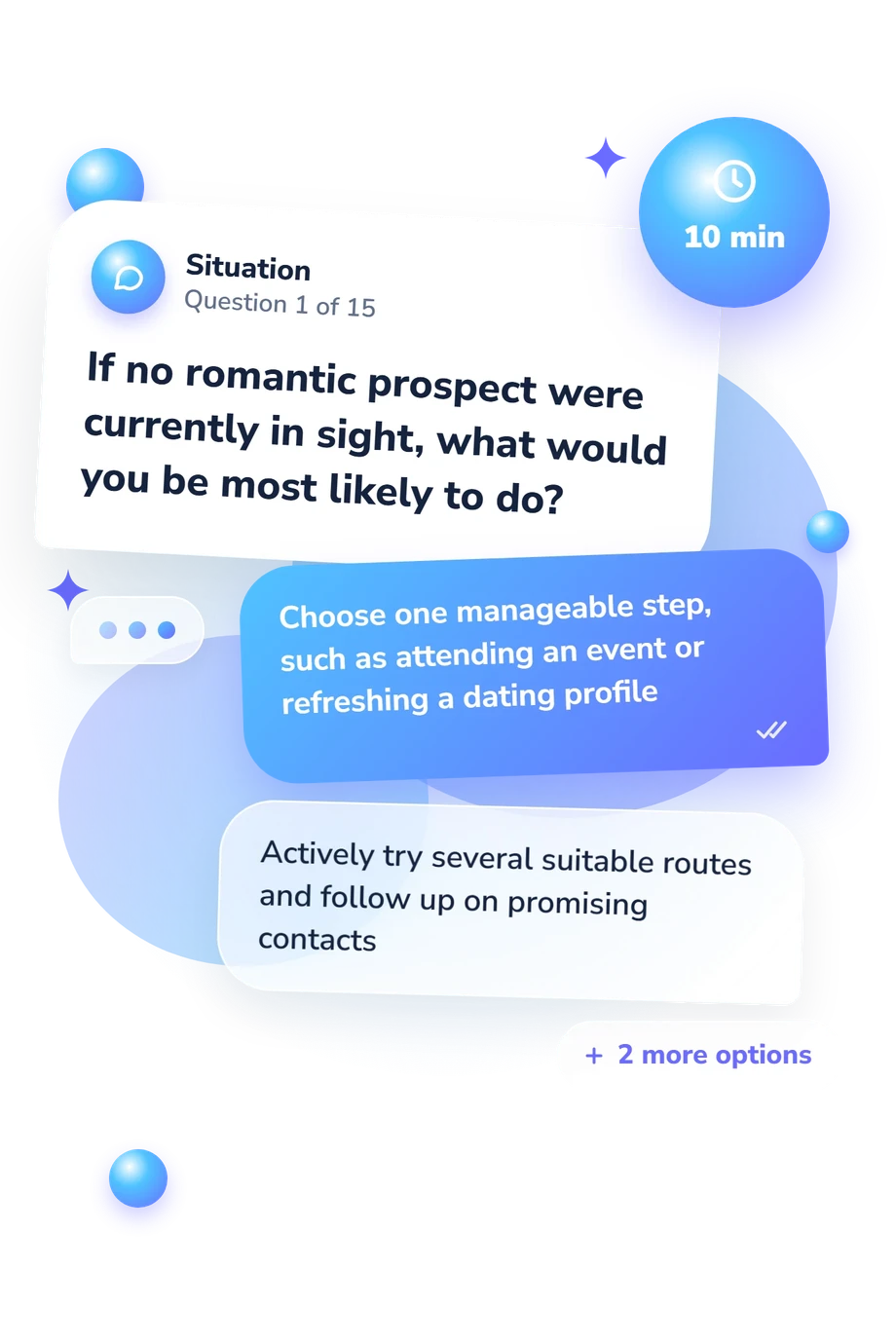
- Send one thoughtful follow-up and see whether they re-engage
- Let it end; I prefer the other person to restart it
- Propose a simple call or meeting if the exchange has felt mutual
- Step away because I am not currently investing energy in dating
- Rarely or never
- Occasionally, perhaps at a larger gathering or special event
- Fairly often through shared plans, groups, or introductions
- Sometimes, although usually through the same one or two routes
- I could probably make room after rearranging something
- I have little capacity for social plans right now
- I have some room, but only on a narrow range of days
- I have enough flexibility to choose among several possible times
Will I Have a Valentine This Year Quiz - Description and methodology of the test
For readers wondering whether their present circumstances support meeting someone, the Will I Have a Valentine This Year Quiz offers a structured way to examine readiness, behavior, and opportunity. It is suited to anyone reflecting on romantic readiness and dating intentions around Valentine’s Day. The result gives a current profile rather than a prediction, highlighting initiative, openness, and social context.
What This Assessment Explores
Three conditions shape romantic possibilities: action, comfort showing interest, and realistic openings provided by current routines and the surrounding social environment. These dating opportunities show where intentions and circumstances may be out of sync.
The profile presents these dimensions:
- Romantic Initiative (0-15) reflects follow-through: Waiting Mode (0-5) leaves developments to timing or others; Responsive Effort (6-10) acts on openings; Active Approach (11-15) initiates, follows up, and makes concrete space for connection.
- Romantic Openness (0-15) reflects present availability: Guarded Right Now (0-5) means romance may not currently feel welcome, clear, or comfortable; Selectively Open (6-10) needs trust or clarity; Readily Open (11-15) is broadly receptive.
- Social Opportunity (0-15) reflects realistic openings from current routines and surrounding social environment: Few Openings (0-5) means limited chances; Some Openings (6-10) means occasional chances; Many Openings (11-15) means frequent or varied chances, not guaranteed success.
Methodology and Scientific Basis
The items ask about dating situations, routines, reactions, intentions, and available social contact. Four response options invite the choice that best fits you, making this a structured self-report. The individual response weights are not specified; results are shown through the three displayed scales and their corresponding bands.
Conceptually, the questionnaire is consistent with studies discussing commitment readiness (Hadden et al., 2018), strategic initiation (Clark, Shaver, and Abrahams, 1999), and intimacy goals and dating plans (Sanderson et al., 2007). These studies address related constructs; they did not author or validate this online questionnaire, which is not presented as an adaptation of any instrument discussed in those studies.
Scores may shift with schedule, confidence, recent experiences, and social setting; self-report also depends on memory, self-awareness, and candid responding. Honest answers therefore matter when taking a will i get a valentine quiz to consider whether you may get a Valentine in your current context. The cited studies are not norming or validation studies for this questionnaire, so their samples and findings should not be treated as population benchmarks for its displayed bands.
- Hadden, Benjamin W., Christopher R. Agnew, and Kenneth Tan. “Commitment Readiness and Relationship Formation.” Personality and Social Psychology Bulletin 44, no. 8 (2018): 1242-1257. 10.1177/0146167218764668
- Clark, Catherine L., Phillip R. Shaver, and Matthew F. Abrahams. “Strategic Behaviors in Romantic Relationship Initiation.” Personality and Social Psychology Bulletin 25, no. 6 (1999): 709-722. 10.1177/0146167299025006006
- Sanderson, Catherine A., Emily J. Keiter, Michael G. Miles, and Darren J. A. Yopyk. “The association between intimacy goals and plans for initiating dating relationships.” Personal Relationships 14, no. 2 (2007): 225-243. 10.1111/j.1475-6811.2007.00152.x
Updated: