
Am I Puerto Rican Quiz
How the Scales are Structured
Who Usually Takes This Test?
See How You Compare
Below is a preview of how scores are typically distributed across each scale.
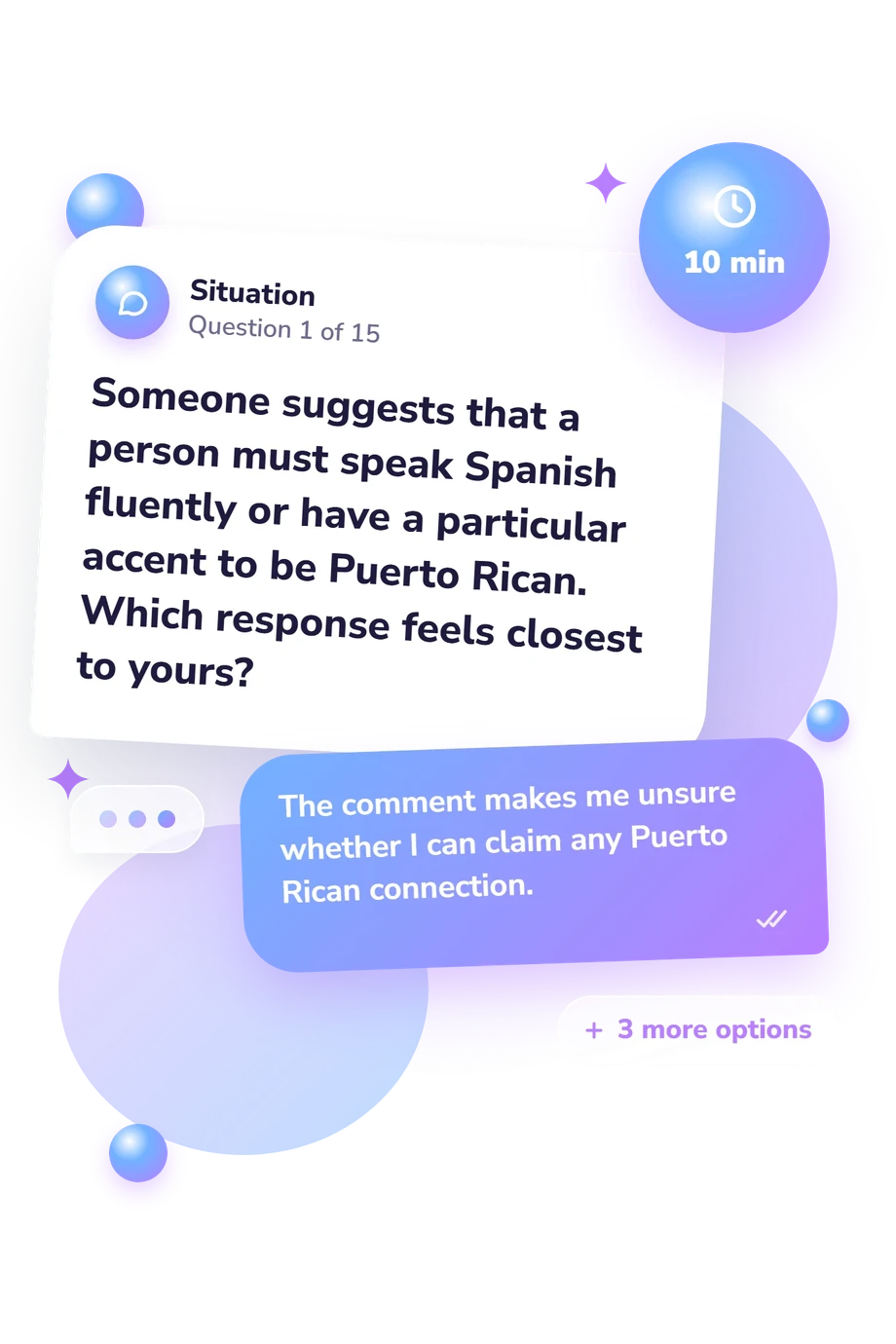
Example Questions From the Test
- The comment makes me unsure whether I can claim any Puerto Rican connection.
- It does not feel personally relevant because I do not identify as Puerto Rican.
- I reject that test and remain secure in my Puerto Rican identity.
- I question the stereotype, although it may still affect my sense of belonging.
- I would share a few things I have learned, while explaining that my connection is still developing.
- I would intentionally pass on stories, values, traditions, or community ties that feel like part of us.
- I would not see Puerto Rican heritage as mine to pass on.
- I would share meaningful parts while making room for a mixed or evolving identity.
- I may notice it, but it would not usually affect my plans.
- I would consider attending if the timing or company worked out.
- I would make an effort to attend or support part of the event.
- I would participate intentionally and engage with the event beyond simply being present.
Am I Puerto Rican Quiz - Description and methodology of the test
People considering how their cultural background, family history, or sense of belonging fits into daily life may find the Am I Puerto Rican Quiz useful. It is intended for people with Puerto Rican connections, mixed backgrounds, diaspora experiences, or open questions about identity. Rather than assigning a yes-or-no identity, this Puerto Rican identity quiz maps cultural, family, and belonging experiences into a profile for closer examination.
What This Assessment Explores
The questionnaire examines cultural participation, family-heritage knowledge and contact, and comfort with Puerto Rican identity in present life. Its situations include festivals, food, music, language, family stories, community spaces, history, and passing traditions forward. The questions make this a Puerto Rican quiz about connection rather than a test of Spanish fluency, accent, cultural purity, or ancestry.
These scales define the result:
- Cultural Engagement (0-15) reflects current cultural involvement: Light engagement 0-5, Growing engagement 6-10, or Active engagement 11-15.
- Family Heritage Connection (0-15) reflects family knowledge and contact: Limited info 0-5, Developing connection 6-10, or Strongly present 11-15; it does not verify ancestry.
- Identity and Belonging (0-15) reflects comfort with identity: Open or uncertain 0-5, Emerging belonging 6-10, or Deep belonging 11-15; it cannot grant or remove identity.
The profile shows where connection feels established, developing, or uncertain.
Methodology and Evidence Base
Each item presents a cultural, family, or social situation with four response options. Choices move from unfamiliarity or limited knowledge toward participation, confidence, and belonging, while allowing mixed feelings. The situations cover cultural participation, language, family stories, records, relatives, and identity in different settings.
Four options lead to three displayed 0-15 profile scores, with each result grouped into the listed 0-5, 6-10, or 11-15 band. These are this test’s profile categories, not universal thresholds.
Its closest conceptual reference is the Psychological Acculturation Scale, associated with Tropp and colleagues in 1999, which addresses cultural connection and adaptation in a Puerto Rican context. This questionnaire is not an adaptation of that measure. Identity themes are conceptually consistent with work by Zhen-Duan and colleagues from 2018 and Umaña-Taylor and colleagues from 2004 on ethnic identity, self-understanding, social context, and cultural experience.
By organizing these experiences into one profile, the questionnaire functions as a Puerto Rican identity test without deciding who is entitled to that identity. Answers can be shaped by current family contact, cultural access, confidence, mood, and self-awareness; limited knowledge may reflect opportunity rather than lack of belonging.
- Tropp, L. R., Erkut, S., García Coll, C., Alarcón, O., & Vázquez García, H. A. (1999). Psychological acculturation: Development of a new measure for Puerto Ricans on the U.S. mainland. Educational and Psychological Measurement, 59(2), 351-367. 10.1177/00131649921969794
- Zhen-Duan, J., Jacquez, F., & Sáez-Santiago, E. (2018). Boricua de Pura Cepa: Ethnic Identity, Cultural Stress and Self-Concept in Puerto Rican Youth. Cultural Diversity and Ethnic Minority Psychology, 24(4), 588-595. 10.1037/cdp0000199
- Umaña-Taylor, A. J., Yazedjian, A., & Bámaca-Gómez, M. Y. (2004). Developing the Ethnic Identity Scale using Eriksonian and social identity perspectives. Identity: An International Journal of Theory and Research, 4(1), 9-38. 10.1207/S1532706XID0401_2
Updated: