
Human Rights Quiz
How the Scales are Structured
Who Usually Takes This Test?
See How You Compare
Below is a preview of how scores are typically distributed across each scale.
Example Questions From the Test
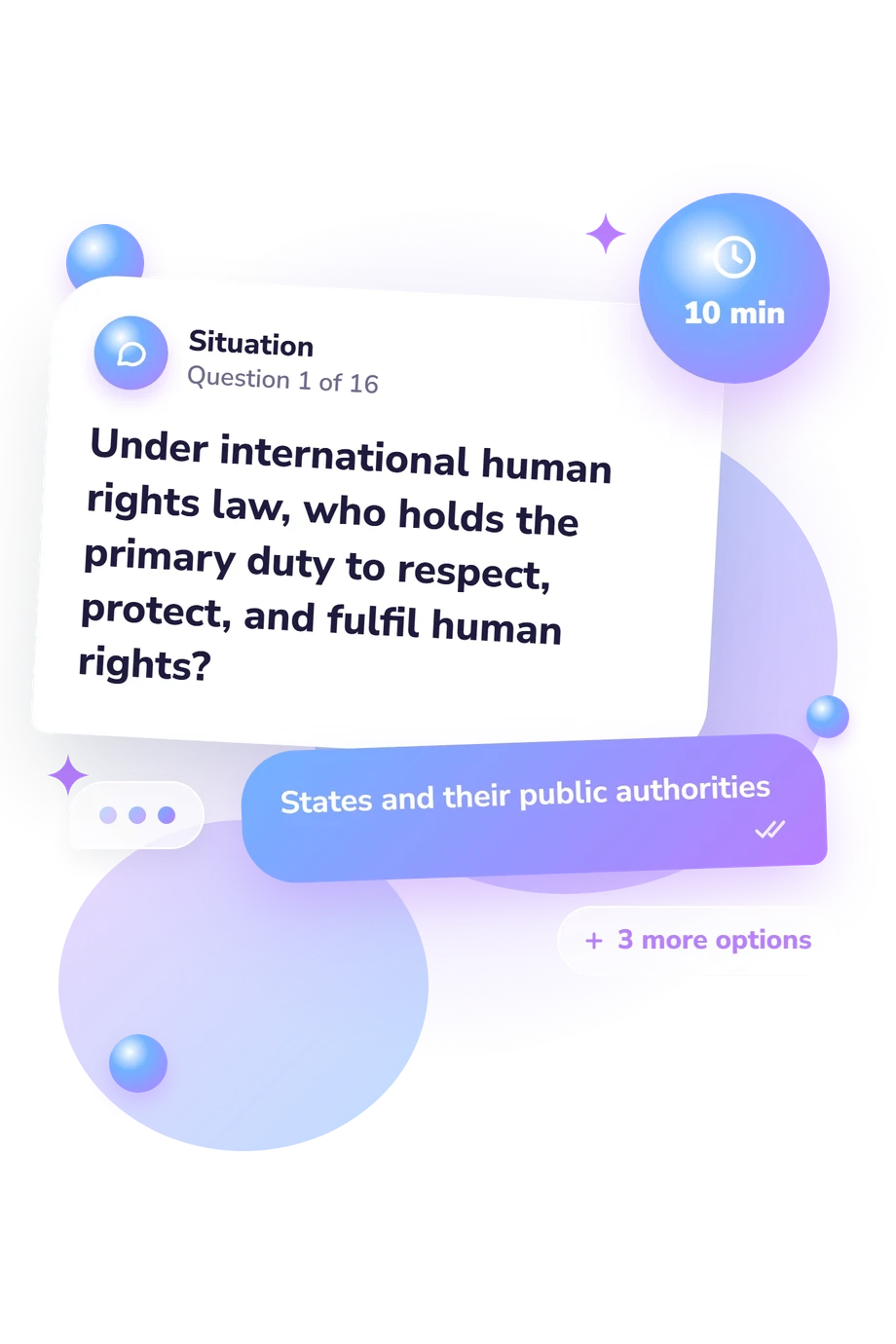
- States and their public authorities
- Individual citizens acting in their personal capacity
- Charities and humanitarian organizations
- News organizations and professional associations
- They apply only after a government incorporates them into local customs
- They apply mainly when people travel outside their home country
- They are identical to citizenship privileges granted by a country
- They belong to every human being, regardless of status or background
- The right to own property
- The right to freedom of peaceful assembly
- The right to social security
- The right to rest and leisure
Human Rights Quiz - Description and methodology of the test
Readers who want to check core rights principles may use this assessment to decide whether a structured introduction fits their needs. The human rights quiz presents short scenarios that let learners, educators, and curious adults test how well they apply principles in context. Teachers may use a student quiz about human rights in class, while independent learners can decide whether further study would help.
What This Assessment Explores
The questionnaire measures foundational knowledge rather than attitudes or legal expertise. Its scenarios cover universality, state duties, discrimination, remedies, fair treatment, participation, and public safeguards.
In discussion or independent review, this quiz about human rights can support learning while the result remains one overall knowledge score.
Human Rights Knowledge is scored from 0-16: Foundations to build (0-6), Developing understanding (7-12), and Strong understanding (13-16). These bands describe educational performance across situations, not legal advice or a judgment about a specific case.
The questions cover four thematic groups:
- Foundational principles show recognition of universality, equality, indivisibility, and non-discrimination.
- Public duties and remedies show understanding of state obligations, protection from torture, and practical redress.
- Freedoms and fair treatment cover assembly, privacy, fair trial, and equal remuneration.
- Participation and protection show how accessibility, education, children’s best interests, and proportionate limits are applied.
Methodology and Evidence Base
Each item presents a short definition or practical scenario with four answer choices. The respondent selects the option that best matches the relevant principle, so the format tests recognition and application rather than a written explanation. The questionnaire reports one overall scale; no item-weighting or subscale procedure is specified.
Nava et al. (2005) and Torney-Purta et al. (2008) are related studies of human-rights awareness and understanding. Their findings provide context for the topics in this questionnaire, not validation of this online instrument, which is conceptually consistent with the studies rather than an adaptation of either one.
Its content addresses principles expressed in the 1948 UN declaration and the child-rights convention, including universality, effective remedies, non-discrimination, participation, and the best interests of the child.
Viewed as an educational self-check, this human rights knowledge test can highlight topics for review. Results may be affected by prior teaching, language comprehension, attention, and the respondent’s interpretation of simplified scenarios. The questionnaire has no stated standardized scoring, population norms, reliability estimates, or validation data, so its result is a snapshot of performance on these items.
- Nava, Lolita H., Ma. Carmela T. Mancao, Ma. Victoria C. Hermosisima, and Felicia I. Yeban. "Human Rights Awareness of Secondary School Students in the Philippines: A Sample Survey." Human Rights Education in Asian Schools, vol. 8, 2005, pp. 151-162.
- Torney-Purta, Judith, Britt Wilkenfeld, and Carolyn Barber. "How Adolescents in 27 Countries Understand, Support, and Practice Human Rights." Journal of Social Issues, vol. 64, no. 4, 2008, pp. 857-880. 10.1111/j.1540-4560.2008.00592.x
- United Nations General Assembly. Universal Declaration of Human Rights. Resolution 217 A (III), 10 December 1948, pp. 71-77.
- United Nations. Convention on the Rights of the Child. Adopted 20 November 1989, entered into force 2 September 1990, United Nations Treaty Series, vol. 1577, p. 3.
Updated: