
Aquarius Quiz
How the Scales are Structured
Who Usually Takes This Test?
See How You Compare
Below is a preview of how scores are typically distributed across each scale.
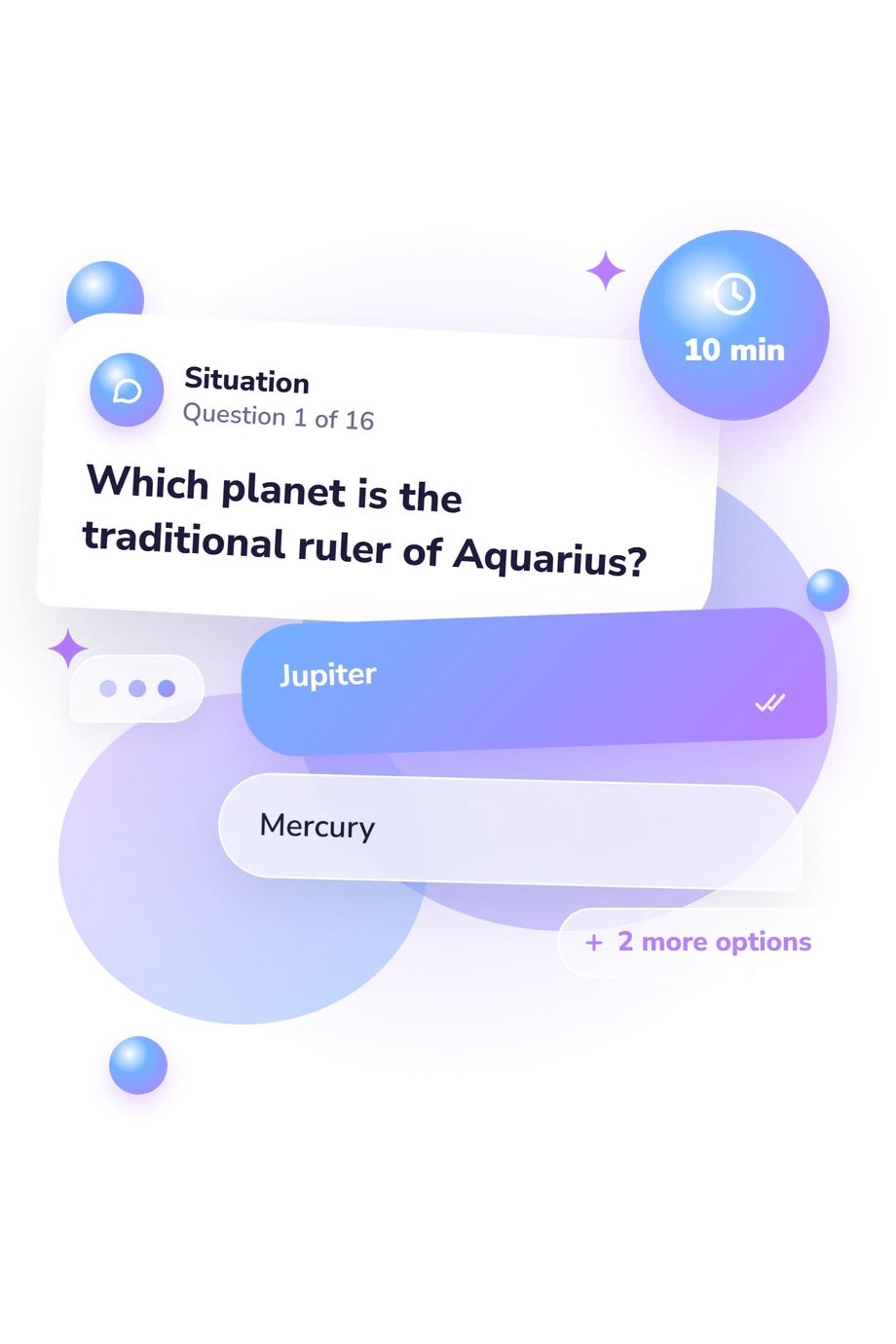
Example Questions From the Test
- Jupiter
- Mercury
- Saturn
- Neptune
- Water
- Air
- Earth
- Fire
- Personal recognition
- Private emotional bonding
- Material security
- Humanitarian concern
Aquarius Quiz - Description and methodology of the test
Readers who want to check their grasp of Aquarius can use this Aquarius Quiz as a focused knowledge exercise. It suits beginners, astrology enthusiasts, and anyone sorting out the sign’s symbols, classifications, and traditional associations. As an Aquarius astrology quiz, it shows which conventions you recognize correctly and which distinctions may need review.
What This Assessment Explores
The questionnaire measures familiarity with common Western astrology conventions about Aquarius, not whether the respondent personally has the sign. Its questions cover the Water Bearer symbol, air element, fixed modality, planetary rulers, zodiac sequence, Leo opposition, and attributed themes including independent thinking, humanitarian concern, innovation, persistence, and emotional detachment.
Trait references are tested as astrology conventions, so this Aquarius knowledge quiz measures familiarity with them rather than the respondent’s personal traits.
These are the displayed result categories:
- Aquarius Knowledge (0-16) reflects familiarity with the sign’s symbolism, structure, and commonly attributed traits.
- Foundations to explore (0-6) indicates recognition of some ideas with possible confusion between classifications.
- Developing knowledge (7-12) shows understanding of central associations while leaving distinctions to refine.
- Strong knowledge (13-16) indicates a well-developed grasp of the conventions tested.
Methodology and Scientific Basis
Each item presents a prompt with four answer choices. Some test recall of Aquarius’s element, ruler, symbol, or position; others use brief scenarios that ask the respondent to apply conventions, such as connecting reform-minded action with collective progress or persistence with fixed modality. The questionnaire therefore combines recognition and interpretation. This Aquarius zodiac quiz produces a single knowledge result followed by the displayed descriptive band. No item-level scoring rule or normative interpretation is supplied; no extra weighting, subscale, or clinical threshold is stated. Prior astrology knowledge, attention, and guessing can affect performance, so the category is a snapshot rather than a normed estimate.
The questions use classical classifications consistent with Ptolemy’s framework; modern rulership is a later convention discussed by Pavitt and Pavitt (1922). Neither source validates this score, and the questionnaire is not an adaptation of either work. Carlson (1985) examined astrology’s empirical claims rather than validating this knowledge result. The bands describe performance for entertainment.
- Pavitt, William Thomas, and Kate Pavitt. The Book of Talismans, Amulets and Zodiacal Gems. 2nd rev. ed., William Rider & Son, 1922.
- Ptolemy. Tetrabiblos. Edited and translated by Frank Egleston Robbins. Loeb Classical Library 435, Harvard University Press, 1940.
- Carlson, Shawn. “A double-blind test of astrology.” Nature, vol. 318, 1985, pp. 419-425. 10.1038/318419a0
Updated: