
Gerund vs Participle Quiz
How the Scales are Structured
Who Usually Takes This Test?
See How You Compare
Below is a preview of how scores are typically distributed across each scale.
Example Questions From the Test
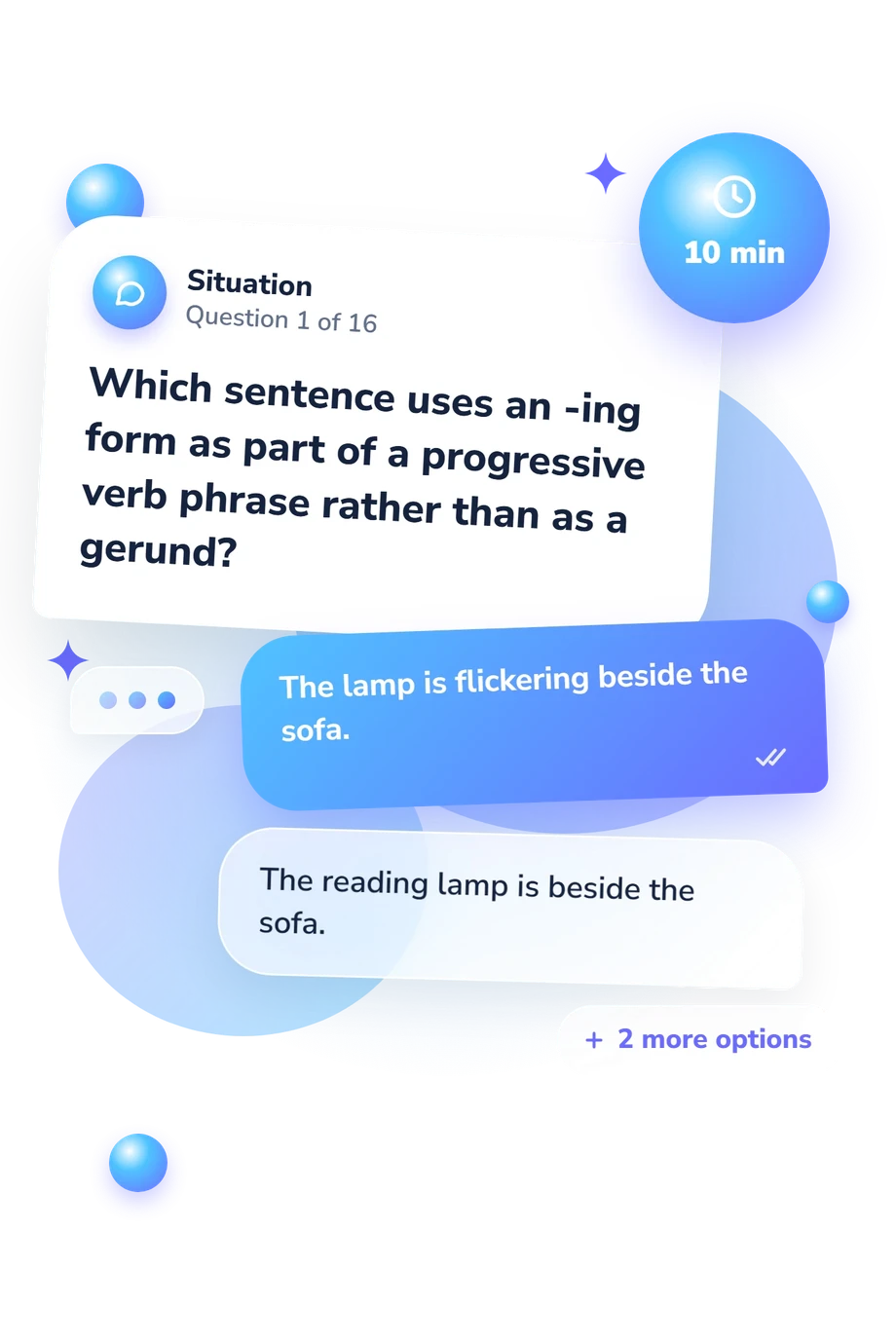
- The lamp is flickering beside the sofa.
- The reading lamp is beside the sofa.
- The flickering lamp needs a new bulb.
- Flickering can indicate a loose connection.
- It acts as a gerund phrase and names the sentence’s subject
- It acts as a participial phrase modifying “Luis”
- It serves as the direct object of “opened”
- It forms a progressive verb with “opened”
- As a gerund naming an activity that woke the baby
- As the sentence’s finite main verb
- As a present participle modifying “dog”
- As a gerund functioning as the object of “woke”
Gerund vs Participle Quiz - Description and methodology of the test
Readers who want to understand how English grammar labels -ing forms can use the gerund vs participle quiz to check their readiness for sentence analysis. It is especially useful for learners, teachers, and writers who want a focused gerund and participle practice quiz rather than isolated definitions. The result reports an overall level based on correct answers, helping indicate whether further review may be useful.
What This Assessment Explores
The questions focus on what an -ing form does in context. They ask whether it names an activity as a gerund, modifies a person or thing as a participle, joins an auxiliary in a progressive phrase, or appears as an object or complement.
Beyond individual labels, this quiz about gerund and participle usage also tests phrase relationships. Items distinguish “solving difficult puzzles” as an object from “barking” as a modifier, and address dangling modifiers and perfect participial constructions.
Results use one scale, Gerund vs Participle Knowledge (0-16), with these result bands:
- Foundations to build (0-6) indicates that you need practice identifying the jobs of -ing forms.
- Developing distinction (7-12) shows that common uses are understood, with phrase analysis still to strengthen.
- Strong command (13-16) indicates consistent distinctions in straightforward and applied examples.
Methodology and Scientific Basis
Each item presents a sentence or short construction with four answer choices. The respondent selects the analysis that best identifies the form’s function, such as subject, object, complement, modifier, or part of a progressive construction. Distractors describe nearby but incorrect roles, so reading the whole sentence matters more than spotting an -ing ending.
The score is the number of correct answers, and the displayed band maps that total to a level of command. The total reflects performance across identifying noun-like uses, modifiers, progressive constructions, complements, and related phrase relationships.
Quirk and Greenbaum describe the traditional classroom distinction between gerunds and participles. Related modern analyses by Huddleston and Huddleston and Pullum use a unified gerund-participial account while discussing that terminology. The assessment is a practical quiz on gerunds and participles, not an adaptation of these books; it applies sentence analysis to that distinction.
Performance may vary with prior instruction, terminology, and careful reading. As a short online knowledge check, it describes performance on these constructions at completion, while reviewing missed patterns and broader grammar work can give a fuller picture.
- Huddleston, Rodney. Introduction to the Grammar of English. Cambridge University Press, 1984. 10.1017/CBO9781139165785
- Quirk, Randolph, and Sidney Greenbaum. A University Grammar of English. Longman, 1973.
- Huddleston, Rodney, and Geoffrey K. Pullum. The Cambridge Grammar of the English Language. Cambridge University Press, 2002. 10.1017/9781316423530
Updated: