
Alice in Wonderland Character Quiz
How the Scales are Structured
Who Usually Takes This Test?
See How You Compare
Below is a preview of how scores are typically distributed across each scale.
Example Questions From the Test
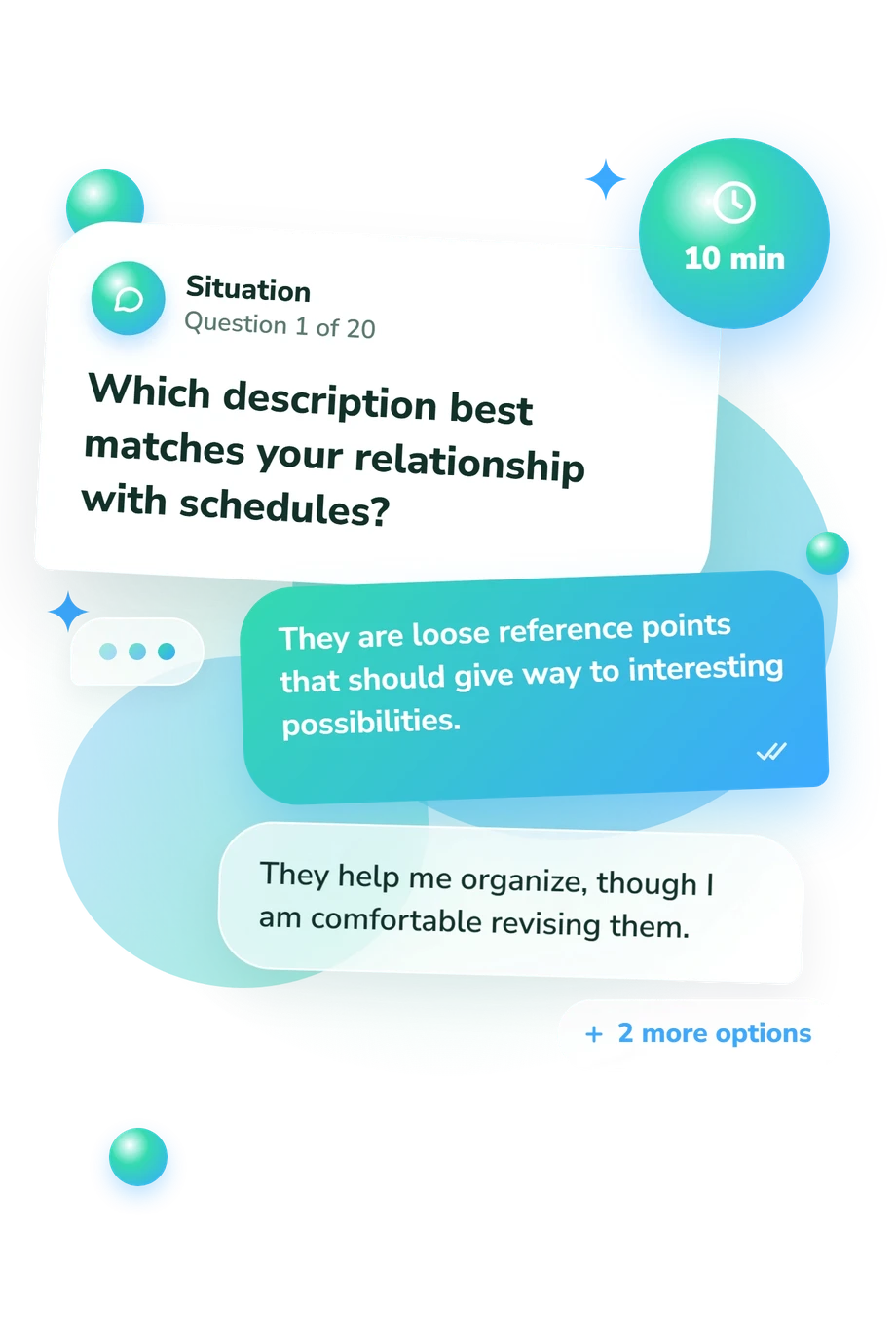
- They are loose reference points that should give way to interesting possibilities.
- They help me organize, though I am comfortable revising them.
- I build in preparation time and take agreed deadlines seriously.
- I monitor them closely and become restless when anything threatens punctuality.
- Work within the existing procedure and raise my objection at the proper moment.
- Challenge the logic clearly, even if everyone else accepts the performance.
- Use a subtle comment that lets others notice the contradiction themselves.
- Step away; I rarely find public confrontations productive.
- I search urgently and feel acutely aware of every passing minute.
- I conduct a quick, methodical search and then use a substitute.
- I tell the organizer and ask how important the item really is.
- I arrive without it and trust that the event can adapt.
Alice in Wonderland Character Quiz - Description and methodology of the test
Readers seeking a playful character profile can use the Alice in Wonderland Character Quiz to compare everyday responses with five recognizable Wonderland patterns. The Which Alice in Wonderland Character Are You quiz offers a practical reflection on uncertainty, imagination, authority, social situations, and obligations. It suits anyone curious about how these tendencies interact across changing conversations, creative challenges, and responsibilities, without treating a fictional figure as a literal identity.
What This Assessment Explores
Each figure in the What Alice in Wonderland Character Are You quiz is a nonliteral pattern expressed through rules, novelty, ambiguity, responsibility, emotion, and group dynamics:
- Alice (0-12) reflects curious exploration, reasoned questioning, adaptability amid strangeness: Familiar Ground (0-4), Curious Visitor (5-8), Wonderland Explorer (9-12).
- Cheshire Cat (0-12) reflects independence, comfort with ambiguity, perceptive observation, indirect communication: Open Path (0-4), Subtle Observer (5-8), Grinning Guide (9-12).
- Mad Hatter (0-12) reflects imaginative improvisation, playful social energy, and freedom from ordinary conventions: Measured Guest (0-4), Playful Improviser (5-8), Tea-Table Original (9-12).
- Queen of Hearts (0-12) reflects commanding presence, emotional intensity, appetite for order, and theatrical decisiveness-not cruelty or actual harm: Quiet Influence (0-4), Firm Presence (5-8), Royal Force (9-12).
- White Rabbit (0-12) reflects time awareness, duty, preparation, and concern about meeting expectations: Unhurried Wanderer (0-4), Conscientious Messenger (5-8), Clock-Watching Courier (9-12).
Methodology and Evidence Base
Each item presents an everyday or Wonderland-like situation followed by four response choices. The options contrast ways of handling schedules, unclear meanings, public challenge, creative tasks, leadership, disruption, and emotional reactions; together, they map recurring preferences onto the displayed character affinities.
In methodological terms, this Alice in Wonderland personality quiz compares five affinity scores. The strongest score is the clearest match, while scores within one point are shown as a blended result. The bands describe relative tendencies within this questionnaire rather than population norms or clinical thresholds.
Carroll (1865) provides the fictional contrasts that give the profiles their recognizable behaviors. Cabiati (2025) offers a psychological reading of Wonderland, while Agarwal and colleagues (2012) examine its character relationships through social-network analysis. The questionnaire is conceptually consistent with these works, but it is not a standardized adaptation of any of them. Self-report remains sensitive to current mood, situation, and self-perception, so a result is best read as a prompt for reflection rather than a fixed account of personality.
- Carroll, Lewis. Alice's Adventures in Wonderland. Macmillan, 1865.
- Cabiati, Alessandro. “Dreaming (and) Insanity: Alice’s Adventures in Wonderland Through the Looking-Glass of Victorian Psychology.” Victorian Literature and Culture, vol. 53, no. 4, 2025, pp. 539-565. 10.1017/S106015032510020X
- Agarwal, Apoorv, Augusto Corvalan, Jacob Jensen, and Owen Rambow. “Social Network Analysis of Alice in Wonderland.” In Proceedings of the NAACL-HLT 2012 Workshop on Computational Linguistics for Literature, pp. 88-96. Association for Computational Linguistics, 2012.
Updated: