
Best Dress for Body Type Quiz
How the Scales are Structured
Who Usually Takes This Test?
See How You Compare
Below is a preview of how scores are typically distributed across each scale.
Example Questions From the Test
- Not close; I prefer straight lines and minimal waist emphasis.
- A little close, provided the diagonal effect is subtle.
- Quite close; that combination usually catches my eye.
- Extremely close; both features are central to what I want.
- A defined natural waist followed by a controlled, close skirt.
- Light shaping through the waist and hips without much volume.
- A raised seam with fabric that falls fairly loosely below it.
- Under-bust definition followed by an airy, uninterrupted flow.
- Firmly defined so the silhouette stays shaped.
- Gently fitted, with the waist still easy to notice.
- Mostly unrestrictive, with only subtle shaping.
- Free of deliberate waist emphasis or pressure.
Best Dress for Body Type Quiz - Description and methodology of the test
People deciding what to try in a fitting room can use the Best Dress for Body Type Quiz when comfort, structure, and visual preference pull in different directions. As a dress silhouette quiz, it focuses on construction rather than body measurements or attractiveness. The resulting profile can support wardrobe planning, fitting-room decisions, and thoughtful experiments with shape, detail, and ease.
What This Assessment Explores
To explore the best clothes for your body type, this quiz assesses construction, proportion, and comfort, not measurements or attractiveness. Choices address waist placement, necklines, skirt movement, adjustability, and ease. Four dress affinities appear in the result:
- Empire-Waist Dress Affinity (0-12) reflects under-bust definition and flowing fabric: Different Direction (0-4), Selective Match (5-8), Strong Affinity (9-12).
- Fit-and-Flare Dress Affinity (0-12) reflects a defined waist and moving skirt: Different Direction (0-4), Selective Match (5-8), Strong Affinity (9-12).
- Shift Dress Affinity (0-12) reflects clean lines, layering, and minimal waist restriction: Different Direction (0-4), Selective Match (5-8), Strong Affinity (9-12).
- Wrap Dress Affinity (0-12) reflects adjustable waist definition and diagonal lines: Different Direction (0-4), Selective Match (5-8), Strong Affinity (9-12).
The highest is the strongest affinity; a style within one point indicates a blended result.
Methodology and Evidence Base
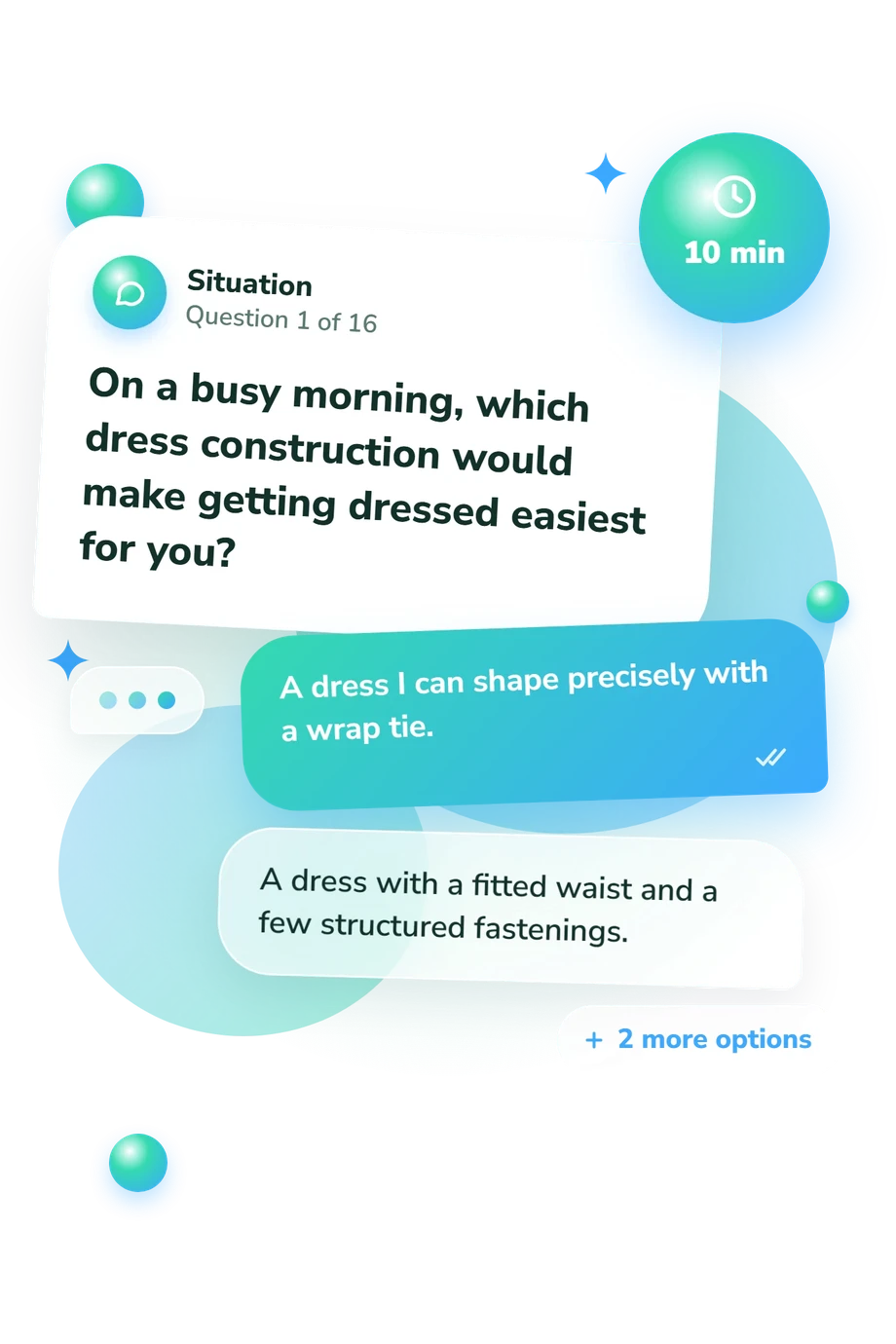
Each item presents a concrete dressing situation with four response choices covering closures, necklines, layering, waist feel, skirt volume, and seam placement. The format keeps attention on lived clothing decisions rather than abstract body judgments.
The result presents four affinity scores, but the questionnaire does not specify how individual responses contribute points. Read these numbers as comparative indicators of dress preference: they describe relative affinity among the four styles rather than norms, probabilities, body-shape measurements, or a documented calculation rule.
Methodologically, the questionnaire is conceptually consistent with Sidberry (2011), which links body shape, body cathexis, and dress preferences, but it is not an adaptation of that study. Grogan et al. (2013) examine body-image experiences during dress fitting; Chattaraman and Rudd (2006) connect clothing preferences with body-related self-perception and perceived size; LaBat and DeLong (1990) address satisfaction with apparel fit. These works provide context for this dress style quiz, not validation of the online version.
The questionnaire is not presented as a standardized measure and has no stated reliability estimates; honest self-report, current context, and limited self-awareness can shift the result, so read it as a comparative profile rather than a fixed rule.
- Sidberry, Phillip Anthony. (2011). Effects of Body Shape on Body Cathexis and Dress Shape Preferences of Female Consumers: A Balancing Perspective. Master's thesis, Auburn University.
- Grogan, Sarah, Simeon Gill, Kathryn Brownbridge, Sarah Kilgariff, and Amanda Whalley. (2013). Dress fit and body image: A thematic analysis of women's accounts during and after trying on dresses. Body Image, 10(3), 380-388. 10.1016/j.bodyim.2013.03.003
- Chattaraman, Veena, and Nancy Ann Rudd. (2006). Preferences for Aesthetic Attributes in Clothing as a Function of Body Image, Body Cathexis and Body Size. Clothing and Textiles Research Journal, 24(1), 46-61. 10.1177/0887302X0602400104
- LaBat, Karen L., and Marilyn R. DeLong. (1990). Body Cathexis and Satisfaction with Fit of Apparel. Clothing and Textiles Research Journal, 8(2), 43-48. 10.1177/0887302X9000800206
Updated: