
Should I Become a YouTuber Quiz
How the Scales are Structured
Who Usually Takes This Test?
See How You Compare
Below is a preview of how scores are typically distributed across each scale.
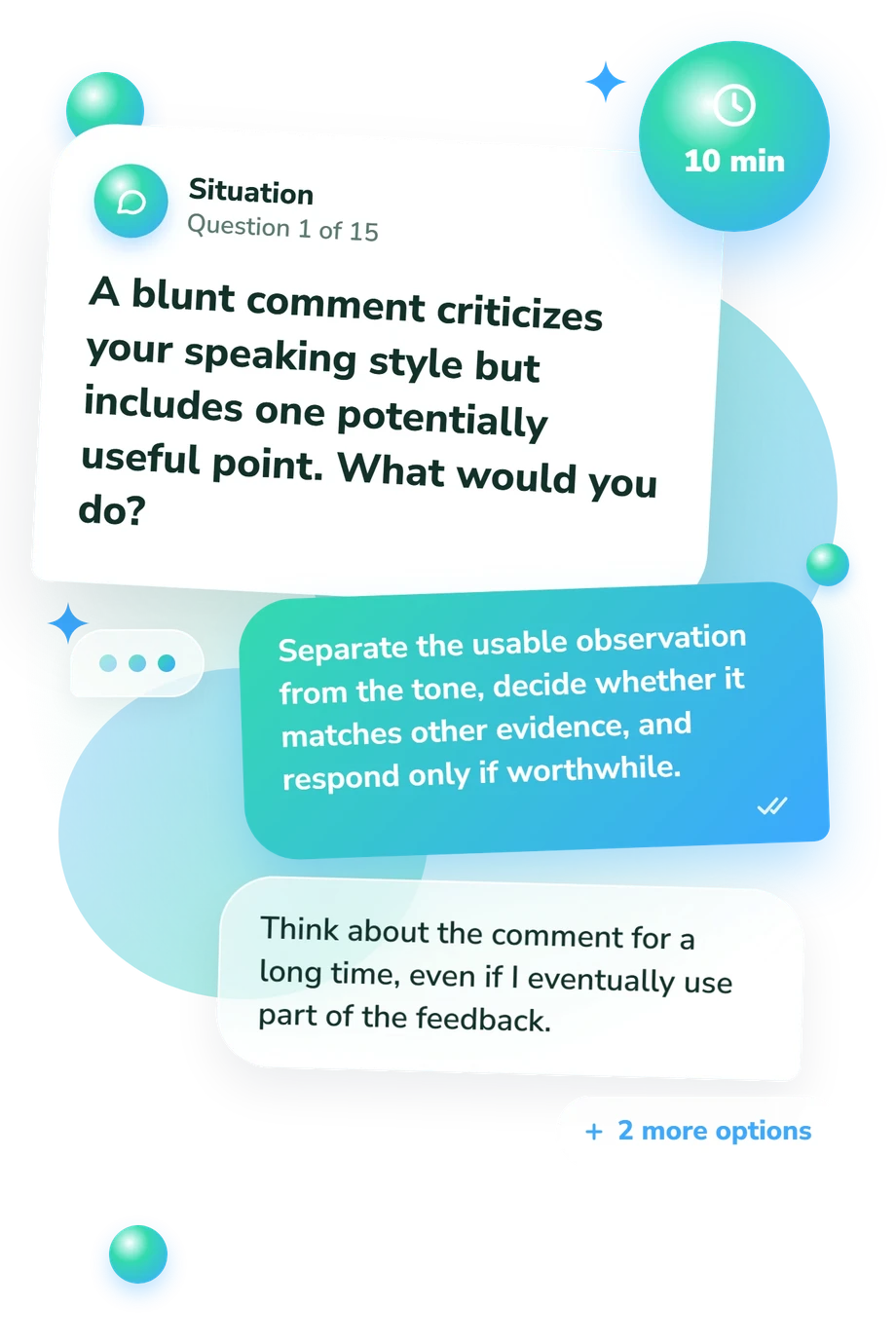
Example Questions From the Test
- Separate the usable observation from the tone, decide whether it matches other evidence, and respond only if worthwhile.
- Think about the comment for a long time, even if I eventually use part of the feedback.
- Reject the whole comment because constructive feedback should always be phrased politely.
- Note the useful point and ask someone I trust whether they noticed the same issue.
- I am still exploring several interests and would need to see which one feels worth filming.
- I know the broad subject, but the videos could vary widely depending on my mood.
- I can name the topic, the likely viewer, and a few videos I would make first.
- I can explain the audience promise, my angle, and repeatable formats in a short sentence.
- I would assume the channel idea has failed and would probably stop posting.
- I would feel discouraged and keep posting mainly in the hope that one video suddenly takes off.
- I would review packaging and audience fit, then test one focused change in the next few videos.
- I would continue for a defined trial period while learning basic lessons from the available response.
Should I Become a YouTuber Quiz - Description and methodology of the test
People considering a channel or experiment can use the Should I Become a YouTuber Quiz to examine readiness before committing. It helps you think through direction, workload, feedback, and personal boundaries rather than seek a yes-or-no verdict. This framing turns the will-I-be-a-good-YouTuber quiz question into practical conditions. That keeps the decision practical. If you are unsure about your fit for YouTube, test one idea, workflow, or boundary.
What This Assessment Explores
It tests whether you would be a good YouTuber through channel demands: turning interests into recognizable videos for an intended audience, scoping, completing, and publishing with actual resources, and learning from response data while protecting motivation, boundaries, and wellbeing. Prospective creators receive a readiness profile addressing the will-you-be-a-good-YouTuber quiz question, not a popularity forecast.
Three scales organize the profile:
- Content Direction & Audience Fit (0-15) indicates how clearly interests become recognizable videos for an intended audience: Exploring (0-5), Taking Shape (6-10), or Well Defined (11-15).
- Production Consistency (0-15) indicates how well you scope, complete, and publish with actual resources: Early Setup (0-5), Workable Foundation (6-10), or Repeatable Process (11-15).
- Sustainable Growth Mindset (0-15) indicates how you learn from response data while protecting motivation, boundaries, and wellbeing: Vulnerable to Friction (0-5), Building Balance (6-10), or Grounded Growth (11-15).
Methodology and Scientific Basis
Each item presents a creator situation with four response options. The prompts address channel positioning, idea selection, time limits, unfinished work, audience signals, criticism, and offline boundaries. This questionnaire gives the would-you-be-a-good-YouTuber quiz question a practical form, turning it into choices about what you would actually do.
The questionnaire uses hypothetical self-report choices and displays scale summaries, but it does not disclose how individual responses contribute to each score. Results therefore describe reported readiness tendencies, not observed ability, and should be read as patterns around direction, execution, and sustainable learning.
The questionnaire’s workload and emotional-demand themes are conceptually consistent with Albiez (2020). Gregersen and Ørmen (2023) support attention to output pressure, productivity, and precarity, while Törhönen, Sjöblom, Hassan, and Hamari (2020) support considering motives beyond fame or income. It is not an adaptation or validated reproduction of these studies.
The online questionnaire has no stated norms or validation study, and self-report answers can shift with current confidence and self-awareness. Use the profile to choose a small pilot, simplify a workflow, or define a boundary before making a larger commitment.
- Albiez, Milena. "Systemic, social and emotional challenges and magic moments in the professional life of full-time and part-time YouTubers: Have fun and work at the same time." Gruppe. Interaktion. Organisation 51 (2020): 457-468. 10.1007/s11612-020-00534-w
- Gregersen, Andreas Lindegaard, and Jacob Ørmen. "The Output Imperative: Productivity and precarity on YouTube." Information, Communication & Society 24(4) (2023): 432-451. 10.1080/1369118X.2021.2006745
- Törhönen, Maria, Max Sjöblom, Lobna Hassan, and Juho Hamari. "Fame and fortune, or just fun? A study on why people create content on video platforms." Internet Research 30(1) (2020): 165-190. 10.1108/INTR-06-2018-0270
Updated: