
Bible Quiz on Nehemiah
How the Scales are Structured
Who Usually Takes This Test?
See How You Compare
Below is a preview of how scores are typically distributed across each scale.
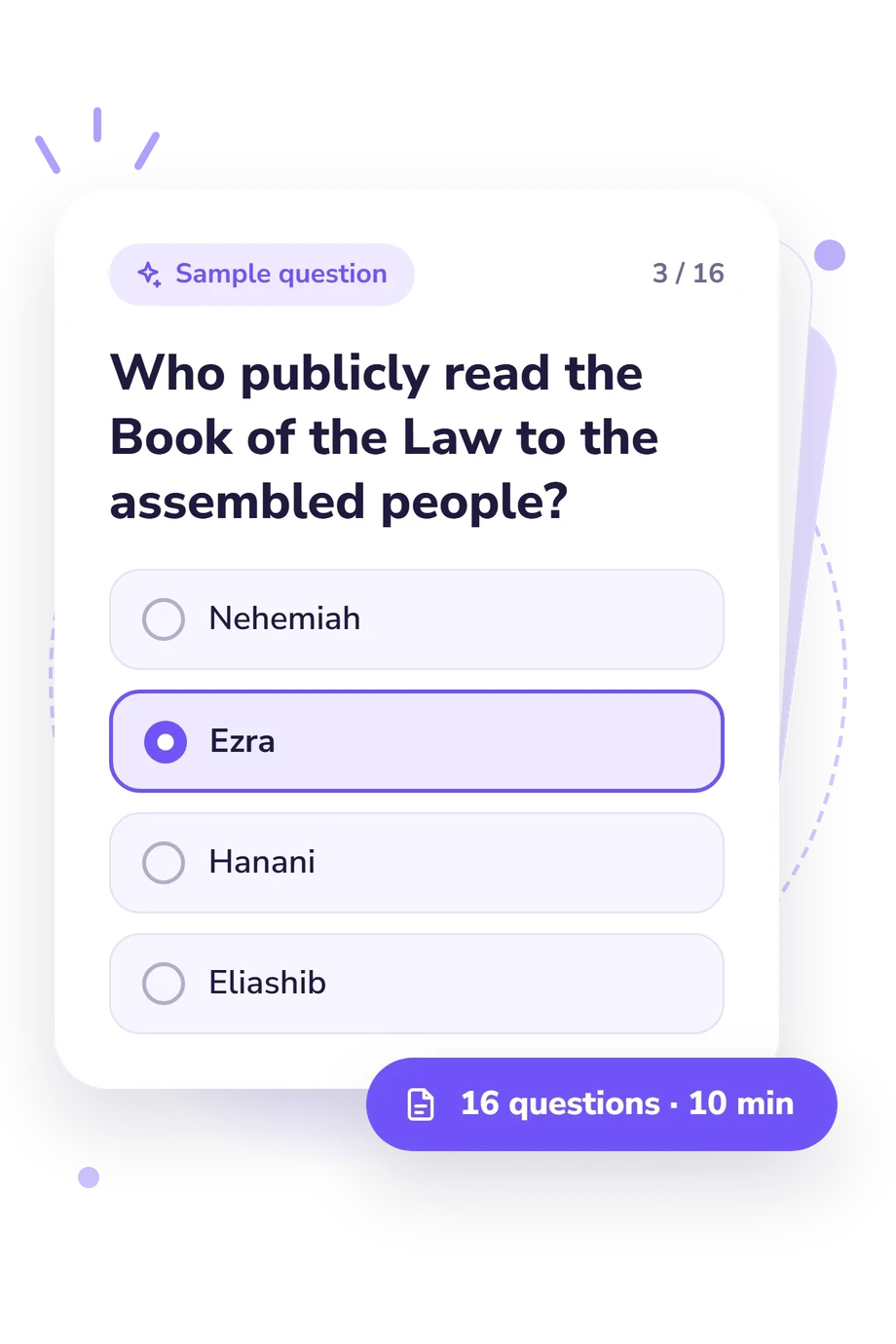
Example Questions From the Test
- Eliashib, Ezra, and Hanani
- Zerubbabel, Jeshua, and Haggai
- Artaxerxes, Cyrus, and Darius
- Sanballat, Tobiah, and Geshem
- Nehemiah
- Ezra
- Hanani
- Eliashib
- Seven days
- Forty days
- Fifty-two days
- Seventy years
Bible Quiz on Nehemiah - Description and methodology of the test
Readers who want to study the book more deliberately can use the Bible Quiz on Nehemiah as a focused knowledge check. It suits learners, Bible-study groups, and teachers who want to review the narrative rather than rely on a summary. As a bible quiz on the book of nehemiah, this test draws attention to leadership, opposition, worship, justice, and covenant renewal, while the result identifies subjects worth revisiting.
What This Assessment Measures
The questionnaire checks knowledge of the biblical narrative, not personality or religious commitment. The bible quiz questions on nehemiah cover people, events, Nehemiah’s decisions, reforms, worship, and covenant obligations. It suits anyone studying or teaching the book who wants a structured check of recall and interpretation.
The main thematic areas are:
- People and leadership show whether the respondent distinguishes officials, priests, opponents, and Nehemiah’s choices.
- Rebuilding, resistance, and justice show how the result captures planning, shared responsibility, vigilance, debt, property, and reform.
- Worship and covenant show whether the respondent connects the Law, festivals, prayer, and communal commitments.
The result uses one Nehemiah Knowledge scale from 0-16: Foundations to Revisit (0-6), Developing Understanding (7-12), and Strong Understanding (13-16). These bands indicate increasing accuracy in recalling and interpreting the book’s central concerns.
Methodology and Evidence Base
Each item presents a biblical question with four answer choices, asking the respondent to select the option that best fits the account. The set combines direct recall with brief interpretive applications, such as relating local repair work to shared responsibility or recognizing why Nehemiah refused a proposed meeting. Answers are summarized in one documented content score, indicating performance on this material rather than personality or faith.
The textual reference is Nehemiah (NRSVue, 2021), while Williamson’s 1985 commentary supplies historical and literary context for the people, conflicts, reforms, and sequence of events. Ganzel’s study adds context for celebrations and communal observance in Ezra-Nehemiah; Friedman and Herskovitz discuss leadership themes in the narrative. These sources provide biblical and contextual reference points for the questions; they do not supply psychometric norms or validation evidence for this questionnaire.
Results depend on prior exposure, item-wording interpretation, and attention during completion. The Nehemiah Bible quiz can guide further reading, but one score cannot represent a person’s broader faith, interpretation, or biblical understanding.
- The Holy Bible: New Revised Standard Version Updated Edition. Friendship Press, 2021.
- Williamson, Hugh Godfrey Maturin. Ezra, Nehemiah. Word Biblical Commentary, vol. 16. Waco, TX: Word Books, 1985.
- Ganzel, Tova. “Ceremonial Celebrations Outside the Temple Compound in Ezra-Nehemiah in Babylonian Ritual Context.” Journal for the Study of the Old Testament 46, no. 2 (2021): 147-160. DOI 10.1177/03090892211032266.
- Friedman, Hershey H., and Paul J. Herskovitz. “Rebuilding of the Temple and Renewal of Hope: Leadership Lessons from Zerubbabel, Ezra, and Nehemiah.” The Journal of Values-Based Leadership 12, no. 2 (2019), Article 6. DOI 10.22543/0733.122.1271
Updated: