
Am I a Bad Girl Quiz
How the Scales are Structured
Who Usually Takes This Test?
See How You Compare
Below is a preview of how scores are typically distributed across each scale.
Example Questions From the Test
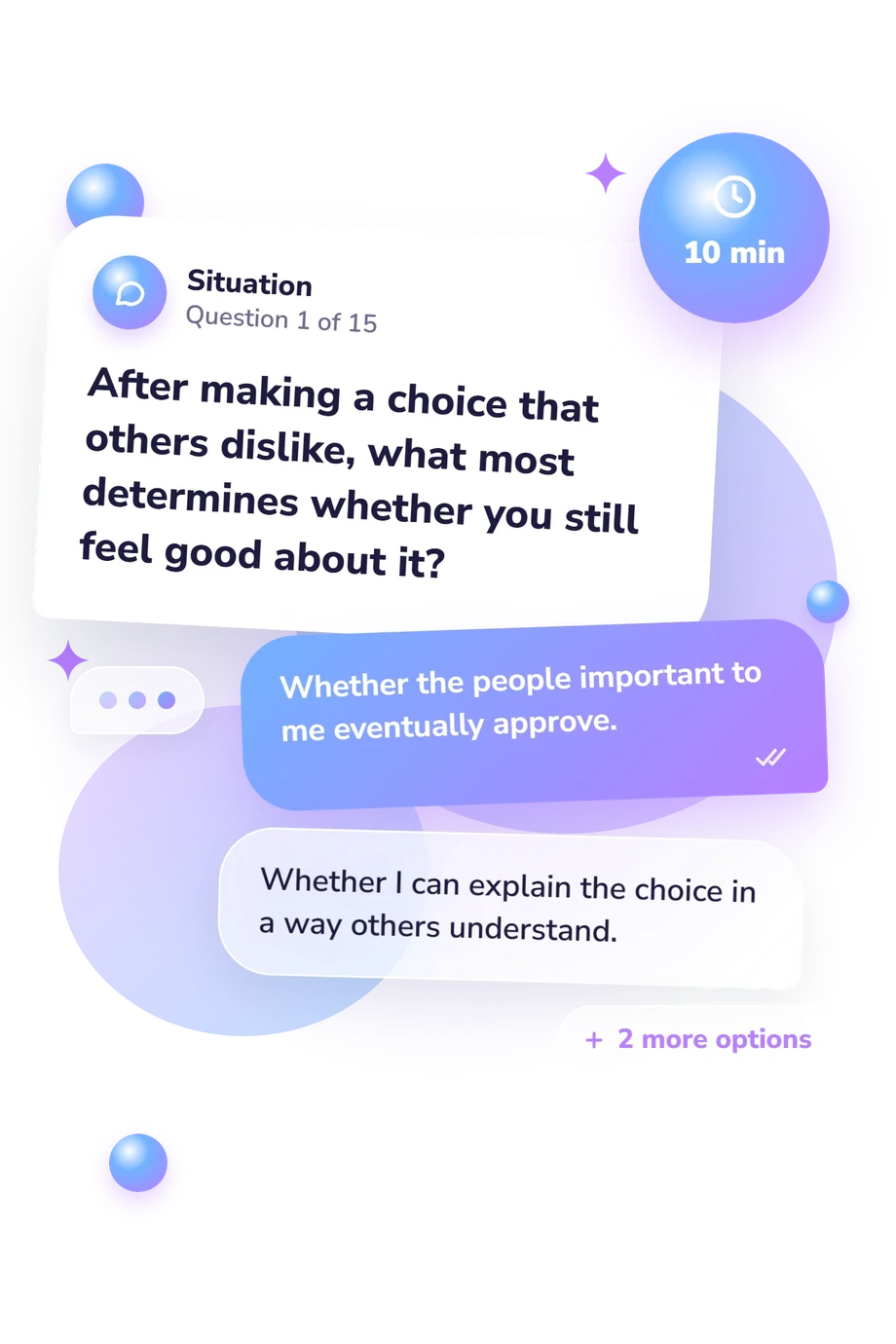
- Whether the people important to me eventually approve.
- Whether I can explain the choice in a way others understand.
- Whether the choice fits my priorities without needlessly damaging relationships.
- Whether it remains consistent with my values after I honestly review its consequences.
- They provide useful guidance for fitting into the communities I value.
- I usually follow them unless they strongly conflict with what I want.
- I consider them alongside my own priorities rather than treating them as rules.
- I expect each norm to earn my agreement before I let it shape my choices.
- Rarely; I usually manage my reaction without discussing it.
- Sometimes, especially if it happens more than once.
- Often, once I am confident the teasing is unwelcome.
- Almost always, as soon as I notice that a limit has been crossed.
Am I a Bad Girl Quiz - Description and methodology of the test
People who feel caught between social expectations and their own reactions can use the Am I a Bad Girl Quiz to examine those tensions without reducing them to a moral label. It suits readers wondering whether their responses reflect approval-seeking, self-direction, firm boundaries, or retaliation. As an are you a bad girl quiz, it offers a pattern profile for separating personal values from social pressure and impulsive pushback.
What This Assessment Explores
This questionnaire examines self-definition under social pressure and reactions to disrespect, exclusion, criticism, interruption, teasing, and control. When read as an are you a good girl or a bad girl quiz, it offers a pattern profile rather than a moral verdict.
These dimensions are:
- Boundary-Setting Under Disrespect (0-15) measures limit-setting: Quiet Protection (0-5) preserves peace, Selective Assertion (6-10) speaks up selectively, and Explicit Boundaries (11-15) states what must change.
- Independent Self-Definition (0-15) measures personal values: Socially Attuned (0-5) weighs others, Negotiated Identity (6-10) balances belonging, and Self-Authored Identity (11-15) follows chosen standards.
- Reactive Defiance (0-15) measures pushback: Measured Response (0-5) pauses, Situational Pushback (6-10) varies with context, and Fast Counterstrike (11-15) challenges or retaliates quickly.
Together, the profile separates self-direction, clear boundaries, and escalation. A good girl or bad girl quiz can map response patterns rather than character.
Methodology and Scientific Basis
Each item presents a charged situation with four responses, moving from caution or accommodation through clarification and assertion to challenge or retaliation. Scenarios cover approval, gendered expectations, privacy, exclusion, criticism, rules, interruptions, teasing, and ambiguous disrespect. This bad girls quiz examines response styles across situations.
Answers produce three scores, but the questionnaire does not state how many points each response contributes. The bands show how strongly each tendency appears and should be read with the situations, not as fixed character types.
A close conceptual reference is Feminine Gender Role Stress Scale (Gillespie & Eisler, 1992), which addresses strain around expectations placed on women. Jack and Dill’s Silencing the Self Scale concerns approval and self-silencing; Hong and Faedda’s Hong Psychological Reactance Scale concerns threatened autonomy; Rathus’s assertiveness schedule concerns direct communication. The questionnaire is conceptually consistent with these works, not a standardized adaptation or validation of them.
Interpretation depends on honest self-report, self-awareness, and current context. Scores describe tendencies in these situations but may miss relationship history, power differences, or whether confrontation is safe; they are not a diagnosis.
- Gillespie, Betty L., and Richard M. Eisler. "Development of the Feminine Gender Role Stress Scale." Behavior Modification, 16(3), 426-438, 1992. 10.1177/01454455920163008
- Jack, Dana Crowley, and Diana Dill. "The Silencing the Self Scale: Schemas of Intimacy Associated With Depression in Women." Psychology of Women Quarterly, 16(1), 97-106, 1992. 10.1111/j.1471-6402.1992.tb00242.x
- Hong, Sung-Mook, and Salvatora Faedda. "Refinement of the Hong Psychological Reactance Scale." Educational and Psychological Measurement, 56(1), 173-182, 1996. 10.1177/0013164496056001014
- Rathus, Spencer A. "A 30-item Schedule for Assessing Assertive Behavior." Behavior Therapy, 4(3), 398-406, 1973. 10.1016/S0005-7894(73)80120-0
Updated: