
Familiar Commands in Spanish Quiz
How the Scales are Structured
Who Usually Takes This Test?
See How You Compare
Below is a preview of how scores are typically distributed across each scale.
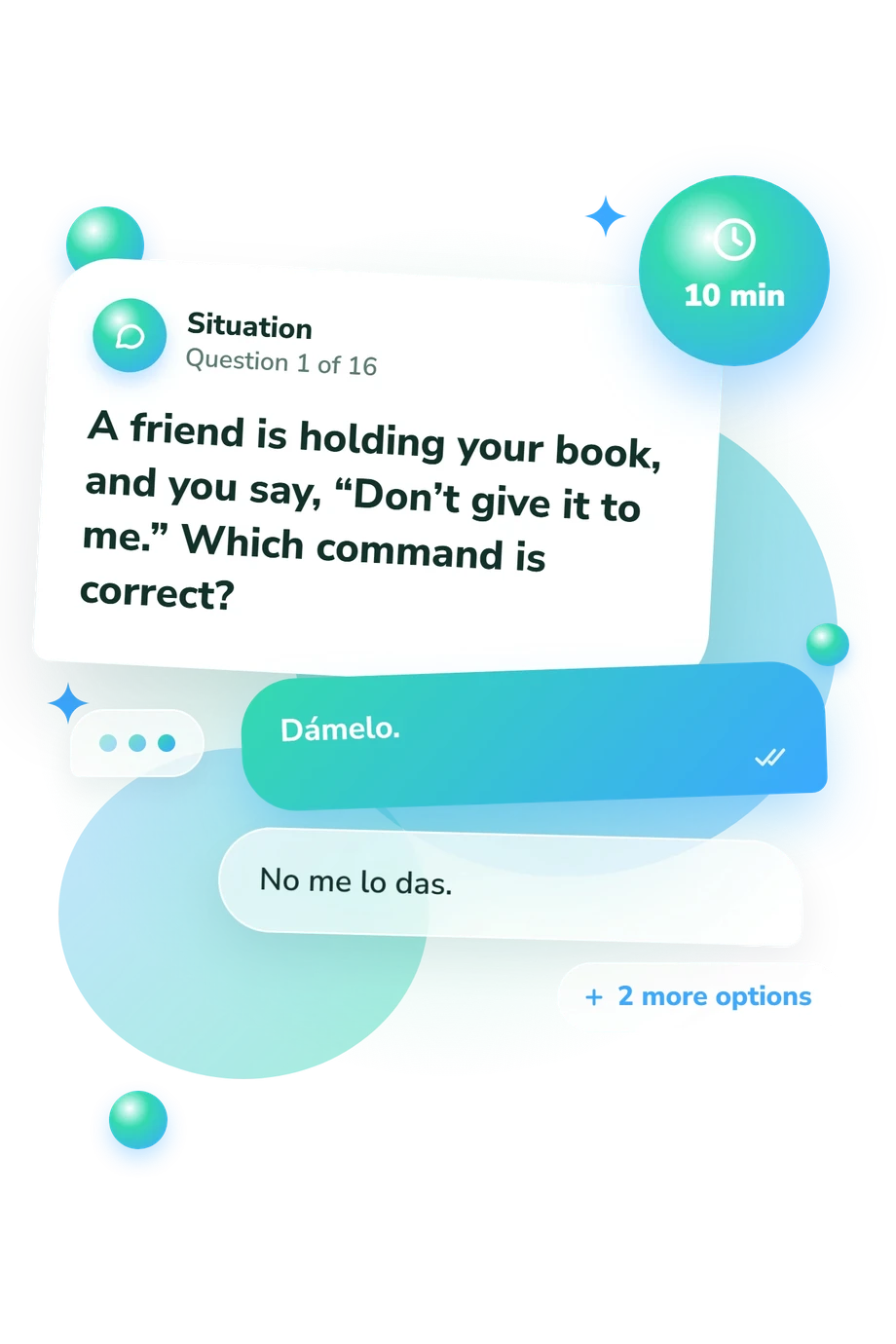
Example Questions From the Test
- Dámelo.
- No me lo das.
- No me lo dé.
- No me lo des.
- Escribes tu nombre.
- Escriba su nombre.
- Escribe tu nombre.
- No escribas tu nombre.
- No buscas las llaves aquí.
- No busces las llaves aquí.
- No busques las llaves aquí.
- Busca las llaves aquí.
Familiar Commands in Spanish Quiz - Description and methodology of the test
For learners who want to check familiar forms in real conversational situations, the Familiar Commands in Spanish Quiz focuses on Spanish commands addressed to one person. It suits students revising tú imperatives, teachers needing a compact classroom activity, and anyone investigating patterns that cause mistakes. The result indicates overall command knowledge and whether broader review may be useful. The format gives learners brief Spanish command practice through short, focused situations.
What This Assessment Explores
The questionnaire concentrates on four connected areas that make informal command practice more specific:
- Affirmative tú commands show whether forms such as escribe, haz, ve, and ten are recognized in familiar requests.
- Negative tú commands show whether forms such as no busques, no abras, and no comas match the intended prohibition.
- Irregular commands reveal whether forms such as di, pon, sal, and ve are distinguished from ordinary patterns.
- Pronoun combinations indicate whether attachment, reflexive placement, and accents are handled in forms such as dímelo and levántate.
Examples cover everyday requests, prohibitions, and actions directed at a familiar person.
The result appears as Familiar Commands in Spanish Knowledge (0-16), with Foundations to Review (0-6), Developing Command (7-12), or Strong Command (13-16); these labels describe performance on this questionnaire.
Methodology and Evidence Base
Each item presents an English situation or meaning with four Spanish options. The respondent selects the form matching familiar address, positive or negative polarity, spelling changes, pronoun placement, and accentuation. Distractors may be statements, usted forms, opposite meanings, or near-miss commands, so the task tests discrimination rather than translation alone.
The questionnaire is an online check of Spanish imperative forms, so it functions as a focused Spanish imperative quiz rather than a translation exercise.
The questionnaire is conceptually consistent with Spanish imperative grammar, is not an adaptation of either grammar reference, and uses questionnaire-specific rather than normative bands.
Batchelor and San José (2010) offer a second reference point for the same system. The questionnaire reports the displayed knowledge scale and its result bands, which describe performance on this questionnaire rather than population norms or formal proficiency certification. The online format suits tú command practice, but selected-answer performance can be affected by attention, guessing, prior instruction, and current learning context.
- Butt, John, Carmen Benjamin, and Antonia Moreira Rodríguez. A New Reference Grammar of Modern Spanish. 6th ed., Routledge, 2019. Chapter 21, “The imperative.” ISBN 9781138124011.
- Batchelor, R. E., and Miguel Ángel San José. A Reference Grammar of Spanish. Cambridge University Press, 2010. DOI 10.1017/CBO9780511845604
Updated: