
Best Trait Quiz
How the Scales are Structured
Who Usually Takes This Test?
See How You Compare
Below is a preview of how scores are typically distributed across each scale.
Example Questions From the Test
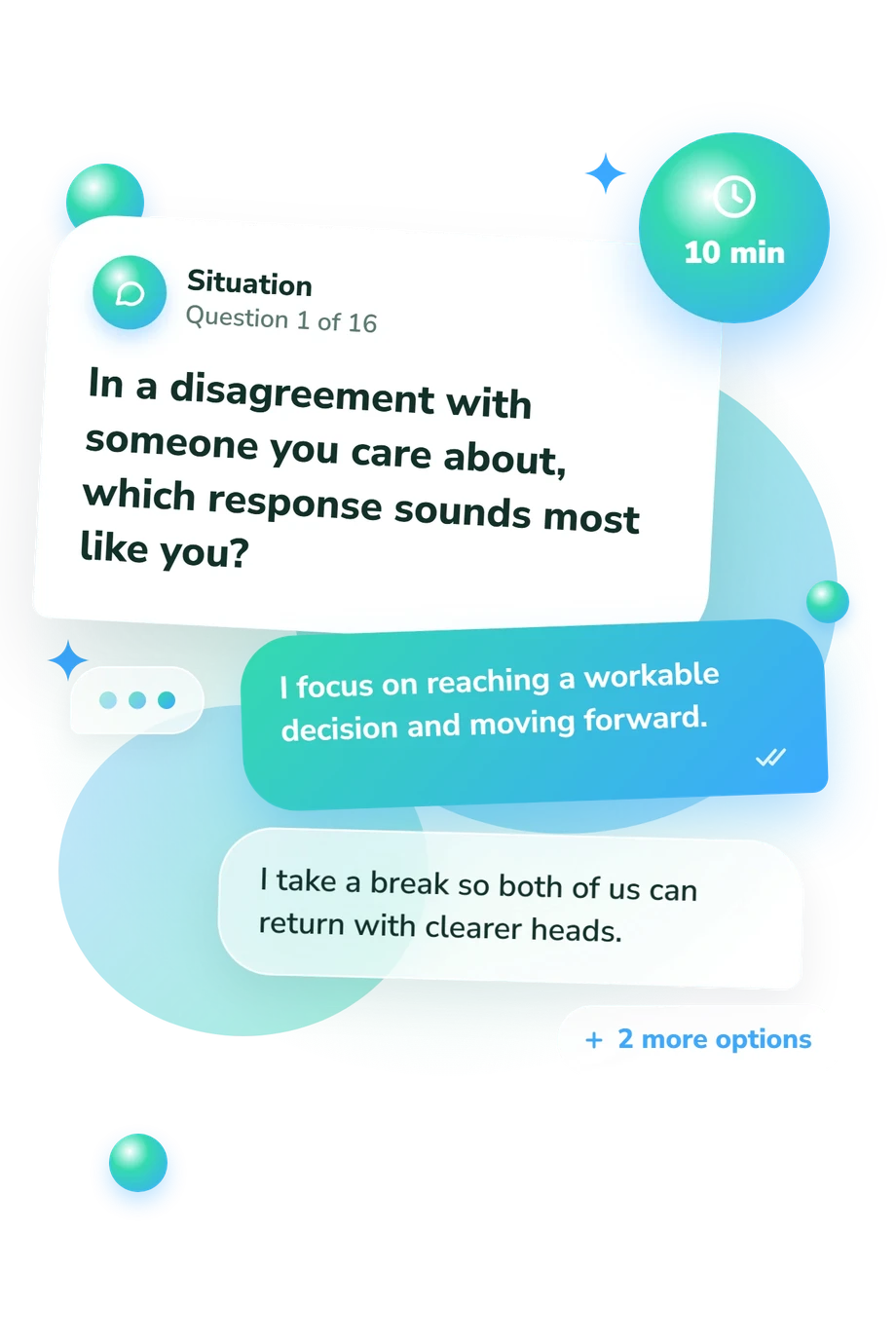
- I focus on reaching a workable decision and moving forward.
- I take a break so both of us can return with clearer heads.
- I summarize their position before explaining where I differ.
- I try to understand the experience behind their position before discussing solutions.
- Accept the praise as recognition of the team’s combined work.
- Invite the colleague to explain the idea in more detail.
- Mention their contribution in a follow-up message to the group.
- Immediately clarify that the central idea came from them.
- Leave it unless it begins to affect the outcome.
- Monitor the situation and prepare a correction if needed.
- Correct it quietly and document the change.
- Acknowledge the mistake to the relevant person and correct it.
Best Trait Quiz - Description and methodology of the test
Visitors who want to understand a personal strength can use this online personality assessment to reflect on choices, relationships, and responses to setbacks. The best trait quiz organizes that reflection around four strengths, helping the reader notice a leading tendency without treating personality as a fixed label.
What This Assessment Explores
Situations involving disagreement, novelty, criticism, commitments, and setbacks show how a person approaches questions, other people, principles, and recovery. There are no correct answers; the pattern indicates which strength feels most natural.
The four result dimensions are:
- Curiosity (0-12) measures attraction to questions and unfamiliar experiences; results are Selective Explorer (0-4), Open Investigator (5-8), or Driven Discoverer (9-12).
- Empathy (0-12) measures attention to feelings and perspectives; results are Respectful Distance (0-4), Responsive Understanding (5-8), or Empathic Attunement (9-12).
- Integrity (0-12) measures alignment with commitments, honesty, and principles; results are Contextual Flexibility (0-4), Grounded Reliability (5-8), or Principle-Led Consistency (9-12).
- Resilience (0-12) measures regrouping and continuing after difficulty; results are Deliberate Recovery (0-4), Adaptive Return (5-8), or Persistent Renewal (9-12).
The highest score shows the strongest affinity; scores within one point can form a blended result, helping connect the profile with character strengths in everyday decisions.
Methodology and Evidence Base
Each item presents an everyday scenario with four response options. The alternatives describe ways of handling novelty, disagreement, responsibility, emotion, or setbacks, and answers combine into four comparable totals. The displayed result compares those totals; because no point-by-point formula is published, no answer-level scoring rule should be inferred.
Conceptually, the structure is consistent with Peterson and Seligman (2004), which treats these qualities as distinct but related capacities. This four-trait arrangement is a separate online questionnaire, not an adaptation of that classification or the VIA-IS. Ruch et al. (2010) show how strengths can be examined with self-report and peer ratings, but their validation does not extend to this item set.
Davis (1983) presents empathy as multidimensional, while Smith et al. (2008) examines bouncing back in a separate resilience measure. These sources clarify the constructs, not norms or clinical cutoffs for this questionnaire.
A self-reflection questionnaire produces a snapshot shaped by current mood, self-awareness, and socially desirable responding. It has no published norms, reliability estimates, or clinical validation, so interpret the pattern as a prompt for reflection rather than a diagnosis.
- Peterson, Christopher, and Martin E. P. Seligman. Character Strengths and Virtues: A Handbook and Classification. Washington, DC: American Psychological Association; New York: Oxford University Press, 2004. ISBN 978-0-19-516701-6.
- Ruch, Willibald, René T. Proyer, Claudia Harzer, Nansook Park, Christopher Peterson, and Martin E. P. Seligman. “Values in Action Inventory of Strengths (VIA-IS): Adaptation and Validation of the German Version and the Development of a Peer-Rating Form.” Journal of Individual Differences 31, no. 3 (2010): 138-149. 10.1027/1614-0001/a000022.
- Smith, Bruce W., Jeanne Dalen, Kathryn Wiggins, Erin Tooley, Paulette Christopher, and Jennifer Bernard. “The Brief Resilience Scale: Assessing the Ability to Bounce Back.” International Journal of Behavioral Medicine 15, no. 3 (2008): 194-200. 10.1080/10705500802222972.
- Davis, Mark H. “The Effects of Dispositional Empathy on Emotional Reactions and Helping: A Multidimensional Approach.” Journal of Personality 51, no. 2 (1983): 167-184. 10.1111/j.1467-6494.1983.tb00860.x
Updated: