
Indian Politics Quiz
How the Scales are Structured
Who Usually Takes This Test?
See How You Compare
Below is a preview of how scores are typically distributed across each scale.
Example Questions From the Test
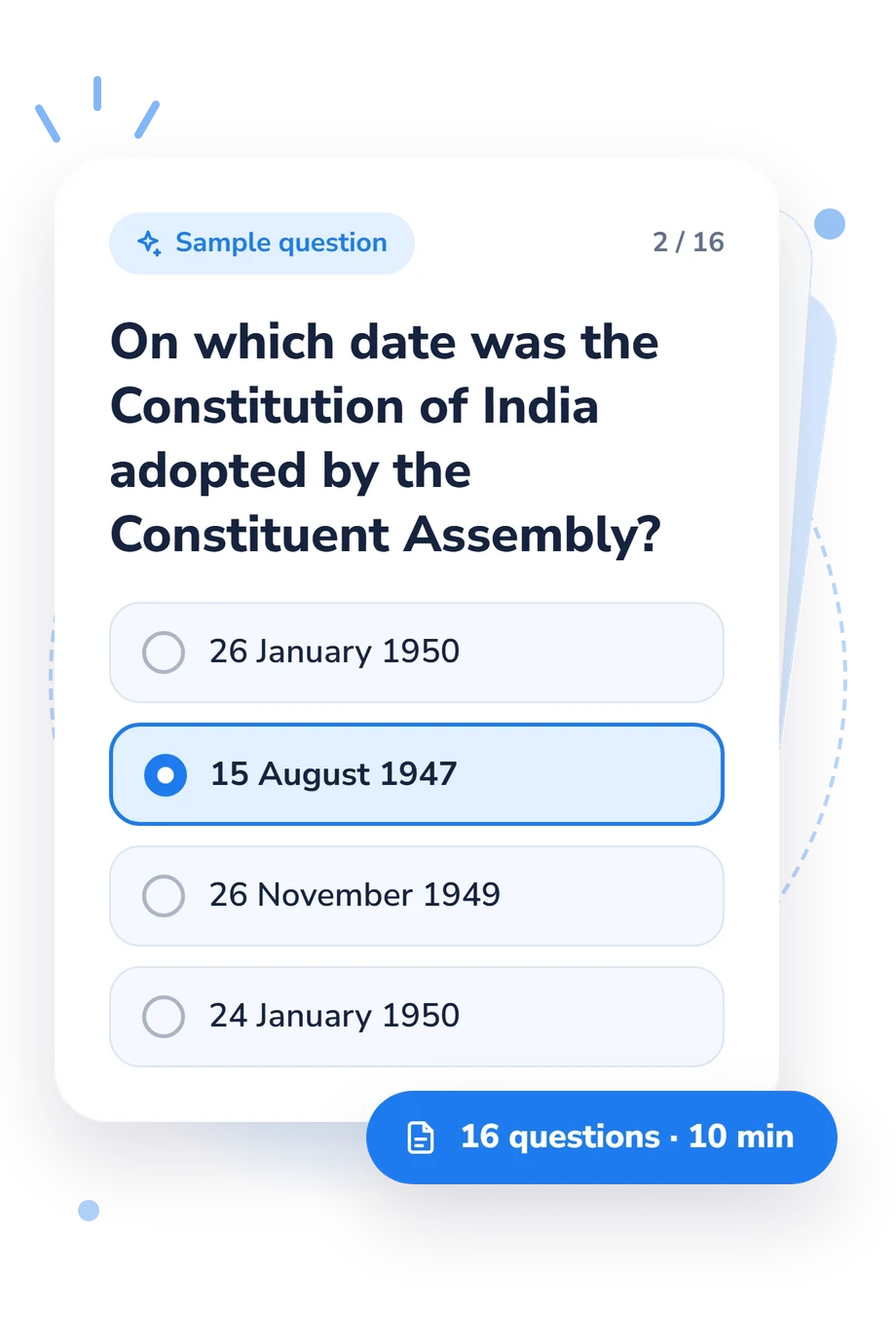
- 26 January 1950
- 15 August 1947
- 26 November 1949
- 24 January 1950
- 42nd Amendment
- 44th Amendment
- 52nd Amendment
- 73rd Amendment
- Article 44
- Article 32
- Article 110
- Article 368
Indian Politics Quiz - Description and methodology of the test
Readers who want to check their understanding of India’s constitutional system can use this assessment to review institutions, procedures, and governing principles. Respondents answer four-option questions about constitutional institutions in the Indian Politics Quiz Questions with Answers format, testing recognition and application rather than opinion. It focuses on how public institutions function. For learners, these quiz questions on Indian politics offer a route into Parliament, elections, executive authority, and Union-state relations.
What This Assessment Explores
The questions assess practical knowledge of India’s constitutional system in institutional and procedural situations. They focus on powers, responsibilities, elections, legislative procedure, and safeguards rather than political preference. As a quiz on Indian politics, it suits readers seeking a structured check of civic understanding.
The main thematic groups are:
- Parliament and executive responsibility show how confidence, chambers, ministers, and government formation work.
- Constitutional structure covers amendments, rights, directives, legislative lists, and constitutional change.
- Elections and representation identify the roles of the Election Commission, houses, parties, and voters.
- Oversight and administration connect audits, committees, local bodies, and state responsibilities.
The displayed scale is Indian Politics Knowledge, scored 0-16: Emerging foundation (0-6), Developing knowledge (7-12), and Strong command (13-16). It reflects performance on this quiz, not overall civic competence.
Methodology and Evidence Base
Each item presents a direct question with four answer choices. Some prompts ask for a constitutional fact; others describe an institutional situation and ask which rule or authority fits it. The displayed result aggregates performance across the questionnaire, with no separate weighting formula stated.
The content is consistent with the procedural-knowledge perspective discussed by Auerbach, Singh, and Thachil (2025), but this questionnaire is not an adaptation of their study. The Constitution of India, issued by the Legislative Department, provides the legal reference for Parliament, elections, amendments, rights, and public offices. Subhash C. Kashyap’s overview helps explain how those provisions work together. As a quiz about the politics of India, it tests constitutional knowledge rather than political ideology.
This questionnaire is presented as a knowledge quiz, not a norm-referenced or clinical instrument; its bands are descriptive levels within the quiz rather than population-based judgments. Prior study, wording interpretation, attention, and confidence can affect performance. Use the result to choose further reading and support self-reflection; broader civic competence requires knowledge and judgment beyond these items.
- Auerbach, Adam Michael, Shikhar Singh, and Tariq Thachil. “Who Knows How to Govern? Procedural Knowledge in India’s Small-Town Councils.” American Political Science Review 119, no. 2 (2025): 708-726. 10.1017/S0003055424000297
- Government of India, Ministry of Law and Justice, Legislative Department, Official Languages Wing. The Constitution of India: As on 1st May, 2024. New Delhi: Government of India, 2024.
- Kashyap, Subhash C. Our Constitution: An Introduction to India’s Constitution and Constitutional Law. 3rd rev. ed. New Delhi: National Book Trust, India, 2001.
Updated: