
Where Did I Grow Up Quiz
How the Scales are Structured
Who Usually Takes This Test?
See How You Compare
Below is a preview of how scores are typically distributed across each scale.
Example Questions From the Test
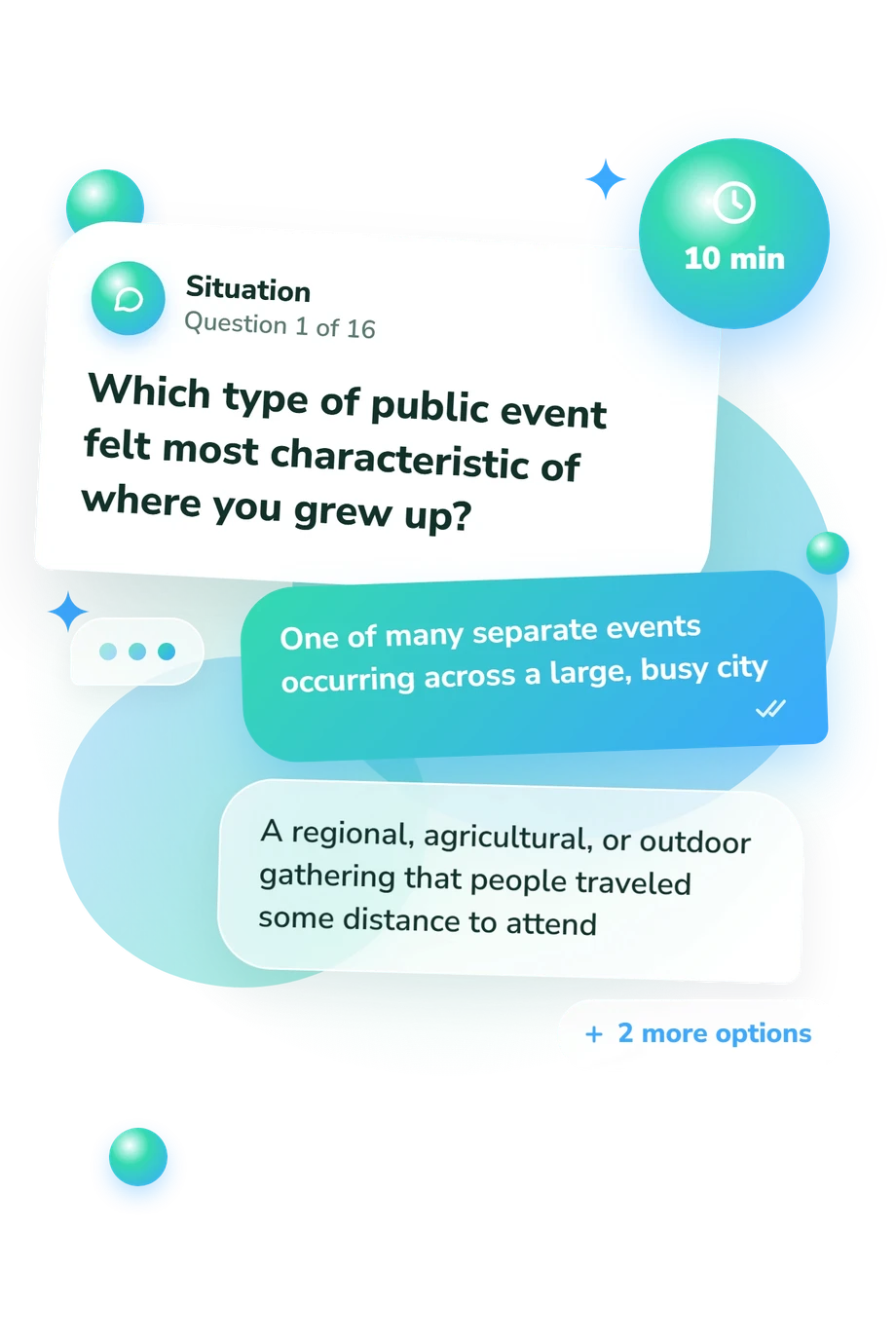
- One of many separate events occurring across a large, busy city
- A regional, agricultural, or outdoor gathering that people traveled some distance to attend
- A neighborhood festival or school event known mainly within one part of the area
- A parade, fair, game, or celebration that seemed to involve much of the town
- I usually walked or used frequent public transit through a dense mixed-use area
- The journey often covered a long distance across open country
- I used a mix of short rides, cycling, walking, and occasional buses
- An adult usually drove a fairly short route along residential and commercial roads
- Walking or taking transit to several shops woven into dense streets
- Traveling to a town or regional center because nearby choices were scarce
- Using a combination of neighborhood businesses and a planned commercial center
- Making a short drive to a supermarket, strip mall, or shopping complex with parking
Where Did I Grow Up Quiz - Description and methodology of the test
People reflecting on childhood surroundings can use this assessment to organize memories of homes, routes, services, social familiarity, and everyday scenes. The Where Did I Grow Up Quiz is intended for readers who want a practical way to sort those details and notice how mobility, access, density, and community shaped daily life. This assessment works as a where did you grow up quiz, turning those memories into a structured reflection.
What This Assessment Explores
The questionnaire treats childhood memories as environmental clues, not as a way to identify an exact location. Prompts about travel, buildings, streets, errands, social familiarity, soundscapes, and views reflect density, distance, walkability, community scale, and reliance on cars. The result indicates whether one setting dominates or several patterns feel similarly familiar.
This childhood environment quiz organizes the result into four affinity dimensions:
- Rural or Remote Affinity (0-12) captures open land, long distances, sparse homes, and limited nearby services.
- Small-Town Affinity (0-12) captures familiar networks, shared institutions, and a recognizable local center.
- Suburban Affinity (0-12) captures planned housing, yards, local facilities, and short driving routines.
- Urban Core Affinity (0-12) captures dense housing, walkable destinations, transit, and active streets.
Each scale uses the displayed bands Limited affinity (0-4), Mixed affinity (5-8), and Strong affinity (9-12).
Methodology and Evidence Base
Each item in this quiz asks where you grew up through four scene-based answer choices, and the respondent selects the description closest to remembered experience. The options cover rural or remote, small-town, suburban, and urban-core contexts, while also sampling transport, access, social overlap, shopping routines, and sensory surroundings.
The result displays four affinity scores. The highest score is the strongest match, and every other score within one point of it forms part of a blended result.
The Places You’ve Lived Interview (PLI) is the closest conceptual comparison because it links childhood living environments with later health-related outcomes. Rosenberg and colleagues’ 2009 NEWS-Y provides a second reference for walkability, land use, street connectivity, and destination access. The questionnaire is conceptually consistent with both works, but is not presented as an adaptation or validation of either instrument.
The displayed scores describe patterns in remembered surroundings, including access, mobility, density, and social familiarity. Memory, self-awareness, current context, and response bias can all shape a self-report profile, especially when childhood settings changed over time.
- Janicki-Deverts, Denise, Sheldon Cohen, William J. Doyle, Anna L. Marsland, and Jos A. Bosch. (2014). Childhood environments and cytomegalovirus serostatus and reactivation in adults. Brain, Behavior, and Immunity, 40, 174-181. 10.1016/j.bbi.2014.03.010
- Rosenberg, Dori, Ding Ding, James F. Sallis, Jacqueline Kerr, Gregory J. Norman, Nefertiti Durant, Sion K. Harris, and Brian E. Saelens. (2009). Neighborhood Environment Walkability Scale for Youth (NEWS-Y): Reliability and relationship with physical activity. Preventive Medicine, 49(2-3), 213-218. 10.1016/j.ypmed.2009.07.011
Updated: