
Jane Austen Characters Quiz
How the Scales are Structured
Who Usually Takes This Test?
See How You Compare
Below is a preview of how scores are typically distributed across each scale.
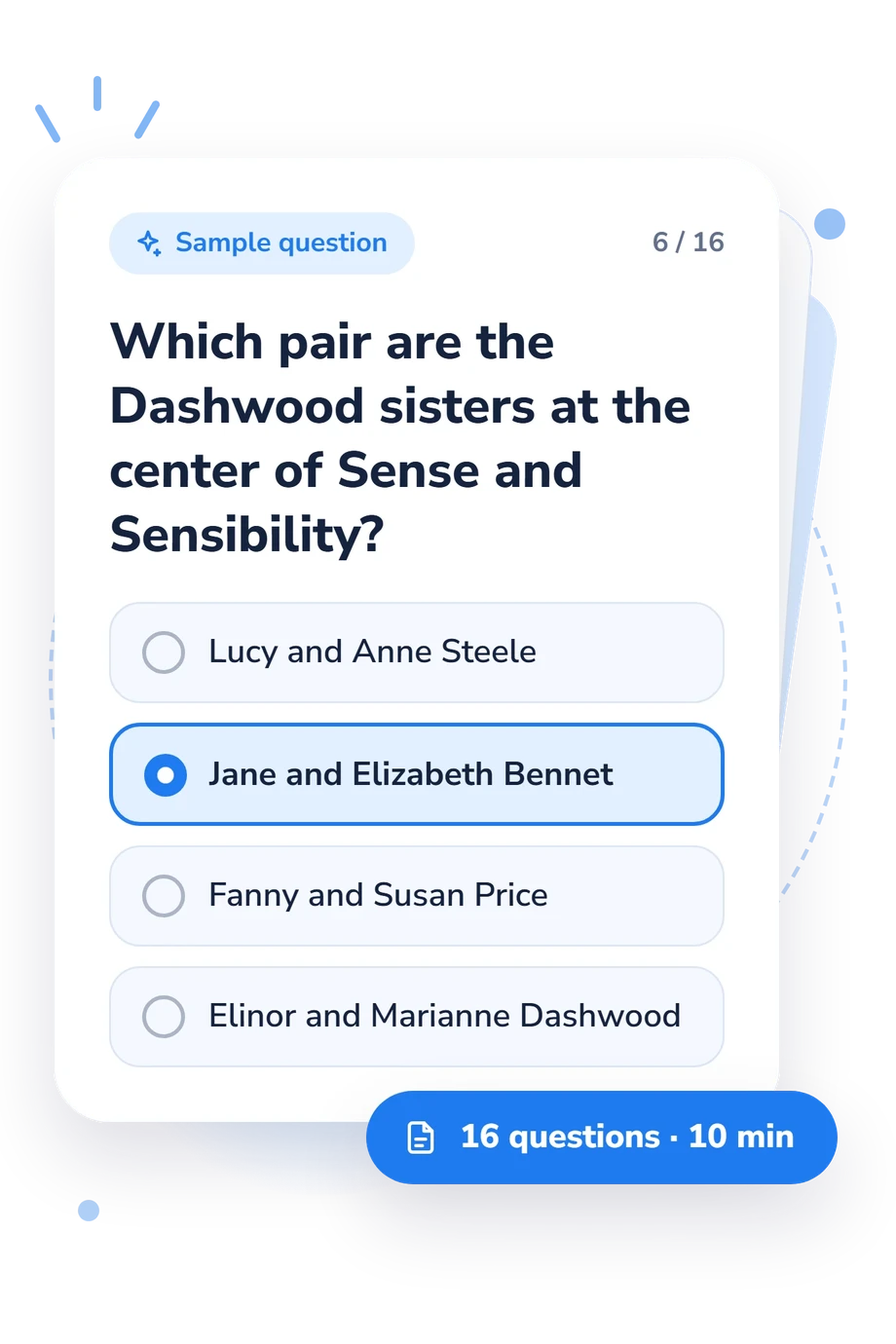
Example Questions From the Test
- Captain Wentworth
- Mr. Elliot
- Charles Musgrove
- Captain Benwick
- Sophia Grey
- Lucy Steele
- Fanny Dashwood
- Nancy Steele
- Captain Benwick
- William Walter Elliot
- Charles Musgrove
- Captain Wentworth
Jane Austen Characters Quiz - Description and methodology of the test
Readers who want to revisit Austen without reducing her novels to personality types can use this assessment as a compact exercise in literary recall. The Jane Austen Characters Quiz focuses on remembering who belongs where in the stories, while its result reveals performance on selected recognition items. It is useful for checking whether your Jane Austen character knowledge remains organized across the novels.
What This Assessment Explores
Items test recognition rather than interpretation. They ask you to identify characters through proposals, letters, marriages, family ties, and choices across six novels. The result reflects names and narrative connections, not resemblance to a heroine.
These prompts test Austen character recognition through context.
Recurring item themes include:
- Character identity shows whether you connect a name with a role, family position, or scene.
- Relationships reveal whether you track courtship, kinship, rivalry, and friendship across plots.
- Defining decisions indicate whether you remember choices that change a character’s direction.
- Cross-novel recognition tests whether you distinguish similar names and situations.
These themes are not four subscales: the displayed result is one overall correct-answer score. The displayed scale, Jane Austen Characters Knowledge, runs from 0-16: Opening Chapters 0-6; Accomplished Reader 7-12; Austen Authority 13-16. These bands describe command of characters, relationships, and defining decisions.
Methodology and Evidence Base
Each item presents an event or relationship with four answer choices. The best answer adds to the correct-answer total, so this questionnaire measures literary character recall rather than personality type.
The result measures recognition accuracy and does not assign a fictional character. Read it as performance on selected items: a higher total means more answers matched the character, relationship, or decision keyed by the question; the bands give descriptive context.
Auyoung (2018) offers relevant reading theory. Its account of familiarity with fictional characters emphasizes attention to minds, actions, relationships, and changing circumstances. This questionnaire is conceptually consistent with that account, but is not an adaptation of the study or evidence that its scoring has been validated.
Copeland and McMaster (2011) provide context for courtship, social pressure, and narrative choices. Austen’s 2006 collected novels supply the events represented in the items. These sources support subject matter, not psychometric properties for this online questionnaire.
Interpretation may vary with rereading history, memory, and familiarity with film or television adaptations. Treat the result as a snapshot of performance on these recognition items.
- Auyoung, Elaine. “Enduring Minds in Austen: Becoming Familiar with Fictional Characters.” In When Fiction Feels Real: Representation and the Reading Mind, 38-60. New York: Oxford University Press, 2018. 10.1093/oso/9780190845476.003.0003
- Copeland, Edward, and Juliet McMaster, eds. The Cambridge Companion to Jane Austen. 2nd ed. Cambridge: Cambridge University Press, 2011. 10.1017/CCO9780521763080
- Austen, Jane. The Complete Novels. Introduction by Karen Joy Fowler. New York: Penguin Books, 2006. ISBN: 9780143039501
Updated: