
Am I Stoic Quiz
How the Scales are Structured
Who Usually Takes This Test?
See How You Compare
Below is a preview of how scores are typically distributed across each scale.
Example Questions From the Test
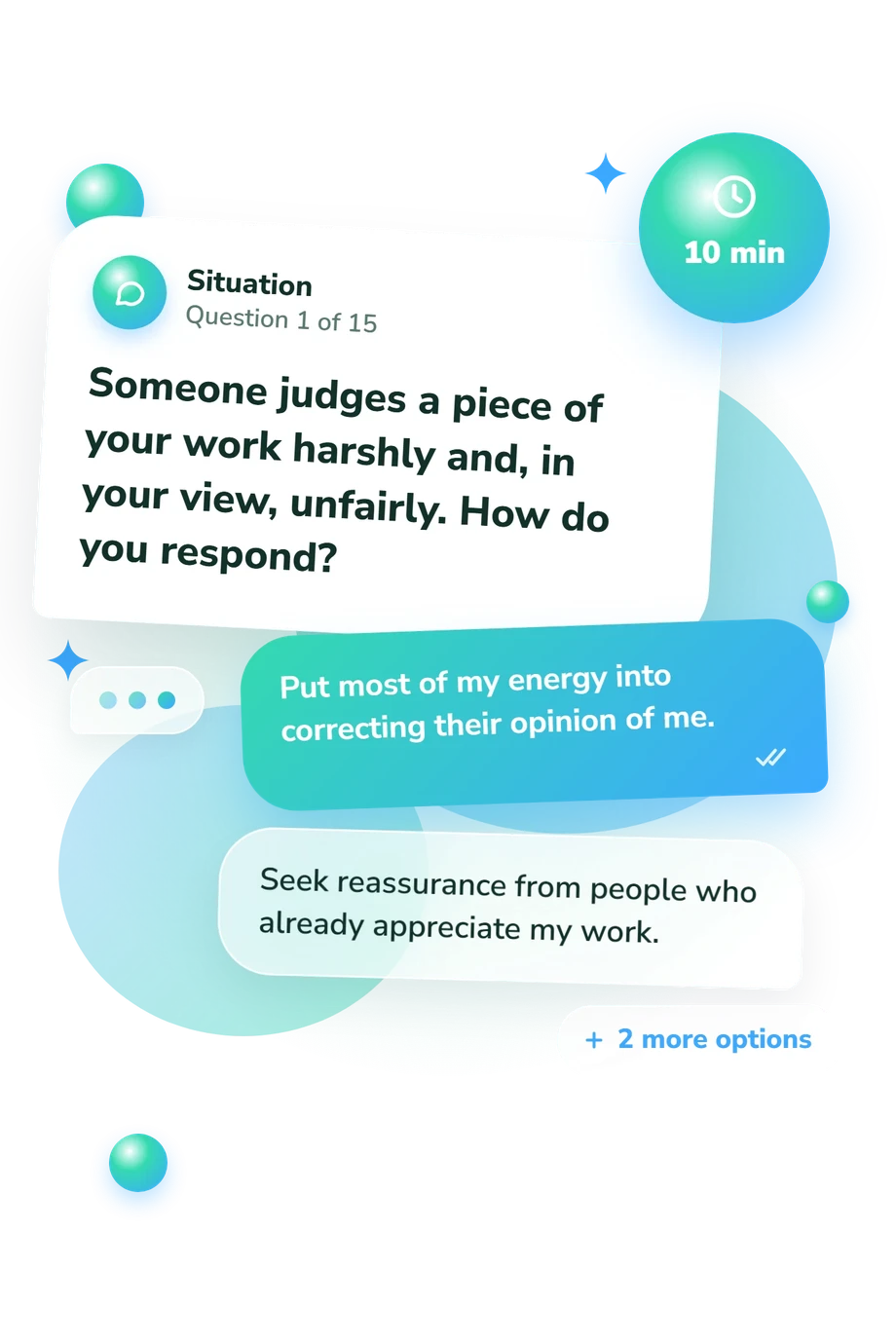
- Put most of my energy into correcting their opinion of me.
- Seek reassurance from people who already appreciate my work.
- Defend the most important points, then consider whether any criticism is useful.
- Separate useful feedback from their personal judgment and improve only what is mine to improve.
- I am less inclined to do it because visible effort opens future opportunities.
- I may contribute, but recognition would make the effort feel more worthwhile.
- I contribute if the benefit is clear, although I still prefer some acknowledgment.
- It changes little; the value of the action matters more than receiving credit.
- Keep trying different ways to improve their mood because distance feels unresolved.
- Give them space and wait for them to decide what happens next.
- Offer support, then check in again later if the silence continues.
- Make my availability clear while accepting that I cannot control when or whether they open up.
Am I Stoic Quiz - Description and methodology of the test
People who want to examine everyday choices through a Stoic lens can use the Am I Stoic Quiz as a structured way to consider difficult situations. It suits readers asking where they can direct effort, how they want to respond under pressure, and which commitments matter when outcomes remain uncertain. A Stoicism-focused quiz keeps those questions centered on influence and chosen action.
What This Assessment Explores
Taken together, these questions make this a how stoic are you quiz about everyday tendencies, not a verdict on moral worth or identity:
- Control and Agency (0-15) distinguishes choices from uncontrollable outcomes: Externals-focused (0-5) centers results, reactions, or past events; Selective agency (6-10) redirects effort toward action, though externals still pull; Control-conscious (11-15) accepts external limits and acts within influence.
- Emotional Judgment (0-15) measures examining emotions and first impressions before acting, not suppressing them: Immediate processing (0-5) follows feelings or initial interpretations; Situational steadiness (6-10) pauses sometimes; Deliberate composure (11-15) acknowledges feelings, tests interpretations, and chooses proportionately.
- Virtue-Guided Action (0-15) reflects character, fairness, courage, and self-restraint when comfort or recognition compete: Context-led priorities (0-5) favor convenience, belonging, or visible outcomes; Mixed alignment (6-10) makes pragmatic tradeoffs under pressure; Principle-centered (11-15) values action over applause, ease, or guaranteed results; bands state preferences, not moral worth or definitive Stoic identity.
Methodology and Scientific Basis
The response format turns principles into ordinary decisions. In practice, this stoic quiz presents everyday situations with four response options. Choices generally range from immediate or externally focused reactions to more deliberate responses, with intermediate positions included. Responses are summarized across three dimensions and placed in displayed bands; the range alone does not reveal how many points each option contributes.
The closest reference is the SABS, a published measure that supplies a conceptual parallel for control, emotional judgment, and virtue-oriented action. This questionnaire is conceptually consistent with that instrument, not a reproduction, adaptation, or validated administration of it. The Stoicism Ideology Scale is a related beliefs measure, while Robertson supplies a theoretical lens connecting Stoic practice with cognitive-behavioral attention to appraisals and chosen responses. None of these sources validated this online questionnaire.
Without stated norms or psychometric standardization for this online format, the profile is a structured reflection rather than a population comparison. Current mood, self-awareness, and presentation concerns can shape self-report, so read the result alongside real situations and over time rather than as a diagnosis or fixed identity.
- LeBon, Tim, Gary Brown, Raymond DiGiuseppe, Johannes Karl, Ronald Fischer, and Gregory Lopez. (2026). The Development and Validation of the Stoic Attitudes and Behaviours Scale. Cognitive Therapy and Research, 50(1), 207-228. 10.1007/s10608-025-10635-9
- Pathak, Elizabeth B., Sarah E. Wieten, and Christopher W. Wheldon. (2017). Stoic beliefs and health: development and preliminary validation of the Pathak-Wieten Stoicism Ideology Scale. BMJ Open, 7(11), e015137. 10.1136/bmjopen-2016-015137
- Robertson, Donald. (2018). The Philosophy of Cognitive-Behavioural Therapy (CBT): Stoic Philosophy as Rational and Cognitive Psychotherapy. Routledge. 10.4324/9780429482748
Updated: