
Shifting Method Quiz
How the Scales are Structured
Who Usually Takes This Test?
See How You Compare
Below is a preview of how scores are typically distributed across each scale.
Example Questions From the Test
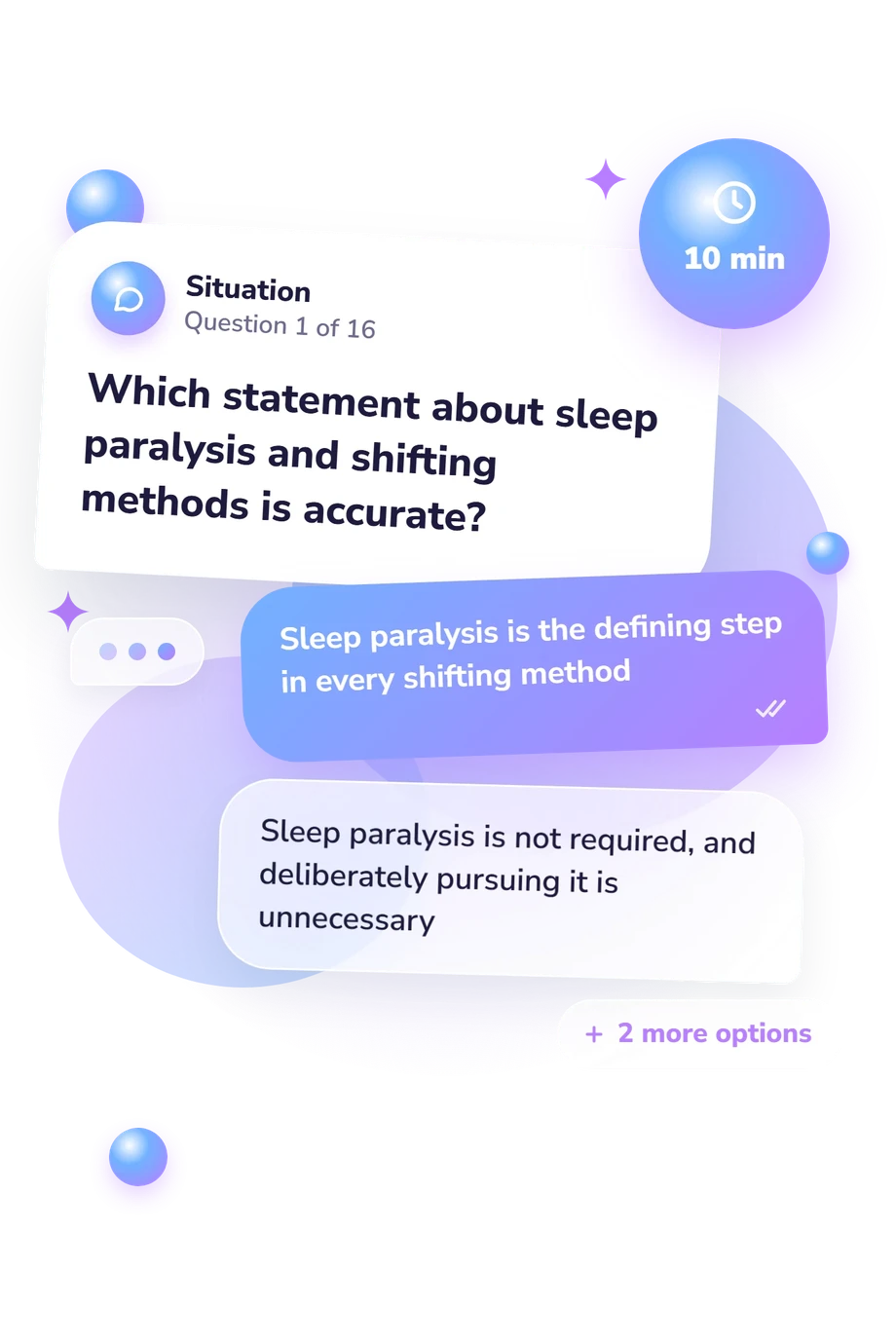
- Sleep paralysis is the defining step in every shifting method
- Sleep paralysis is not required, and deliberately pursuing it is unnecessary
- A person must experience sleep paralysis before using visualization
- Sleep paralysis confirms that literal reality travel has occurred
- Lying comfortably, counting toward 100, and repeating affirmations
- Writing an intention and placing it beneath a pillow
- Imagining a train arriving at a chosen destination
- Following a person through a rabbit hole in a visualization
- Following a guide through a rabbit hole toward another setting
- Riding upward and noticing energy increase at each floor
- Watching numbers appear while floating in darkness
- Reading a script repeatedly until every line is memorized
Shifting Method Quiz - Description and methodology of the test
Readers who want a grounded introduction to common reality-shifting practices can use the shifting method quiz to check their understanding of method labels, typical routines, and evidence limits. It helps answer the question of what shifting method should I use by comparing how techniques are described, what they actually involve, and where community claims exceed current evidence. The aim is clearer, safer self-reflection-not a promise of literal travel.
What This Assessment Explores
The questionnaire tests knowledge rather than sensations or a particular experience. It asks readers to distinguish named routines, match scenarios with common descriptions, and spot when posture, tingling, counting, scripting, or visualization are overinterpreted. It also covers sleep, comfort, grounding, and claims about movement to another reality. This suits curious readers and beginners comparing reality shifting methods.
The result uses the Shifting Method Knowledge scale (0-16), with these bands:
- Foundation (0-6) indicates partial knowledge and a need to review methods, community claims, and responsible practice.
- Developing (7-12) indicates solid familiarity with common methods, with some comparisons to strengthen.
- Strong (13-16) indicates broad, careful knowledge of methods, adaptations, evidence limits, and grounding, without proving literal travel or shifting ability.
Methodology and Evidence Base
The approach is an educational, scenario-based knowledge assessment: each item offers four answer choices about a method, comparison, sensation, or safety decision. Responses produce one educational result; the displayed format does not specify a point value for each choice, so no formula should be inferred. The result is an educational category, not a population norm or diagnostic cutoff.
Its evidence base is conceptual, not a validation study. The questions align with Reality shifting (Somer et al., 2021), which treats the topic as an online culture, and with van Rijn and van Rijn (2024), which examines it as an online spiritual practice. O’Neill et al. (2023) adds psychiatric context for shifting realities. These sources support attention to community language, lived experience, and evidence limits; the quiz is not their validated adaptation.
For someone asking which shifting method works best for me, the result can organize comparisons but cannot establish personal effectiveness. Performance may vary with familiarity with community terminology and attention to wording. Current research does not validate literal reality shifting as established fact; persistent unreality, distress, or disrupted sleep is a reason to pause, ground yourself, and seek support.
- Somer, Eli, Etzel Cardeña, Ramiro Figueiredo Catelan, and Nirit Soffer-Dudek. “Reality shifting: psychological features of an emergent online daydreaming culture.” Current Psychology 42, no. 14 (2023): 11415-11427. 10.1007/s12144-021-02439-3
- van Rijn, Bastiaan, and Sarah van Rijn. “Understanding Reality Shifting as a New Online-based Spiritual Practice.” Correspondences: Journal for the Study of Esotericism 12, no. 2 (2024): 205-253.
- O’Neill, John F., Bahareh Nakisa, Harris A. Eyre, Ipsit V. Vahia, Stephen M. Schueller, Marina Tolou-Shams, and Robert M. Lundin. “As a new challenger approaches, how will modern psychiatry cope with ’shifting realities’?” Acta Neuropsychiatrica 35, no. 6 (2023): 377-379. 10.1017/neu.2023.31
Updated: