
Is He a Mama's Boy Quiz
How the Scales are Structured
Who Usually Takes This Test?
See How You Compare
Below is a preview of how scores are typically distributed across each scale.
Example Questions From the Test
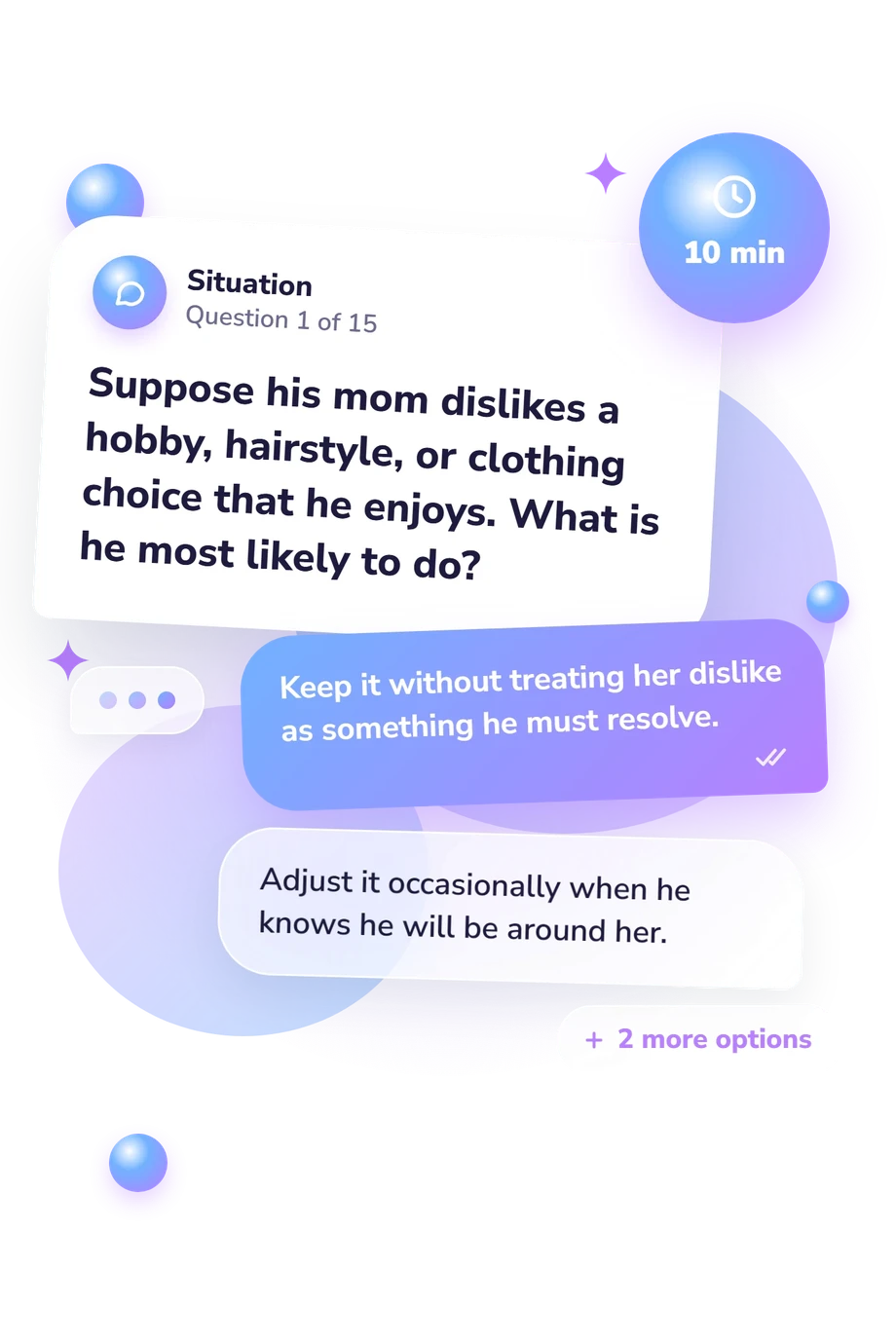
- Keep it without treating her dislike as something he must resolve.
- Adjust it occasionally when he knows he will be around her.
- Change it substantially because her disapproval weighs on him.
- Give it up because going against her preference feels unacceptable.
- It rarely changes the choice unless she provides important new information.
- It can lead to a modest compromise while the main decision remains intact.
- It often makes him scale back or substantially revise what he chose.
- It usually makes him abandon the choice and adopt what she wants.
- He works toward a plan that considers the couple's goals and all relevant relationships.
- He tends to offer his mom the preferred time but remains willing to negotiate.
- He expects most plans to center on his mom and asks others to fit around them.
- He treats his mom's preferred plan as final, regardless of commitments to you.
Is He a Mama's Boy Quiz - Description and methodology of the test
People who feel a partner’s family may shape private decisions can use the Is He a Mama's Boy Quiz to examine recurring patterns rather than rely on one upsetting incident. Partners asking whether their boyfriend is a mama's boy can use a situation-based profile; Is My Boyfriend a Mama's Boy Quiz focuses that concern on decision-making, privacy, and shared commitments. The result can give couples topics for calm discussion.
What This Assessment Explores
Questions focus on situations where maternal advice, requests, reactions, or access compete with couple plans. They ask about choices, holidays, visits, calls, favors, criticism, disclosures, home access, and nonurgent requests, so the result reflects perceived or anticipated patterns in respondent answers. The mama's boy quiz covers access, privacy, and couple time, helping partners discuss whether family involvement leaves room for joint decisions.
The result separates three dimensions:
- Decision Autonomy (0-15) shows how much his mother’s approval or direction shapes his choices: Self-directed (0-5), Noticeable influence (6-10), or Strong dependence (11-15).
- Mother-Couple Boundaries (0-15) indicates how much access she has to couple time, private space, or conflict: Clear boundaries (0-5), Permeable boundaries (6-10), or Highly open boundaries (11-15).
- Partnership Balance (0-15) reflects whether nonurgent maternal wishes displace couple commitments: Room for both (0-5), Recurring imbalance (6-10), or Partnership frequently secondary (11-15).
Methodology and Scientific Basis
Each item presents a defined scenario with four response options about his likely behavior. The choices move from independent action through negotiation to substantial accommodation, so the profile shows degrees of influence rather than assigning a simple label. The questionnaire displays three 0-15 scales but does not document how individual responses become points, and it has no standardization, population norms, reliability estimates, or diagnostic cutoffs.
Drummond (2016) treats the mama's-boy pattern as an identity negotiated in mother-son relationships, offering context. Items in this mama's boy relationship test overlap with Hann-Morrison’s (2012) themes, while its dimensions remain the three displayed scales. Minuchin’s family-systems model explains boundary effects, while Wu et al. (2010) connects conflict with mothers-in-law to marital satisfaction and husband support. These sources contextualize the questionnaire: it is conceptually consistent with them, not an adaptation of their instruments.
This questionnaire is a reflective self-report tool. Scores may shift with current conflict, family culture, caregiving, finances, or respondent perspective, so concrete examples and calm discussion help interpret the profile.
- Drummond, Darlene K. (2016). Mama's Boy: One Type of Identity Negotiated in Mother-Son Relationships. The Florida Communication Journal, 44(1), 25-32.
- Hann-Morrison, Dee. (2012). Maternal Enmeshment: The Chosen Child. SAGE Open, 2(4), 2158244012470115. 10.1177/2158244012470115
- Wu, Tsui-Feng, Kuang-Hui Yeh, Susan E. Cross, Lisa M. Larson, Yi-Chao Wang, and Yi-Lin Tsai. (2010). Conflict With Mothers-in-Law and Taiwanese Women's Marital Satisfaction: The Moderating Role of Husband Support. The Counseling Psychologist, 38(4), 497-522. 10.1177/0011000009353071
- Minuchin, Salvador. (1974). Families and Family Therapy. Harvard University Press.
Updated: