
Fairy Tale Character Quiz
How the Scales are Structured
Who Usually Takes This Test?
See How You Compare
Below is a preview of how scores are typically distributed across each scale.
Example Questions From the Test
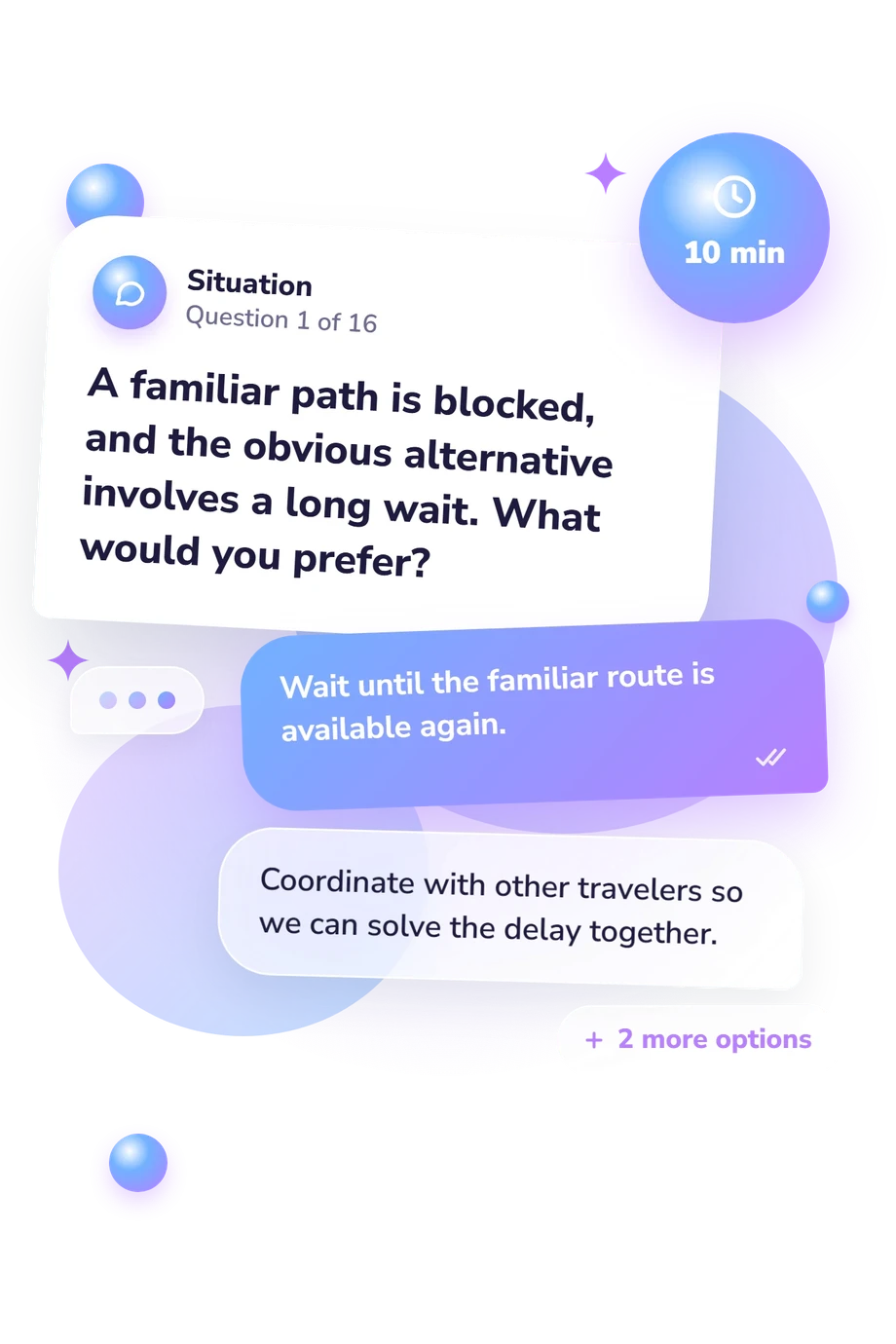
- Wait until the familiar route is available again.
- Coordinate with other travelers so we can solve the delay together.
- Study the surroundings and prepare before choosing another route.
- Climb, improvise, or invent an unconventional way forward.
- Finish several useful tasks by taking the most efficient route.
- Bring something thoughtful to a loved one and enjoy an interesting route there.
- Accept a spontaneous challenge without deciding where the day must end.
- Invite several people over and let the gathering become the day's focus.
- A familiar favorite that lets me focus on the company.
- The dish recommended by someone whose taste I trust.
- The boldest item on the menu, even if it is a gamble.
- A tasting selection that lets me compare flavors and textures.
Fairy Tale Character Quiz - Description and methodology of the test
People who enjoy using familiar stories to reflect on their own choices may find this assessment useful. As a story-based character-affinity quiz for self-reflection, it suits readers curious about responses to change, uncertainty, recognition, connection, and opportunity. The fairy tale character quiz turns those answer patterns into a narrative profile, showing which character affinities feel recognizable rather than describing personality as a whole.
What This Assessment Explores
These affinities connect familiar story roles with preferences for coping, choosing, connection, and change. The Which Fairytale Character Are You Quiz shows which affinity fits your choices across four dimensions; the strongest affinity reveals your most visible response style:
- Cinderella - Quiet Resilience (0-12) measures patient hope and values through change: Different Path (0-4), Shared Grace (5-8), Strong Cinderella Affinity (9-12).
- Goldilocks - Hands-On Discernment (0-12) measures firsthand comparison and sensory fit: Broad Fit (0-4), Selective Explorer (5-8), Strong Goldilocks Affinity (9-12).
- Jack - Bold Improvisation (0-12) measures resourceful leaps toward uncertainty: Steadier Ground (0-4), Adventurous Streak (5-8), Strong Jack Affinity (9-12).
- Little Red Riding Hood - Purposeful Curiosity (0-12) measures mission, detail, and openness: Different Route (0-4), Shared Journey (5-8), Strong Affinity (9-12).
The highest score is the strongest affinity; any score within one point joins it, allowing a blended result.
Methodology and Evidence Base
Items present situations within the What Fairy Tale Are You Quiz, with four options. Choices distinguish preserving a plan, coordinating with others, testing what fits, or taking an inventive risk. Responses are compared across the four dimensions; the result uses relative affinity, not a pass-fail score.
Narrative identification (Huang & Fung, 2024) supplies the closest framework: it describes identification as a person’s relationship with a narrative character and the sense of seeing personal qualities in that figure. Cohen (2001) offers a broader theory of audience-character identification, while Tatar’s collection provides the classic fairy-tale context. This questionnaire is conceptually consistent with these works, not a direct adaptation of their measures.
The result helps readers reflect on which fairy-tale character resonates with their choices. The highest relative score indicates the character affinity most visible across the selected responses, while a score within one point of it creates a blended result. Self-report can shift with mood, circumstances, memory, self-awareness, or the wish to choose an appealing answer, so the profile is most useful when considered alongside the situations that prompted each choice.
- Huang, Kate Y., and Helene H. Fung. “Measuring identification with narrative characters: the development and validation of a new scale.” Current Psychology 43 (2024): 24835-24849. 10.1007/s12144-024-06191-2
- Cohen, Jonathan. “Defining Identification: A Theoretical Look at the Identification of Audiences With Media Characters.” Mass Communication and Society 4, no. 3 (2001): 245-264. 10.1207/S15327825MCS0403_01
- Tatar, Maria, editor. The Annotated Classic Fairy Tales. New York: W. W. Norton & Company, 2002.
Updated: