
Am I Good at Basketball Quiz
How the Scales are Structured
Who Usually Takes This Test?
See How You Compare
Below is a preview of how scores are typically distributed across each scale.
Example Questions From the Test
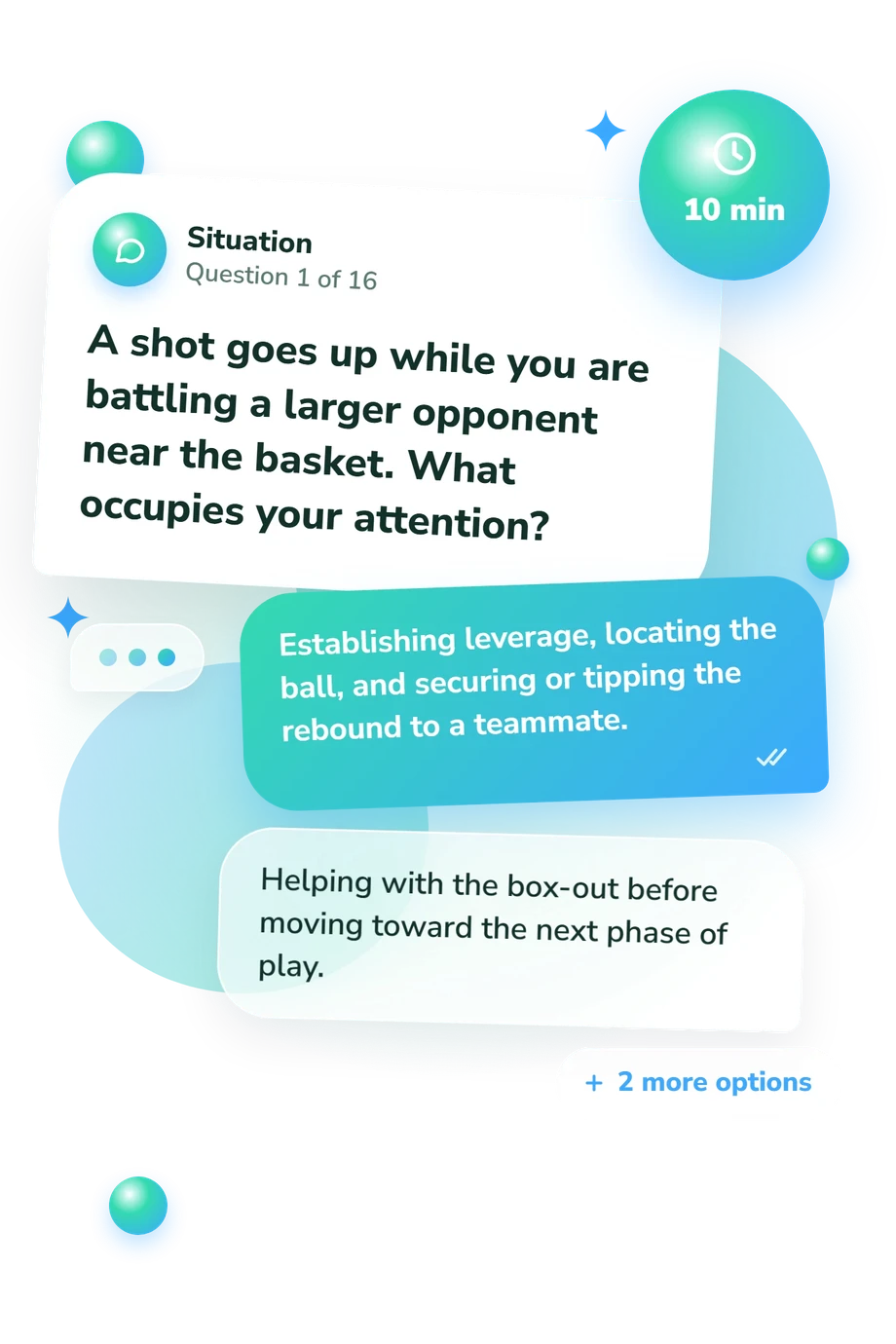
- Establishing leverage, locating the ball, and securing or tipping the rebound to a teammate.
- Helping with the box-out before moving toward the next phase of play.
- Reading whether I should rebound directly or seal space so someone else can collect it.
- Starting toward the perimeter in case the rebound launches a fast break.
- I keep creating, but change the setup or counter rather than repeating the same attempt.
- I shift toward cutting, screening, or defense until easier chances appear.
- I still want the ball and trust myself to solve the matchup with another approach.
- I choose my next isolation carefully and otherwise let the offense flow through others.
- Drawing attention with a short drive before moving the ball to an open teammate.
- Testing the defender’s balance, then choosing a pull-up, drive, or counter based on the reaction.
- Relocating so a teammate can exploit a different mismatch.
- Using space, rhythm, and several possible counters to create my own scoring window.
Am I Good at Basketball Quiz - Description and methodology of the test
Players who want to understand their basketball instincts, rather than receive a single verdict about ability, can use the Am I Good at Basketball Quiz to identify the roles they naturally notice and prefer. It suits recreational players, developing athletes, and anyone discussing fit with teammates or coaches. For someone asking how good are you at basketball quiz, this profile offers a useful role description rather than a simple grade.
What This Assessment Explores
It explores basketball style: how a player organizes possessions, works near the basket, creates offense, and changes assignments. Scenarios cover rebounds, transitions, mismatches, off-ball choices, and defensive rotations. The result describes tendencies, not height, athleticism, shooting percentage, or effectiveness.
These displayed dimensions describe the result:
- Floor General (0-12) measures directing tempo and creating for others: 0-4 Independent Operator; 5-8 Situational Organizer; 9-12 Court Conductor.
- Interior Anchor (0-12) measures paint protection, rebounding, screening, and positioning: 0-4 Perimeter-Oriented Role; 5-8 Situational Anchor; 9-12 Paint Foundation.
- Shot Creator (0-12) measures self-created offense through timing and improvisation: 0-4 Supporting Scorer; 5-8 Selective Creator; 9-12 Offensive Inventor.
- Two-Way Wing (0-12) measures adaptable defense, off-ball offense, transition, and switching: 0-4 Specialized Contributor; 5-8 Flexible Connector; 9-12 Versatile Two-Way Presence.
This basketball role quiz is most useful when its profile is compared with real possessions and lineup needs.
Methodology and Evidence Base
Each item presents a game situation with four response choices. The options emphasize different priorities-directing teammates, protecting the interior, creating a shot, or covering several tasks-while the questionnaire displays four separate scores and named bands. The contribution of each response is not specified.
The questionnaire’s role categories are conceptually consistent with the 2017 study by Bianchi and colleagues, which treats basketball positions as multidimensional roles. Its emphasis on versatility also aligns with Rangel and colleagues’ 2019 work on tactical-role diversity and with Coma-Ribes and colleagues’ 2026 review of individual playing roles. Those relationships describe conceptual consistency, not a direct adaptation, validation, or reproduction of any one instrument.
Interpret scores within your own profile: a higher band means stronger affinity for that style, not superior ability. Because it functions as a basketball playing style test, the result can support reflection on choices that shift with teammates, coaching, fatigue, and context. The questionnaire provides style bands without normative benchmarks, and self-report remains sensitive to memory, self-awareness, and current context.
- Bianchi, Federico, Tullio Facchinetti, and Paola Zuccolotto. "Role revolution: Towards a new meaning of positions in basketball." Electronic Journal of Applied Statistical Analysis, 10(3), 712-734 (2017). 10.1285/i20705948v10n3p712
- Coma-Ribes, Marc, Albert Altarriba-Bartés, Daniele Conte, Sergio José-Ibáñez, and Julio Calleja-González. "Identifying individual playing roles in professional and semi-professional male and female basketball players. A systematic review." Retos, 77, 199-219 (2026). 10.47197/retos.v77.117617
- Rangel, Wellington, Carlos Ugrinowitsch, and Leonardo Lamas. "Basketball players' versatility: Assessing the diversity of tactical roles." International Journal of Sports Science & Coaching, 14(4), 552-561 (2019). 10.1177/1747954119859683
Updated: