
Bones Personality Quiz
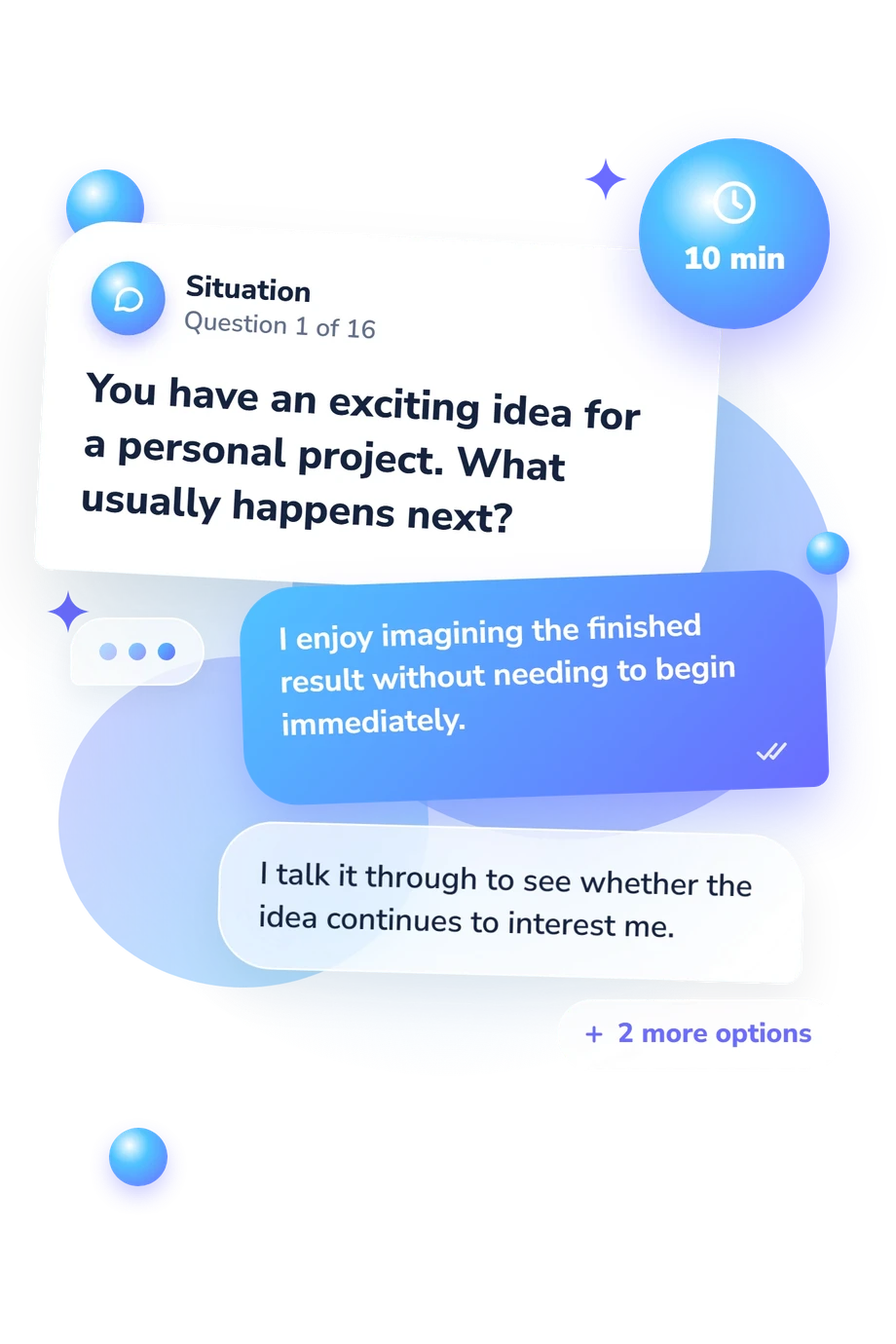
How the Scales are Structured
Who Usually Takes This Test?
See How You Compare
Below is a preview of how scores are typically distributed across each scale.
Example Questions From the Test
- I accept the uncertainty and focus on how the ending felt.
- I compare my reaction with what other people thought.
- I revisit a few clues and settle on a likely explanation.
- I build several theories and test each one against the details.
- Freedom to come and go without many expectations.
- Familiar routines and objects that make daily life comfortable.
- A welcoming atmosphere where people can relax together.
- A strong sense that everyone there is known, held, and cared for.
- Give them room and assume they will engage when they want to.
- Include them naturally in the next group conversation.
- Check in briefly and let them choose whether to talk.
- Find a calmer moment to offer focused company and support.
Bones Personality Quiz - Description and methodology of the test
People who enjoy personality frameworks can use this assessment to reflect on how they approach ideas, relationships, uncertainty, and commitments. It works well as a bones character quiz for readers who prefer a playful profile with several dimensions instead of one fixed label. The bonejr personality quiz compares four affinities and shows which combination most strongly describes a person’s everyday style.
What This Assessment Explores
Rather than reducing personality to one type, the questionnaire maps four complementary affinities. The result creates a Bones personality profile focused on preferences rather than fixed identity.
The dimensions cover practical action, emotional presence, reflective thinking, and resolve. They show how someone learns, supports others, handles uncertainty, and persists.
The four result dimensions are:
- Hand (0-12) shows affinity for making and learning by doing; Conceptual Observer 0-4, Practical Explorer 5-8, Resourceful Maker 9-12.
- Rib Cage (0-12) reflects emotional attentiveness and protective support; Spacious Companion 0-4, Responsive Supporter 5-8, Protective Heart 9-12.
- Skull (0-12) reflects curiosity, analysis, and pattern-finding; Experiential Thinker 0-4, Curious Interpreter 5-8, Deep Pattern-Seeker 9-12.
- Spine (0-12) reflects consistency, independence, and staying power; Adaptive Navigator 0-4, Grounded Balancer 5-8, Steadfast Anchor 9-12.
The highest score marks the strongest affinity; scores within one point form a blended result.
Methodology and Scientific Basis
Each item presents an everyday situation with four response options. The choices address learning, belonging, emotional support, uncertainty, practical problem-solving, priorities, and persistence. They describe preferred approaches, not intelligence or fixed ability.
Responses feed four totals, and the highest total marks the strongest affinity; scores within one point can be read as a blended result. The questionnaire does not document how many points each answer contributes, so its ranges should not be reverse-engineered into a scoring rule. As a Bones personality test, it is a self-reflection tool.
Fetterman and Robinson (2013) offer the closest conceptual reference, connecting self-location with personality, emotion, decision-making, and performance. This questionnaire is conceptually consistent with that work, not an adaptation. Kolb supports experiential learning, while Deci and Ryan address autonomy, competence, and relatedness. DeYoung, Quilty, and Peterson connect broad personality domains with narrower aspects.
No normative sample, reliability estimate, or clinical cutoff is established for this questionnaire, so the bands are descriptive. Self-report can shift with mood, self-awareness, and impression management; read the profile as a reflective snapshot rather than a final account of personality.
- Fetterman, A. K., & Robinson, M. D. (2013). Do You Use Your Head or Follow Your Heart? Self-Location Predicts Personality, Emotion, Decision Making, and Performance. Journal of Personality and Social Psychology, 105(2), 316-334. 10.1037/a0033374
- Deci, E. L., & Ryan, R. M. (2000). The "What" and "Why" of Goal Pursuits: Human Needs and the Self-Determination of Behavior. Psychological Inquiry, 11(4), 227-268. 10.1207/S15327965PLI1104_01
- Kolb, D. A. (1984). Experiential Learning: Experience as the Source of Learning and Development. Prentice-Hall.
- DeYoung, C. G., Quilty, L. C., & Peterson, J. B. (2007). Between Facets and Domains: 10 Aspects of the Big Five. Journal of Personality and Social Psychology, 93(5), 880-896. 10.1037/0022-3514.93.5.880
Updated: