
Bible Quiz on the Book of Esther
How the Scales are Structured
Who Usually Takes This Test?
See How You Compare
Below is a preview of how scores are typically distributed across each scale.
Example Questions From the Test
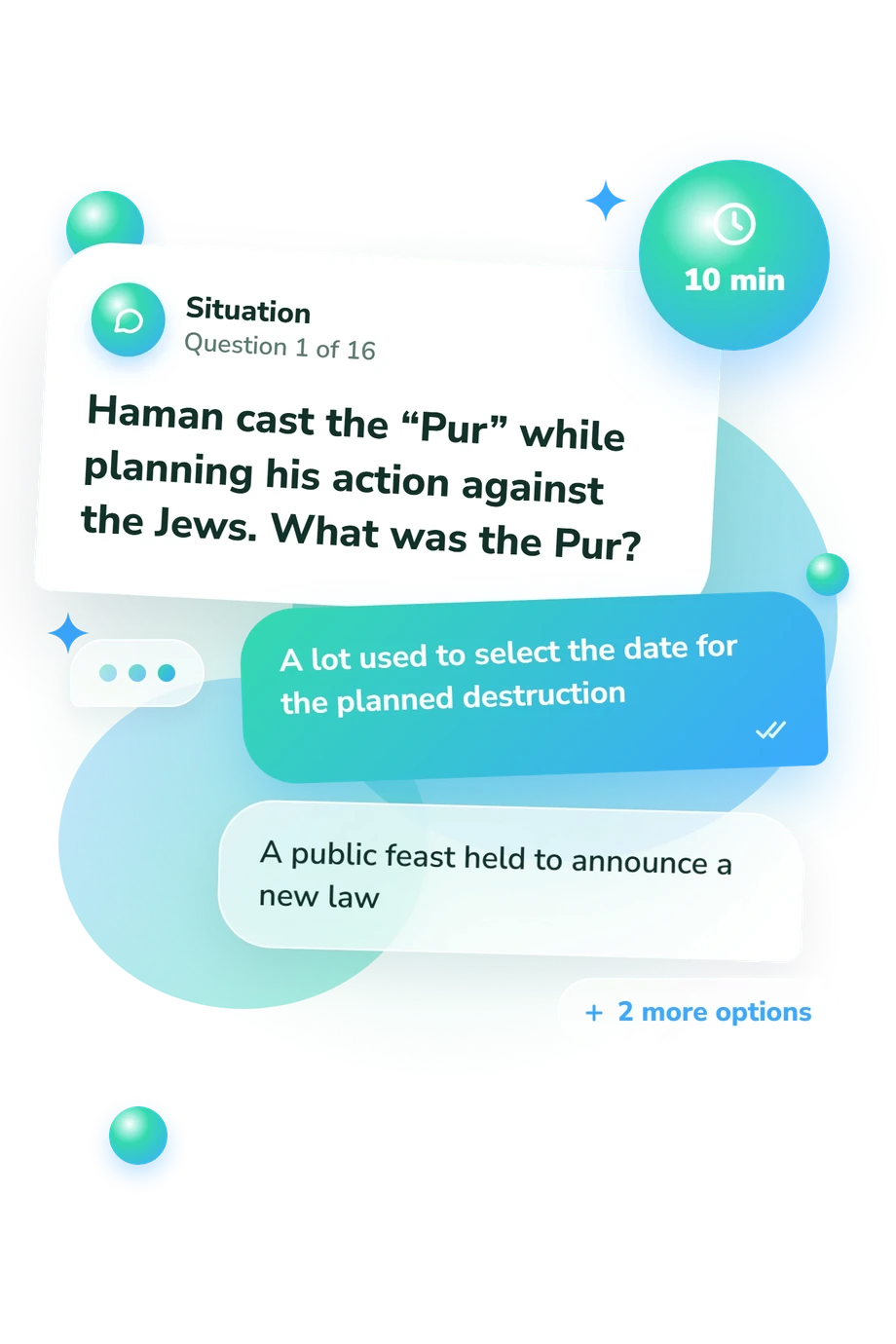
- A lot used to select the date for the planned destruction
- A public feast held to announce a new law
- A royal seal used to authorize an execution
- A golden scepter presented to the king’s chief official
- The king orders Haman’s sons to destroy it publicly.
- It is dismantled and used to build Mordecai a house.
- Haman himself is executed on it.
- Mordecai converts it into a platform for reading the new decree.
- Mordecai refused to surrender his position at the king’s gate.
- Mordecai would not kneel or pay homage to him.
- Mordecai publicly accused him of plotting against the king.
- Mordecai prevented his sons from receiving palace appointments.
Bible Quiz on the Book of Esther - Description and methodology of the test
Readers who want to check their understanding of Esther can use this bible quiz on the book of esther to revisit its people, political turns, and festival practices. This book of Esther quiz suits anyone studying the biblical text or returning to it after time away. The result can help readers choose passages to reread, questions to discuss, or details to investigate next.
What This Assessment Explores
The questionnaire measures knowledge of Esther’s narrative rather than personal belief or theological opinion. Items cover the court setting, the threat against the Jews, Esther, Mordecai, Haman, and Purim. They test sequence, motive, consequence, and details connecting separate scenes.
The result uses one scale: Book of Esther Knowledge (0-16). Foundation to Build (0-6) marks details to review; Developing Knowledge (7-12) shows understanding with gaps; Strong Knowledge (13-16) indicates a well-developed grasp of characters, turning points, and themes.
The questions represent three connected dimensions:
- Story sequence shows how well you connect events.
- Characters and motives show whether you recognize relationships and reversals.
- Law, custom, and setting show how well you remember decrees, Purim, geography, and court procedure.
The result can direct rereading, while Esther quiz questions and answers can serve as prompts for checking the relevant scenes.
Methodology and Evidence Base
Each item presents four answer choices, with one response matching the biblical account. Questions combine direct recall with cause-and-effect reasoning, covering the Pur, the second decree, Haman’s proposed honor, Esther’s danger, and Mordecai’s reversal. The displayed score counts correct answers, so it reflects retained content rather than confidence or theological interpretation.
The questions and answer choices in this Esther quiz can show whether a missed detail is isolated or part of a wider recall gap. This is a structured online knowledge check; its bands classify performance on these 16 items rather than compare it with a reference population.
Screnock and Holmstedt’s Esther handbook supports attention to Hebrew wording and narrative detail. The NRSVue supplies an English rendering, while Berlin’s commentary helps frame structure, character contrasts, and reversals. Kalimi’s study adds context for Jewish identity, power, and later interpretation. These sources make the questionnaire conceptually consistent with the biblical material, not an adaptation of a published instrument.
Results may reflect prior study, translation familiarity, memory, and current focus, so reading or discussion can add context beyond one score.
- Screnock, John, and Robert D. Holmstedt. Esther: A Handbook on the Hebrew Text. Baylor University Press, 2015.
- National Council of the Churches of Christ in the United States of America. New Revised Standard Version Updated Edition. Friendship Press, 2021.
- Berlin, Adele. Esther: The Traditional Hebrew Text with the New JPS Translation. The JPS Bible Commentary. Jewish Publication Society, 2001.
- Kalimi, Isaac. The Book of Esther between Judaism and Christianity: The Biblical Story, Self-Identification, and Antisemitic Interpretation. Cambridge University Press, 2023. 10.1017/9781009266147
Updated: