
Mermaid Tail Color Quiz
How the Scales are Structured
Who Usually Takes This Test?
See How You Compare
Below is a preview of how scores are typically distributed across each scale.
Example Questions From the Test
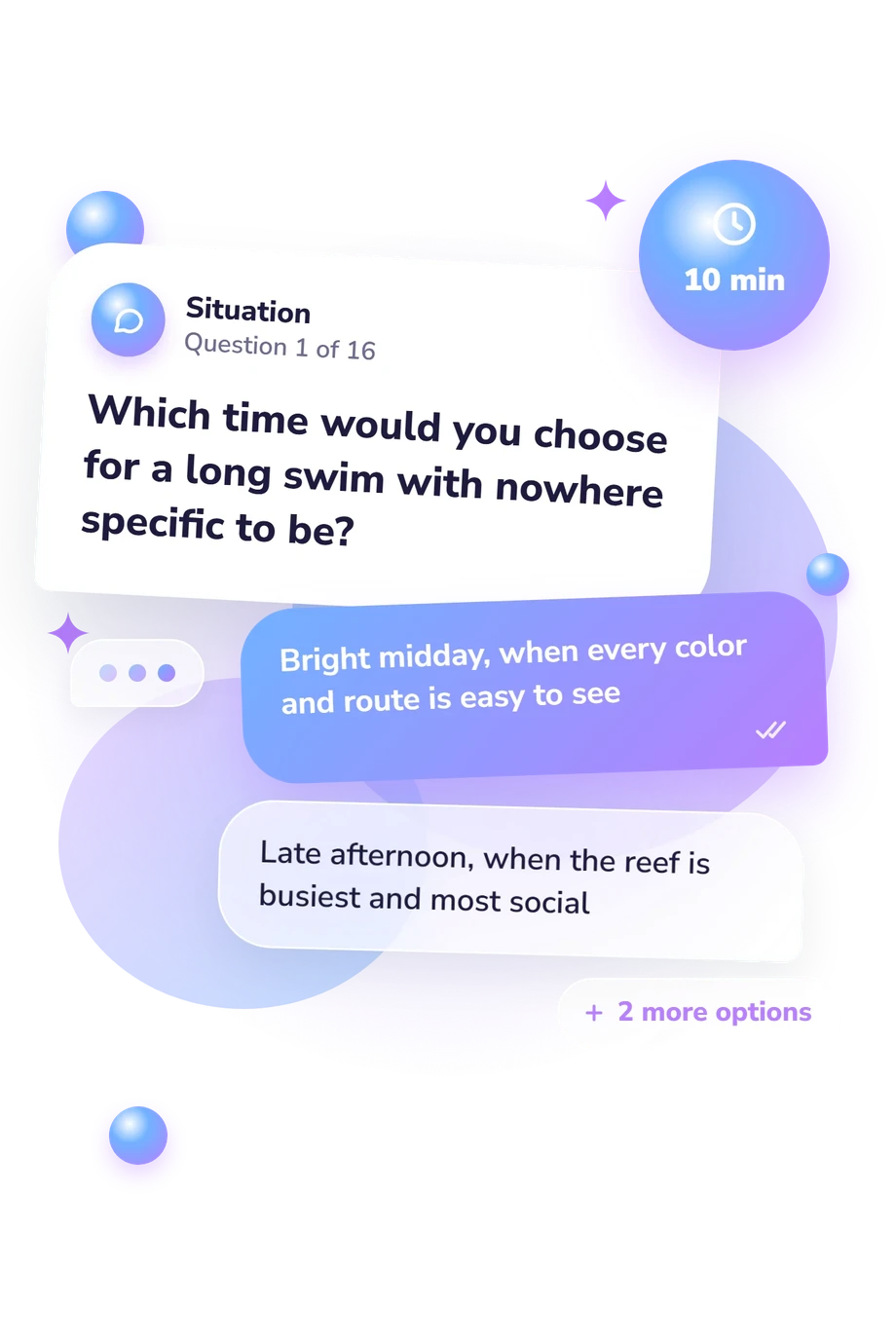
- Bright midday, when every color and route is easy to see
- Late afternoon, when the reef is busiest and most social
- Early morning, when the underwater gardens begin to stir
- Deep night, when moonlight and bioluminescence transform the sea
- The bright channels where sunlight dances through shallow water
- The warm beach where music and conversation carry over the sand
- The dense greenery surrounding a shaded freshwater pool
- The dark sea cave where faint lights shimmer on the walls
- Add bright coral beads connected to memories of friends
- Polish it until it reflects the pale blue of shallow water
- Wrap the handle with fine green seagrass
- Carve a tiny moon-and-stars pattern into its surface
Mermaid Tail Color Quiz - Description and methodology of the test
For readers who enjoy imaginative self-reflection, the mermaid tail color quiz is a light activity for comparing imagined settings, companions, and adventures. It suits someone choosing a symbolic tail color, using a quiz to discover what color my mermaid tail is, or wanting a simple prompt for discussing an underwater style with friends. The scenes keep the exercise playful rather than fixed.
What This Assessment Explores
The questionnaire turns imagined underwater choices into four symbolic color profiles. It covers settings, social encounters, nature, exploration, and mystery as scenario themes rather than separate measures. The scenarios turn it into a quiz about what color your mermaid tail is. The result shows the strongest affinity and allows a blended outcome. These are the displayed dimensions:
- Aquamarine Tail (0-12) reflects freedom, brightness, and playful motion: Quiet Ripple (0-4), Open Current (5-8), or Clear-Water Match (9-12).
- Coral Pink Tail (0-12) reflects warmth, connection, and shared delight: Soft Accent (0-4), Glowing Reef (5-8), or Radiant Coral Match (9-12).
- Emerald Green Tail (0-12) reflects nature-centered steadiness and patient growth: Passing Frond (0-4), Living Lagoon (5-8), or Emerald Guardian Match (9-12).
- Midnight Violet Tail (0-12) reflects mystery, imagination, and reflective solitude: Twilight Trace (0-4), Moonlit Depths (5-8), or Midnight Magic Match (9-12).
Methodology and Scientific Basis
Each item presents an underwater situation with four response options. The choices represent different ways of approaching freedom, connection, nature, or mystery, so you select what feels most natural rather than rating agreement. The questionnaire displays scores for four color scales; its response-to-point allocation is not specified. The highest score indicates the strongest affinity, while scores within one point indicate a blended result.
The mermaid tail color test is conceptually consistent with Ou and colleagues' colour-preference model, which links colour preference with emotional associations. Related work by Ou and colleagues examines emotions attached to single colours, while Palmer and Schloss's ecological valence theory explains preferences through positive or negative associations with objects and experiences. This questionnaire is not presented as an adaptation of those published studies.
This online questionnaire has no stated population norms or standardised scoring. Results can vary with mood, context, culture, and the meaning attached to each scene because they depend on self-report. Use the profile as a focused reflection prompt rather than a clinical assessment.
- Ou, Li-Chen, M. Ronnier Luo, Andrée Woodcock, and Angela Wright. “A Study of Colour Emotion and Colour Preference. Part III: Colour Preference Modeling.” Color Research & Application 29, no. 5 (2004): 381-389. 10.1002/col.20047
- Ou, Li-Chen, M. Ronnier Luo, Andrée Woodcock, and Angela Wright. “A Study of Colour Emotion and Colour Preference. Part I: Colour Emotions for Single Colours.” Color Research & Application 29, no. 3 (2004): 232-240. 10.1002/col.20010
- Palmer, Stephen E., and Karen B. Schloss. “An Ecological Valence Theory of Human Color Preference.” Proceedings of the National Academy of Sciences 107, no. 19 (2010): 8877-8882. 10.1073/pnas.0906172107
Updated: