
Comma and Semicolon Quiz
How the Scales are Structured
Who Usually Takes This Test?
See How You Compare
Below is a preview of how scores are typically distributed across each scale.
Example Questions From the Test
- The emergency supplies included: rope, water, and a flashlight.
- The emergency kit included rope, water, and a flashlight.
- The bag was packed with: water, food, and spare batteries.
- The kit contained items such as: a radio, matches, and a blanket.
- Insert a comma between “you” and “review.”
- Add a comma before the name “Lena.”
- Place a semicolon after “paragraph.”
- Set off “this paragraph” with two commas.
- Use a semicolon after “Austin” and a comma after “Texas.”
- Place a comma after “Austin” and another after “Texas.”
- Add only one comma between “Texas” and “begins.”
- Set off the entire phrase “in Austin Texas” with parentheses.
Comma and Semicolon Quiz - Description and methodology of the test
If you want to decide whether your punctuation choices are secure, this comma and semicolon quiz offers a focused way to examine decisions that affect clarity. The result highlights conventions that feel secure and those that deserve deliberate review before the next draft. It provides a practical check of comma-and-semicolon use, keeping this comma-and-semicolon quiz grounded in actual editing choices.
What This Assessment Measures
Rather than testing terminology alone, the questions ask you to choose the edit that fits a sentence’s grammar and meaning. They cover introductory clauses, direct address, nonrestrictive details, lists, quotations, locations, comma splices, and independent-clause joins. Together, these items make the questionnaire a practical quiz on commas, colons, and semicolons, so the format suits learners and editors checking punctuation knowledge.
The main themes are:
- Introductory material and direct address show where commas mark openings or identify the addressee.
- Colons introduce explanations, quotations, and lists after a complete lead-in.
- Semicolons connect independent clauses or separate complex list units with internal commas.
Results use one scale: Comma and Semicolon Knowledge (0-16). Foundations to Review (0-6) marks basic rules to revisit; Developing Control (7-12) reflects many correct patterns with practice still needed for embedded details, conjunctive adverbs, or complex lists; Strong Command (13-16) indicates accurate use across varied editing situations.
Methodology and Evidence Base
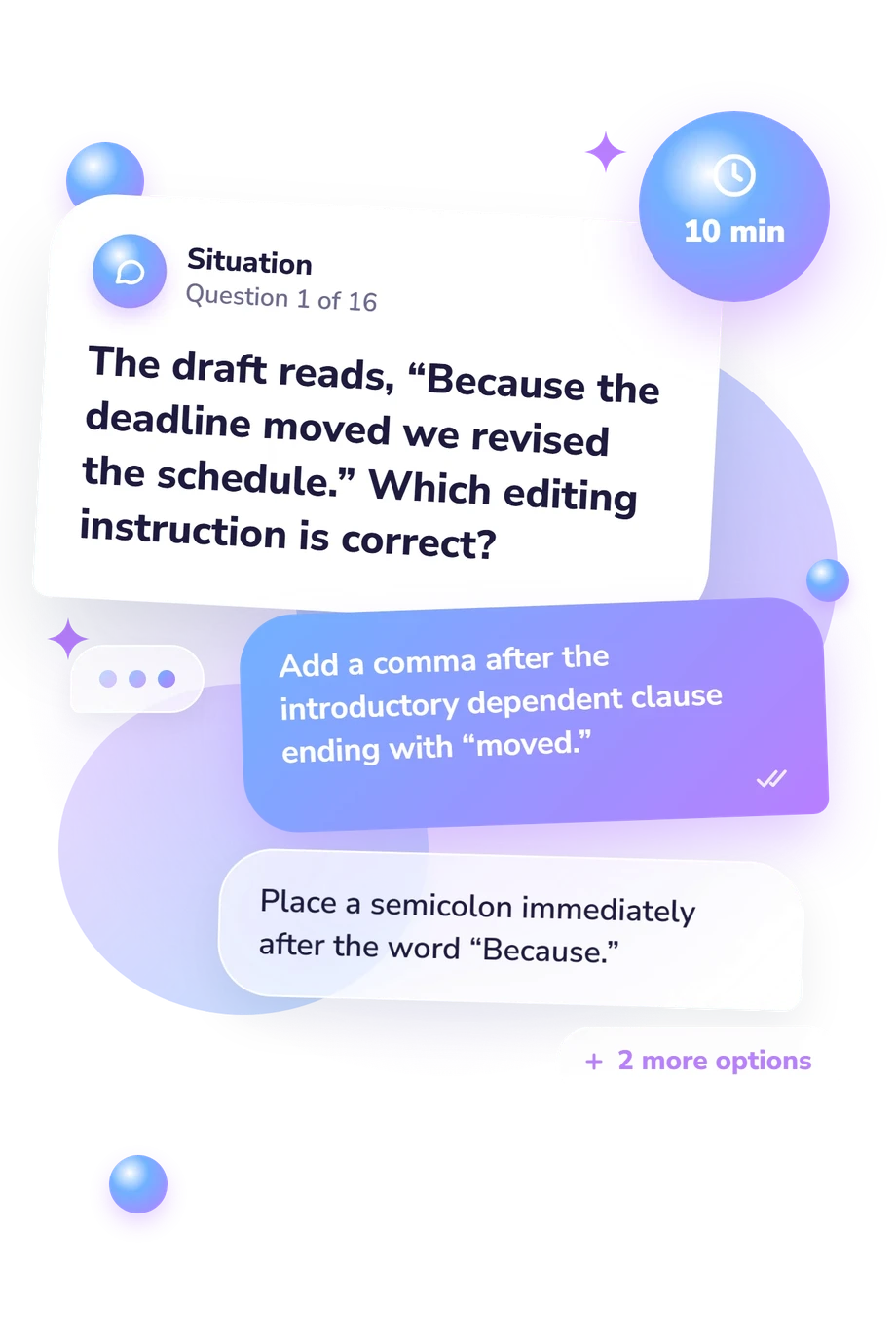
Each item presents a sentence or editing situation followed by four answer choices. You select the option that applies a punctuation convention most precisely; the format makes this a focused punctuation quiz, testing recognition and rule application rather than free-form composition.
The displayed score adds one point for each correct answer, producing a direct total from 0 to 16. It does not infer partial credit or award points for stylistic preference.
The questionnaire is conceptually consistent with the Cambridge Grammar punctuation chapter (Nunberg et al., 2002), which links punctuation to clause structure, information grouping, and meaning. Guidance from Hacker and Sommers (2023) and the 18th-edition Chicago editorial manual (2024) supports the conventional editing patterns represented here.
The quiz is an online instructional questionnaire, not a standardized adaptation, and it has no reported normative sample, reliability estimate, or independent validation data. Its bands therefore work as instructional checkpoints rather than population-based cutoffs. Performance can also vary with prior editing experience and familiarity with house style; the result describes selected punctuation knowledge, not overall writing ability.
- Nunberg, Geoffrey, Ted Briscoe, and Rodney Huddleston. "Punctuation." In The Cambridge Grammar of the English Language, edited by Rodney Huddleston and Geoffrey K. Pullum, pp. 1723-1764. Cambridge University Press, 2002. 10.1017/9781316423530.021
- Hacker, Diana, and Nancy Sommers. The Bedford Handbook. 12th ed. Bedford/St. Martin’s, 2023.
- University of Chicago Press Editorial Staff. The Chicago Manual of Style. 18th ed. University of Chicago Press, 2024. 10.7208/cmos18
Updated: