
Bhagavad Gita Quiz
How the Scales are Structured
Who Usually Takes This Test?
See How You Compare
Below is a preview of how scores are typically distributed across each scale.
Example Questions From the Test
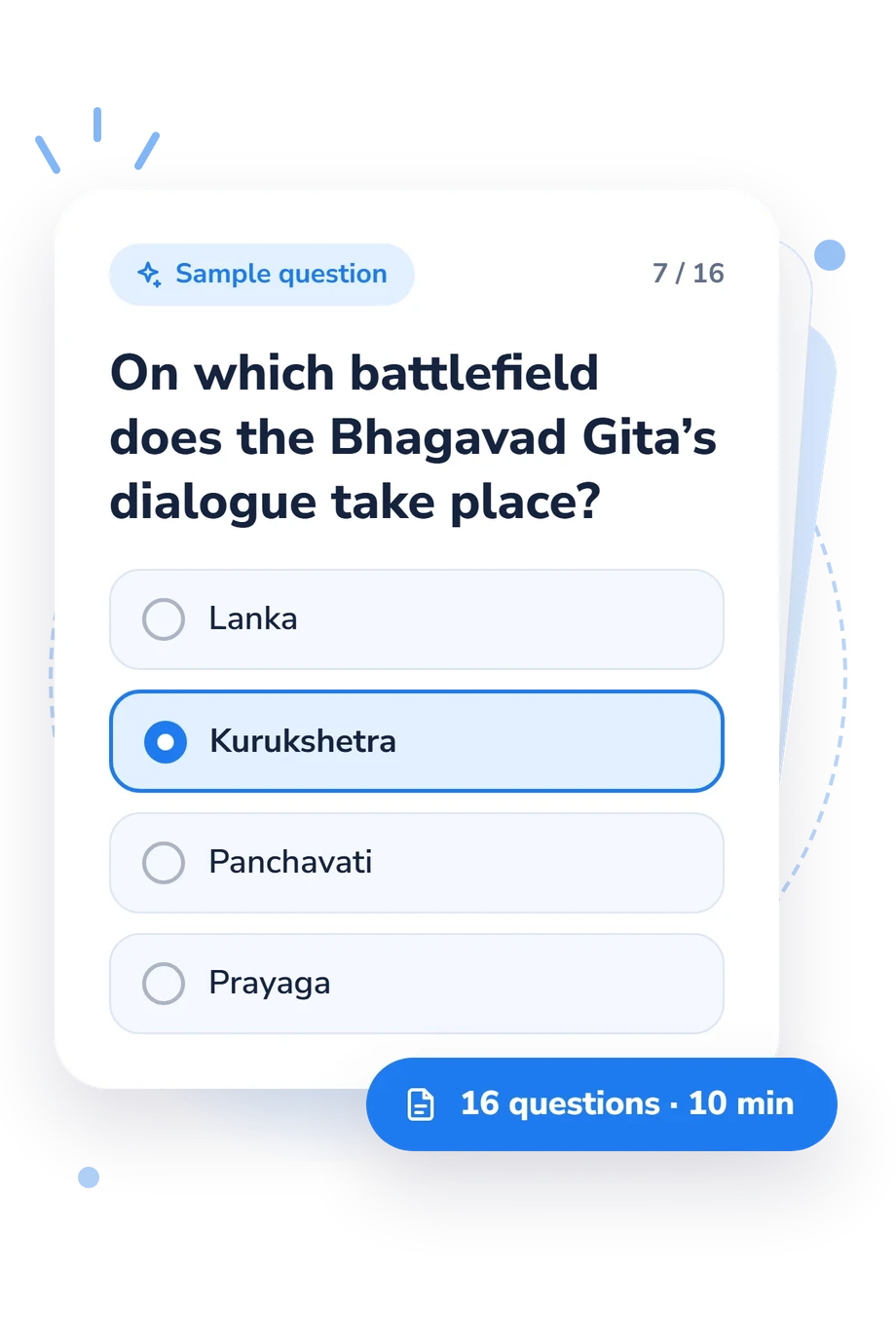
- Lanka
- Kurukshetra
- Panchavati
- Prayaga
- Reflect fully on the teaching and then act as he chooses
- Withdraw immediately, regardless of what he has understood
- Ask another warrior to make the final choice for him
- Obey without reflecting because questioning is forbidden
- Commander of the opposing army
- Arjuna’s charioteer and spiritual guide
- Neutral messenger between both armies
- Priest conducting a victory ritual
Bhagavad Gita Quiz - Description and methodology of the test
Readers who want an active way to check their understanding can use this assessment as a Bhagavad Gita study guide, while the result directs later review. Students, practitioners, and curious readers can use the score to identify areas needing attention. The Bhagavad Gita Quiz is intended as a focused knowledge exercise rather than a measure of belief.
What This Assessment Explores
The questionnaire measures textual knowledge rather than spiritual insight, personal worth, or religious commitment. It suits readers reviewing the dialogue's story, teachings, symbols, and practical applications. As a Bhagavad Gita knowledge test, it combines recall with brief situations asking which principle fits a choice or state of mind.
The main areas represented in the questions are:
- Narrative and setting cover Arjuna's crisis, Krishna's role, Kurukshetra, and the dialogue's structure.
- Teachings and practice examine karma yoga, svadharma, devotion, knowledge, meditation, equanimity, and attachment.
- Symbols and concepts test the gunas, the ashvattha tree, kshetra, and kshetrajna.
- Applied interpretation shows whether a reader connects a Gita principle with a dilemma about duty, action, or inner steadiness.
The displayed scale is Bhagavad Gita Knowledge (0-16): Foundations to revisit (0-6), Developing understanding (7-12), and Strong knowledge (13-16). It describes recognition of the text's content, not spiritual realization.
Methodology and Evidence Base
Every item presents four choices. Some ask for facts such as the battlefield or chapter structure; others describe duty, meditation, equanimity, attachment, or moral conflict and ask which teaching fits. Responses produce one aggregate knowledge result, with bands organizing the total score rather than separate traits.
Methodologically, the questionnaire is an online knowledge exercise using questions and answers about the Bhagavad Gita in a four-option multiple-choice format. It is not presented as an adaptation of a published instrument or as a psychological scale. The response pattern is summarized in one displayed total, with bands organizing that score rather than separate traits.
Easwaran's English translation provides a reference for Bhagavad Gita teachings on action, devotion, meditation, and equanimity. The displayed bands organize the result as a snapshot of current textual knowledge. Results can vary with memory, translation familiarity, attention, current context, and the respondent's interpretation of a keyed answer. They do not measure belief, character, or spiritual development.
- Chauhan, Sakshi, Isha Karn, and Varun Dutt. “Evaluating large language models for philosophical reasoning on ancient Indian texts.” Discover Artificial Intelligence 6 (2026): 611. 10.1007/s44163-026-01278-0
- Chauhan, Sakshi, and Varun Dutt. “Bridging ancient wisdom and cognitive engagement: a comparative study of chatbot-based moral instruction.” Frontiers in Robotics and AI 13 (2026): 1739259. 10.3389/frobt.2026.1739259
- Easwaran, Eknath. The Bhagavad Gita. 2nd ed. Tomales, CA: Nilgiri Press, 2007.
Updated: