
Islamic Quiz in Urdu
How the Scales are Structured
Who Usually Takes This Test?
See How You Compare
Below is a preview of how scores are typically distributed across each scale.
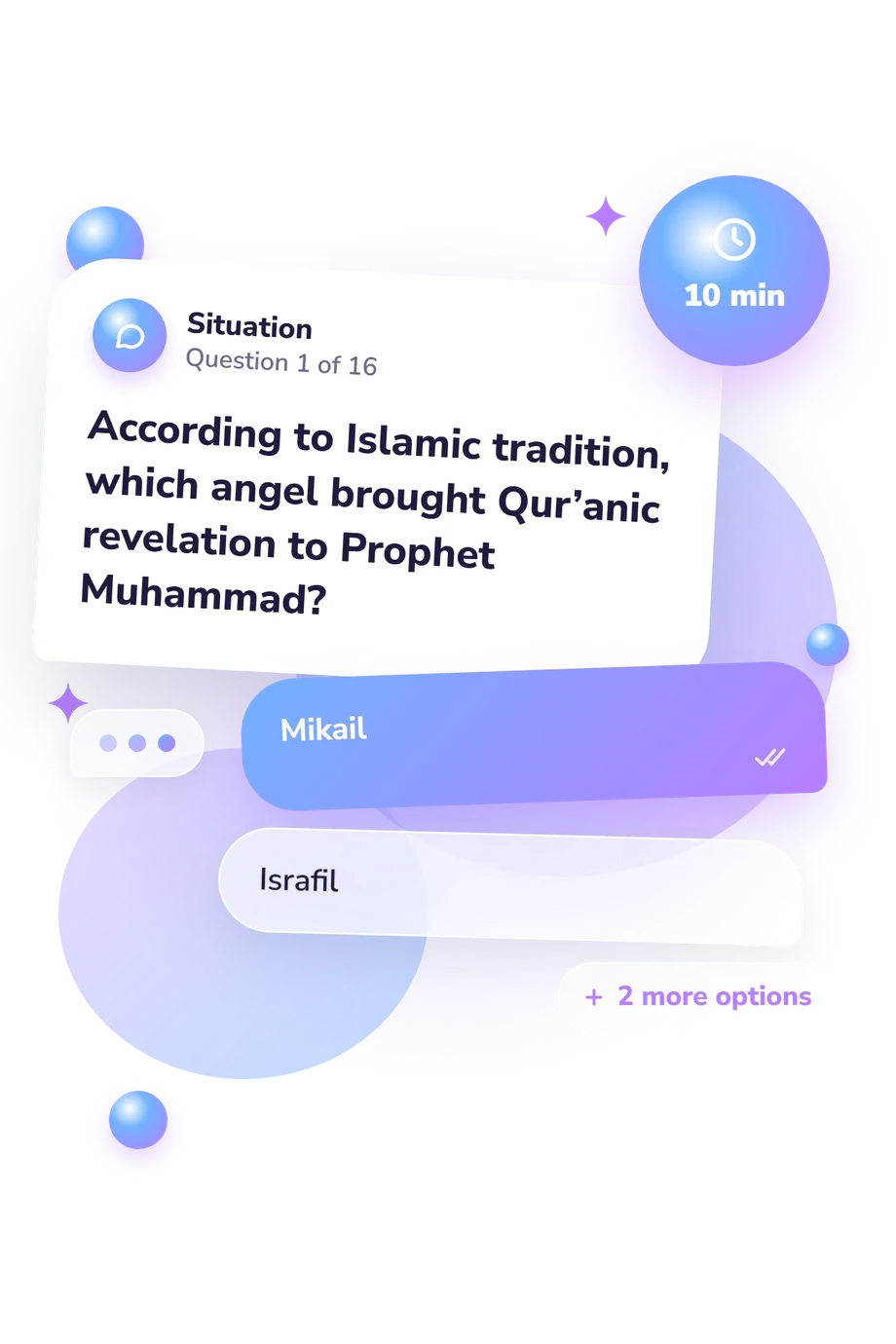
Example Questions From the Test
- Mikail
- Israfil
- Jibril
- Malik
- Al-Fatihah
- Al-Baqarah
- Al-Ikhlas
- An-Nas
- Khatib
- Qari
- Muezzin
- Mufti
Islamic Quiz in Urdu - Description and methodology of the test
Readers who want a focused way to review core Islamic concepts can use the Islamic Quiz in Urdu to check their familiarity with revelation, worship, prophetic tradition, and major religious occasions. It suits learners who are revising foundational material and want to judge whether general review may be useful. Presented as islamic quiz questions and answers in urdu, it gives learners a simple way to judge how much general review may be useful.
What This Assessment Explores
The questions cover foundational knowledge rather than personal religiosity. They address Qur’anic surahs and revelation, prophets, hadith, prayer, purification, the Five Pillars, Ramadan, Hajj, and sacred times. The result therefore reflects recall and basic application of concepts, not the depth of a person’s faith.
For anyone using islamic quiz questions in urdu for study, the result indicates an overall knowledge band and whether general review may be useful.
The result uses one educational scale, Islamic Knowledge (0-16), with three displayed result bands:
- Foundations to Build (0-6) indicates recognition of some key ideas and points toward review of worship, the Five Pillars, and basic Qur’anic terms.
- Developing Knowledge (7-12) indicates understanding of many central concepts, with finer distinctions still available for review.
- Strong Foundation (13-16) indicates broad command of the general knowledge sampled here; it does not measure faith or religious commitment.
Methodology and Scientific Basis
This Islamic knowledge quiz in Urdu uses fixed-choice items: each question presents four alternatives, and the respondent selects the answer that best fits the fact or situation. The topics include definitions, recognition, chronology, and practical application, with examples such as Jibril, wudu, zakah, ihram, hadith, and the prayer beginning at sunset. The result is presented as a total on the displayed scale with three descriptive bands, and no standardised scoring procedure or norm-referenced interpretation is established.
The quiz is conceptually consistent with IslamicMMLU’s broad Islamic-knowledge coverage and draws on content represented in Nasr and colleagues’ work, Sahih Muslim, and DeLong-Bas’s work, while remaining a separate online questionnaire rather than an adaptation or psychometrically validated version of those sources.
Interpret the bands as descriptive study feedback, not population norms or a diagnosis. Performance may vary with recall, prior instruction, language familiarity, and the limited topics sampled. A high result reflects success on these items; a lower result suggests that general review may be useful, but neither measures sincerity, observance, or overall religious understanding.
- Abdelaal, Ali, Mohammed Nader Al Haffar, Mahmoud Fawzi, and Walid Magdy. "IslamicMMLU: A Benchmark for Evaluating LLMs on Islamic Knowledge." arXiv preprint arXiv:2603.23750, 2026.
- Seyyed Hossein Nasr, Caner K. Dagli, Maria Massi Dakake, Joseph E. B. Lumbard, and Mohammed Rustom, eds. The Study Quran: A New Translation and Commentary. New York: HarperOne, 2015.
- Muslim ibn al-Hajjaj al-Qushayri. Sahih Muslim: English Translation of Sahih Muslim. 7 vols. Riyadh: Darussalam, 2007. ISBN 9789960992747.
- DeLong-Bas, Natana J. "The Five Pillars of Islam." Oxford Bibliographies in Islamic Studies. Oxford University Press, 2009. 10.1093/obo/9780195390155-0062.
Updated: