
Freudly+971 508685814hello@freudly.ai
Freudly
identity

What HBCU Should I Go To Quiz
What HBCU Should I Go To Quiz - Free Go To Test - FreudlyTake a free what hbcu should i go to quiz to find out which hbcu you really should have gone to. Quick, no sign-up needed. Start now!en
With 20 questions taking about 10 minutes, the What HBCU Should I Go To Quiz helps you explore which campus environment, academic style, location, and community may fit your preferences. Your result highlights affinities with five HBCUs, giving you a practical starting point for comparison and self-reflection.
Questions: 2010 minutes
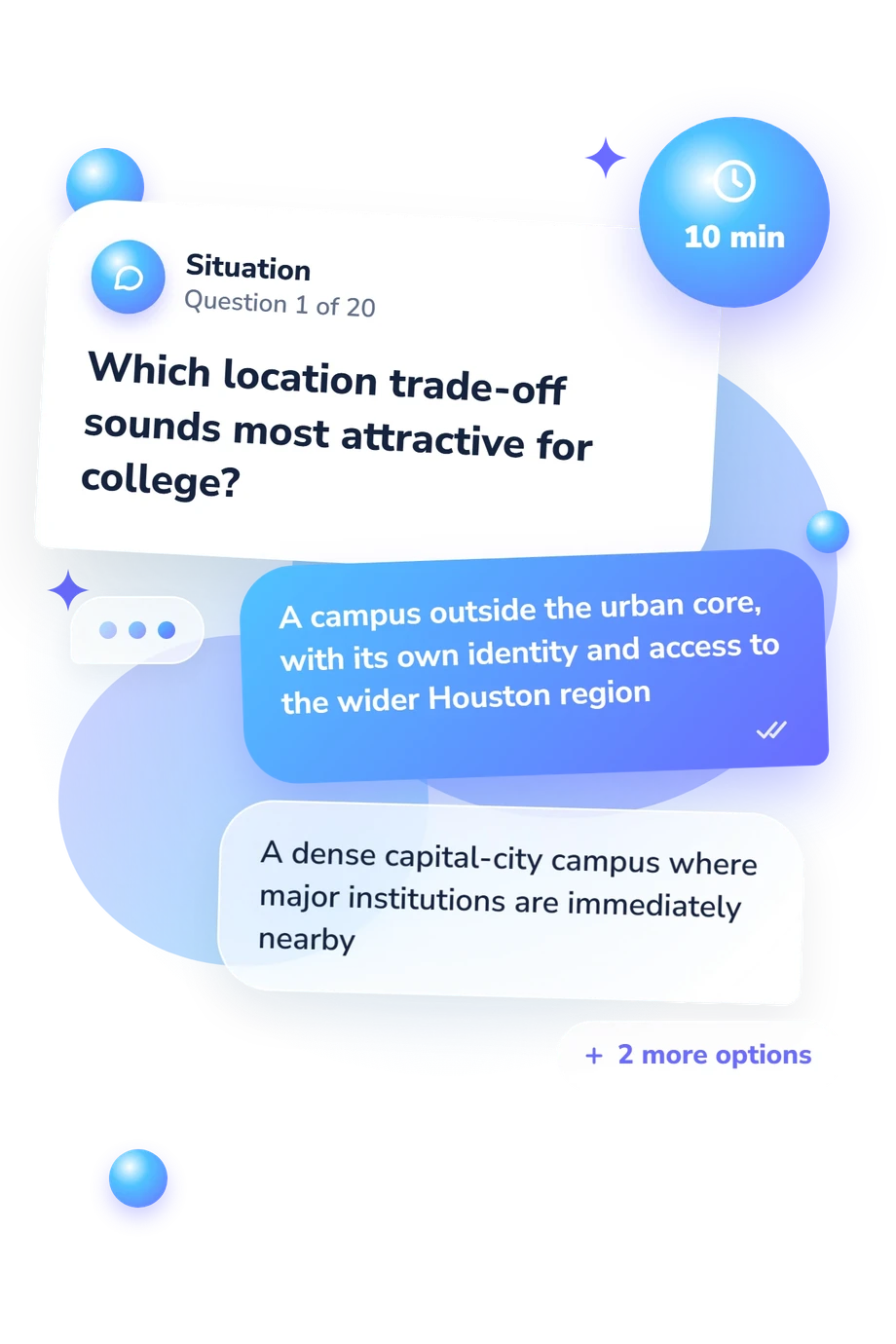
What HBCU Should I: situation and reply bubbles
July 22, 2026July 22, 2026Material has been updatedJuly 22, 2026Material has been published
8,003 views
755 completions
684 likes
Daniel HallPsychologist · Test reviewer
684 likes
Scale Explorer

How the Scales are Structured

Florida A&M University AffinityFAUA
Measures how strongly your preferences align with Florida A&M University’s campus environment, culture, and Tallahassee setting.
example score4/12
4/12Different Directionexample score
0 – 4Different Direction
5 – 8Worth Exploring
9 – 12Strong Affinity
A score of 4 suggests FAMU’s warm-weather, public-university energy and Tallahassee context are not major priorities for you right now.
Hampton University AffinityHUA
Measures how closely your preferred college setting and campus experience align with Hampton University’s private, residential, coastal environment and traditions.
example score6/12
6/12Worth Exploringexample score
0 – 4Different Direction
5 – 8Worth Exploring
9 – 12Strong Affinity
A score of 6 suggests Hampton may be a workable fit in some areas, but you’ll likely want to compare specific campus features and programs against your priorities.
Howard University AffinityHUA
Measures how closely your preferences align with Howard University’s urban, professionally connected campus environment.
example score5/12
5/12Worth Exploringexample score
0 – 4Different Direction
5 – 8Worth Exploring
9 – 12Strong Affinity
A score of 5 suggests some alignment with Howard’s environment, but it’s worth comparing pace, programs, and costs against your other school affinity scores.
North Carolina A&T State University AffinityNCASUA
Measures how well your preferred HBCU environment aligns with North Carolina A&T State University’s large, applied, tradition-rich campus experience.
example score7/12
7/12Worth Exploringexample score
0 – 4Different Direction
5 – 8Worth Exploring
9 – 12Strong Affinity
A score of 7 suggests A&T is worth exploring, with several overlaps in goals and fit while still benefiting from comparison against the other schools’ environments.
Prairie View A&M University AffinityPVAUA
Measures how strongly Prairie View A&M University’s Texas land-grant, hands-on, community-focused campus environment matches your preferences and goals.
example score6/12
6/12Worth Exploringexample score
0 – 4Different Direction
5 – 8Worth Exploring
9 – 12Strong Affinity
A score of 6 suggests Prairie View A&M is worth exploring, with several elements likely fitting you—especially practical learning and proximity to the Houston region.
just completed the test
DATA-BASED USER COHORTS

Who Usually Takes This Test?

Prospective HBCU Freshmen
46%OF USERS
High school juniors and seniors use it to see which campus vibe and academic environment fits their goals before building a college list.
Transfer and Re-Deciders
31%OF USERS
Students considering transferring or switching plans take it to compare settings, culture, and student life among a few well-known options.
Supportive Family and Mentors
23%OF USERS
Parents, guardians, and counselors take it to understand what type of HBCU experience might suit a student and spark discussion.
BASED ON AGGREGATED, ANONYMIZED DATA FROM TENS OF THOUSANDS OF FREUDLY USERS.
Benchmarking

See How You Compare

Once you complete the test, your results are compared with real-world data from people in your country.
Below is a preview of how scores are typically distributed across each scale.
Shaded area — where most people score
Dot — the average
You — your score lands on each curve after the test— your score, after the test
Florida A&M University AffinityFAUA
You?
Average5.5
Typical rangeTypical3.3 – 7.7
Possible0 – 12
Hampton University AffinityHUA
You?
Average7.6
Typical rangeTypical5.4 – 9.8
Possible0 – 12
Howard University AffinityHUA
You?
Average3.6
Typical rangeTypical1.6 – 5.5
Possible0 – 12
North Carolina A&T State University AffinityNCASUA
You?
Average8.1
Typical rangeTypical6.6 – 9.6
Possible0 – 12
Prairie View A&M University AffinityPVAUA
You?
Average5.2
Typical rangeTypical3.5 – 6.9
Possible0 – 12
Featured On
SAMPLE QUESTIONS

Example Questions From the Test

    • A campus outside the urban core, with its own identity and access to the wider Houston region
    • A dense capital-city campus where major institutions are immediately nearby
    • A coastal campus that feels relatively self-contained
    • A midsize-city campus with daily amenities close at hand
    • I would rather have a very small campus where nearly everyone knows one another
    • I could enjoy it, but I would spend most of my time in a small academic circle
    • That combination of scale, energy, and options strongly appeals to me
    • I prefer a medium-size private campus with a more contained atmosphere
    • Build and test a practical solution with a multidisciplinary team
    • Write an individual analysis based mainly on archival sources
    • Develop a community proposal with some technical research
    • Create a performance or exhibition for a small audience
WHAT THE TEST MEASURES

What HBCU Should I Go To Quiz - Description and methodology of the test

identity

Students comparing historically Black colleges and universities can use this questionnaire to clarify the campus setting, academic orientation, regional context, and community style that fit their preferences. The What HBCU Should I Go To Quiz turns those choices into a comparative profile rather than a universal ranking. A student asking which HBCU should I go to can use the result to decide which campuses deserve closer research.

What This Assessment Explores

College fit covers setting, scale, academic style, community, traditions, and regional or professional links. The result treats the question of which HBCU is best for me as compatibility, not a quality ranking.

Results present five affinities with three bands: Different Direction (0-4), Worth Exploring (5-8), and Strong Affinity (9-12). These five lines describe the campus profiles behind the scales:

  • Florida A&M University Affinity (0-12) measures fit with a warm, spirited public university in a capital setting.
  • Hampton University Affinity (0-12) measures fit with a private, historic, residential waterfront community.
  • Howard University Affinity (0-12) measures fit with an urban campus and national professional networks.
  • North Carolina A&T State University Affinity (0-12) measures fit with a large, applied, collaborative public environment.
  • Prairie View A&M University Affinity (0-12) measures fit with a Texas-rooted, hands-on, service-oriented setting.

The highest score is your strongest affinity; scores within one point form a blended result.

Methodology and Evidence Base

The questionnaire functions as an HBCU college fit quiz: each item offers four alternatives describing a preference, situation, or campus trade-off. Choosing the closest response maps your pattern across the five profiles. The displayed totals are comparative signals within the questionnaire.

Clayton et al. (2023) provides the closest conceptual context, linking HBCU and PWI decisions with family and community input, academic considerations, affordability, location, and campus culture. Johnson (2019) adds that connections with HBCU students and alumni, alongside experiences of isolation or alienation, can shape college interest. These studies examine college-choice motivations, not this online questionnaire, so they support its themes rather than validate its scores.

Hossler and Gallagher (1987) offers a three-phase model-predisposition, search, and choice-that fits the questionnaire’s role in clarifying preferences before comparing schools. The questionnaire is conceptually consistent with these works, not an adaptation of any one of them, and the cited studies do not provide standardized norms for its score bands. Current priorities, financial realities, program availability, and self-perception can all affect the outcome, making it a focused starting point for further comparison.

Literature:
  • Clayton, Ashley B., McClay, Langley P., Davis, Raeshan D., & Tevis, Tenisha L. (2023). Considering Both HBCU and PWI Options: Exploring the College Choice Process of First-Year Black Students. The Journal of Higher Education, 94(1), 34-59. 10.1080/00221546.2022.2131966
  • Johnson, Jennifer Michelle. (2019). Pride or Prejudice? Motivations for Choosing Black Colleges. Journal of Student Affairs Research and Practice, 56(4), 409-422. 10.1080/19496591.2019.1614936
  • Hossler, Don, & Gallagher, Karen S. (1987). Studying Student College Choice: A Three-Phase Model and the Implications for Policymakers. College and University, 62(3), 207-221.

Updated:

Popular tests
Comments
Leave a Comment