
Black Death Quiz
How the Scales are Structured
Who Usually Takes This Test?
See How You Compare
Below is a preview of how scores are typically distributed across each scale.
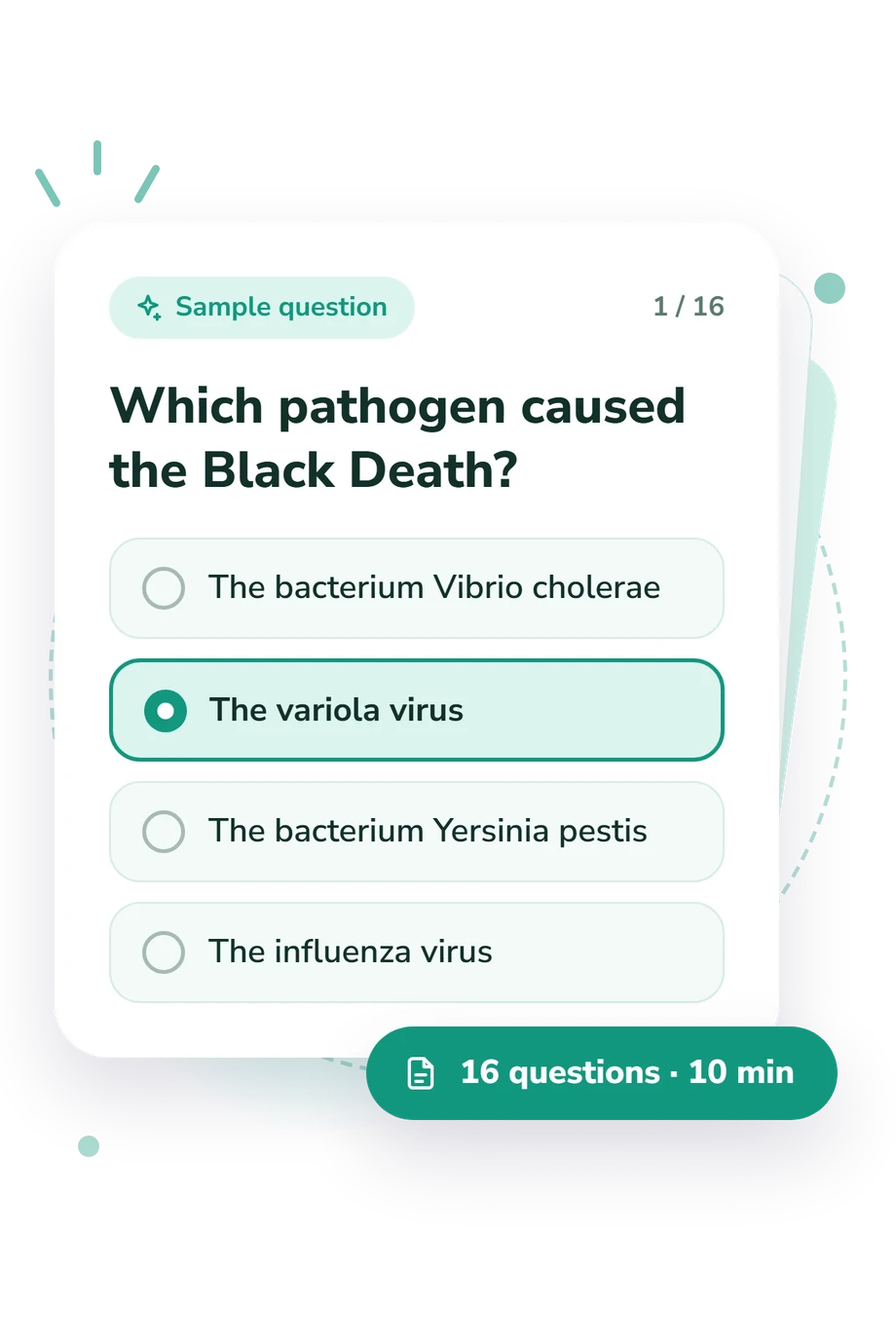
Example Questions From the Test
- The bacterium Vibrio cholerae
- The variola virus
- The bacterium Yersinia pestis
- The influenza virus
- Bubonic plague
- Pneumonic plague
- Septicemic plague
- Smallpox
- Humanist scholars
- Flagellants
- Merchant guild officers
- Harbor quarantine guards
Black Death Quiz - Description and methodology of the test
Readers who want to check their understanding of medieval epidemics can work through black death quiz questions as a focused learning exercise. This assessment connects factual recall with evidence-based reasoning about disease biology, historical change, and social consequences. Curious learners can use the black death quiz to build a clear profile of what they know and which topics merit further study.
What This Assessment Explores
The questionnaire tests knowledge rather than symptoms or opinions. Items cover the pathogen and plague forms, transmission and quarantine, medieval explanations, geographic spread, evidence, population loss, labor scarcity, persecution, and later outbreaks. The groups are:
- Disease biology shows whether the result recognizes Yersinia pestis, plague forms, and key signs.
- Transmission and public health indicate links among rodents, fleas, respiratory spread, shipping, and quarantine.
- Medieval context measures beliefs, religious responses, chronology, and evidence.
- Social and economic consequences show understanding of population loss, persecution, labor scarcity, and changed work conditions.
Questions about bubonic plague are one topic within this broader assessment, which also works as a useful bubonic plague quiz. Its result appears on the Black Death Knowledge scale from 0-16. Foundations to Build (0-6) indicates material to reinforce; Developing Knowledge (7-12) reflects a sound grasp with details to refine; Strong Knowledge (13-16) signals command of disease, context, consequences, and evidence.
Methodology and Scientific Basis
Each item presents four answer choices, with one option supported by historical or biological evidence. The format combines factual recognition with brief inferences, such as linking rodent deaths to flea exposure or burial registers to sudden mortality. It checks recall and evidence-based reasoning.
Scoring produces a total mapped to displayed levels. The score shows knowledge reflected by selected answers and can identify topics for further study. In this format, interpretation of the black death quiz stays tied to the questions.
Its evidence base is conceptual rather than a claim of direct adaptation. A study tracing the Black Death’s source in fourteenth-century Central Eurasia supports genetic and archaeological questions; research on distinct Yersinia pestis clones clarifies pathogen history; historical work on plague in Tudor and Stuart England supplies medical and social context. These sources support the subject matter without showing that the questions reproduce any one instrument.
Results from this history quiz about the Black Death can be affected by prior exposure, guessing, question interpretation, and concentration at completion. The result is a structured guide to topics where historical claims, biological mechanisms, and social consequences need connection.
- Spyrou, Maria A., Lyazzat Musralina, Guido A. Gnecchi Ruscone, Arthur Kocher, Pier-Giorgio Borbone, Valeri I. Khartanovich, Alexandra Buzhilova, Leyla Djansugurova, Kirsten I. Bos, Denise Kühnert, Wolfgang Haak, Philip Slavin, et al. "The source of the Black Death in fourteenth-century central Eurasia." Nature 606 (2022): 718-724. 10.1038/s41586-022-04800-3
- Haensch, Stephanie, Raffaella Bianucci, Michel Signoli, Minoarisoa Rajerison, Michael Schultz, Sacha Kacki, Marco Vermunt, Darlene A. Weston, Derek Hurst, Mark Achtman, Elisabeth Carniel, and Barbara Bramanti. "Distinct Clones of Yersinia pestis Caused the Black Death." PLoS Pathogens 6, no. 10 (2010): e1001134. 10.1371/journal.ppat.1001134
- Slack, Paul. "Plague: A Very Short Introduction." 2nd ed. Oxford University Press, 2021. 10.1093/actrade/9780198871118.001.0001
Updated: