
Business Ethics Quiz
How the Scales are Structured
Who Usually Takes This Test?
See How You Compare
Below is a preview of how scores are typically distributed across each scale.
Example Questions From the Test
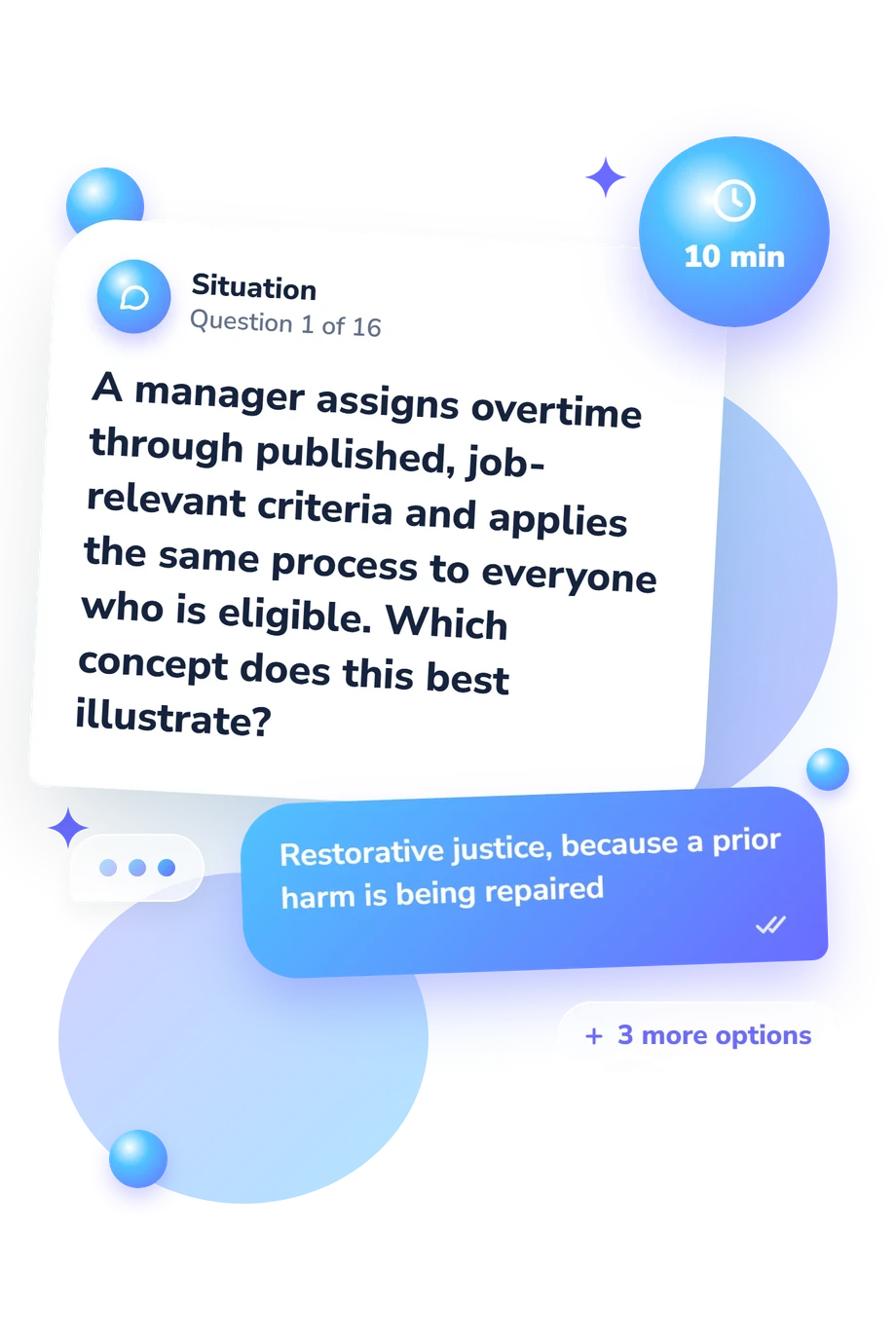
- Restorative justice, because a prior harm is being repaired
- Outcome equality, because every employee receives identical overtime
- Ethical egoism, because employees can pursue additional income
- Procedural justice, because the decision process is consistent and transparent
- Legal compliance is a minimum standard and does not settle every ethical question.
- A legal practice is ethical unless customers submit formal complaints.
- The practice is ethical if it produces enough revenue to benefit employees.
- Ethical analysis applies only when regulations specifically require it.
- Greenwashing
- Cause-related marketing
- Environmental due diligence
- Product differentiation
Business Ethics Quiz - Description and methodology of the test
For readers who want to check how they reason about workplace dilemmas, this business ethics quiz offers a focused way to review principles in context. Learners, employees, and managers can use this business ethics assessment and its result to guide further study. The result gives a concise picture of conceptual understanding rather than a judgment of personal character.
What This Assessment Explores
It asks whether respondents can apply ethical ideas when decisions affect others. Scenarios address fairness, consent, conflicts, bribery, reporting, supply chains, financial integrity, and stakeholder impact.
The questionnaire uses ethical reasoning scenarios to distinguish concepts rather than measuring one attitude. A strong result indicates broader knowledge; a lower result suggests reviewing core concepts or distinctions may help, not a particular weak topic.
The questions cover four areas:
- Fairness and justice show whether procedures are consistent and transparent.
- Ethical frameworks distinguish duties, consequences, rights, virtues, and self-interest.
- Integrity and accountability cover conflicts, improper payments, retaliation, misleading reporting, and disclosure.
- Stakeholder responsibility considers effects on employees, customers, suppliers, owners, and communities.
The result is reported as Business Ethics Knowledge (0-16), summarizing core principles and application. Its bands are Foundations to Build (0-6), Developing Knowledge (7-12), and Strong Knowledge (13-16).
Methodology and Evidence Base
Each item presents a workplace scenario and four answer choices, with one option offering the best fit. The format tests recognition and application: the respondent connects each situation with the principle that most directly explains it rather than giving a personal narrative.
The Ethical Issues Rating Scale offers contextual support for the scenario theme by examining ethical orientation toward business practices; it does not establish this questionnaire's knowledge measurement. The online questionnaire is a separate knowledge assessment, not an administration or adaptation of that instrument. Treviño and Nelson offer an applied framework for compliance, reporting channels, conflicts, leadership example, and organizational culture. Freeman's stakeholder perspective supports the way effects across affected groups are considered.
Selected responses produce a single knowledge result; this online version has no stated population norms, reliability estimates, or clinical cutoffs. These business ethics questions can support learning and structured self-reflection, while performance may vary with prior education, attention, and interpretation of a scenario. It should not be treated as a diagnosis or substitute for broader professional assessment.
- Daniel, Larry G., Florence E. Elliott-Howard, and Debbie D. DuFrene. (1997). The Ethical Issues Rating Scale: An Instrument for Measuring Ethical Orientation of College Students toward Various Business Practices. Educational and Psychological Measurement, 57(3), 515-526. 10.1177/0013164497057003012
- Treviño, Linda K., and Katherine A. Nelson. (2021). Managing Business Ethics: Straight Talk about How to Do It Right (8th ed.). Hoboken, NJ: Wiley.
- Freeman, R. Edward. (1984). Strategic Management: A Stakeholder Approach. Boston: Pitman.
Updated: