
Do I Have High Cheekbones Quiz
How the Scales are Structured
Who Usually Takes This Test?
See How You Compare
Below is a preview of how scores are typically distributed across each scale.
Example Questions From the Test
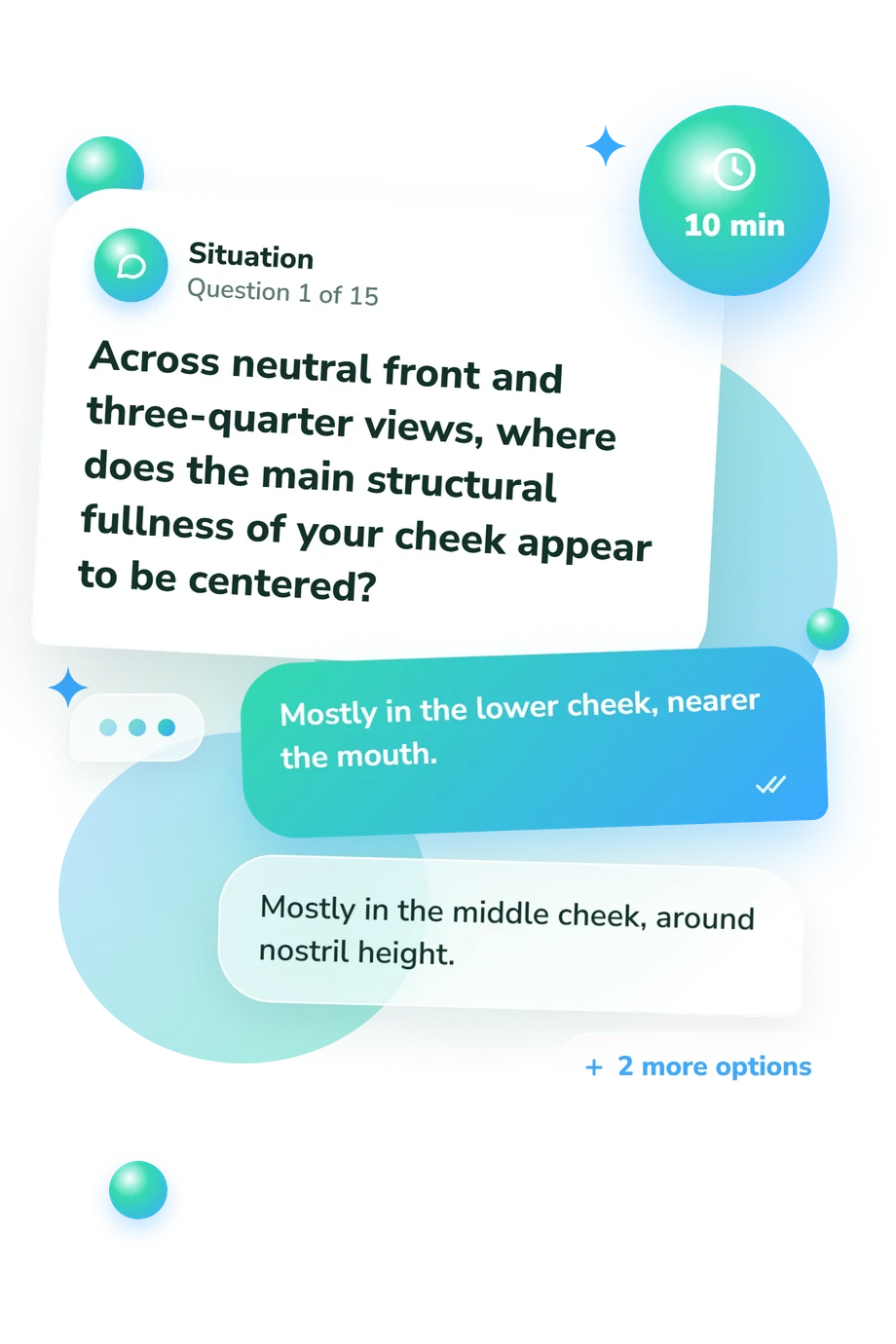
- Mostly in the lower cheek, nearer the mouth.
- Mostly in the middle cheek, around nostril height.
- In the upper-middle cheek, between nostril and lower-eye height.
- High in the cheek, directly beneath the outer eye area.
- It is consistently pronounced across suitable angles.
- It appears moderately projected in most suitable photos.
- It appears only in particularly favorable light or poses.
- The midface generally looks smooth without a distinct projection.
- The space between the nostril and upper lip.
- The nostril or lower part of the nose.
- The upper side of the nose, below the eye.
- The outer lower eyelid or immediately beneath it.
Do I Have High Cheekbones Quiz - Description and methodology of the test
People wondering whether their facial structure reads as high-set cheekbones can use the Do I Have High Cheekbones Quiz as a guided visual check rather than relying on one flattering angle. It is intended for anyone who wants a clearer description of cheek contour, projection, and placement. This high cheekbones quiz organizes visual observations and offers a way to judge whether the cheekbones appear high.
What This Assessment Explores
Front visibility, projection, and vertical position are separate: prominent cheekbones are not necessarily high-set. Questions cover expressions, front, three-quarter, and side views, landmarks, shadows, highlights, and consistency across angles. Mirrors and unfiltered photographs support observation.
The three displayed dimensions are:
- Front-View Prominence (0-15) describes front visibility: Subtle definition (0-5), Moderate definition (6-10), or Strong definition (11-15).
- Three-Quarter and Profile Projection (0-15) describes a visible plane or forward curve: Gentle projection (0-5), Moderate projection (6-10), or Strong projection (11-15).
- Vertical Cheekbone Placement (0-15) describes the peak’s position: Lower-to-middle placement (0-5), Intermediate or mixed placement (6-10), or Upper placement (11-15).
For readers considering how to tell if you have high cheekbones, this quiz shows whether upper placement most closely reflects high cheekbones visually; prominence and projection add visual context. The result is descriptive, not a yes-or-no verdict.
Methodology and Scientific Basis
Each item offers four plain-language visual descriptions, and the respondent chooses the option closest to observed structure. Prompts move across front, three-quarter, and side perspectives, asking about landmarks, repeatability across photos, and changes caused by light or expression. This is a self-report method, so neutral observation matters. Some prompts ask for cross-view comparisons, while others focus on rest, lighting, or repeated photographs.
The questionnaire reports descriptive results within the displayed scales and bands. No standardized clinical scoring rule, normative sample, or validated cutoff system is established for this questionnaire. The bands are descriptive categories, not population-based judgments.
Kaptein et al. (2015) is the closest conceptual source for vertical localization of malar prominence. Czerwinski et al. (2005) contributes a topographical perspective on the orbitozygomatic complex, while Frey (2013) addresses anterior malar projection. The present questionnaire is conceptually consistent with these works, not a reproduction or validated adaptation of them.
Lighting, lens, pose, expression, and natural asymmetry can alter the apparent contour, so this visual cheekbone assessment is best used for structured self-reflection rather than clinical or medical conclusions.
- Kaptein YE, Kaptein JS, Markarian A. Vertical Localization of the Malar Prominence. Plastic and Reconstructive Surgery Global Open. 2015;3(6):e411. 10.1097/GOX.0000000000000383
- Czerwinski M, Martin M, Lee C. Quantitative topographical evaluation of the orbitozygomatic complex. Plastic and Reconstructive Surgery. 2005;115(7):1858-1862. 10.1097/01.prs.0000165077.40778.00
- Frey ST. New diagnostic tenet of the esthetic midface for clinical assessment of anterior malar projection. The Angle Orthodontist. 2013;83(5):790-794. 10.2319/111612-881.1
Updated: