
Is Human Resources Right for Me Quiz
How the Scales are Structured
Who Usually Takes This Test?
See How You Compare
Below is a preview of how scores are typically distributed across each scale.
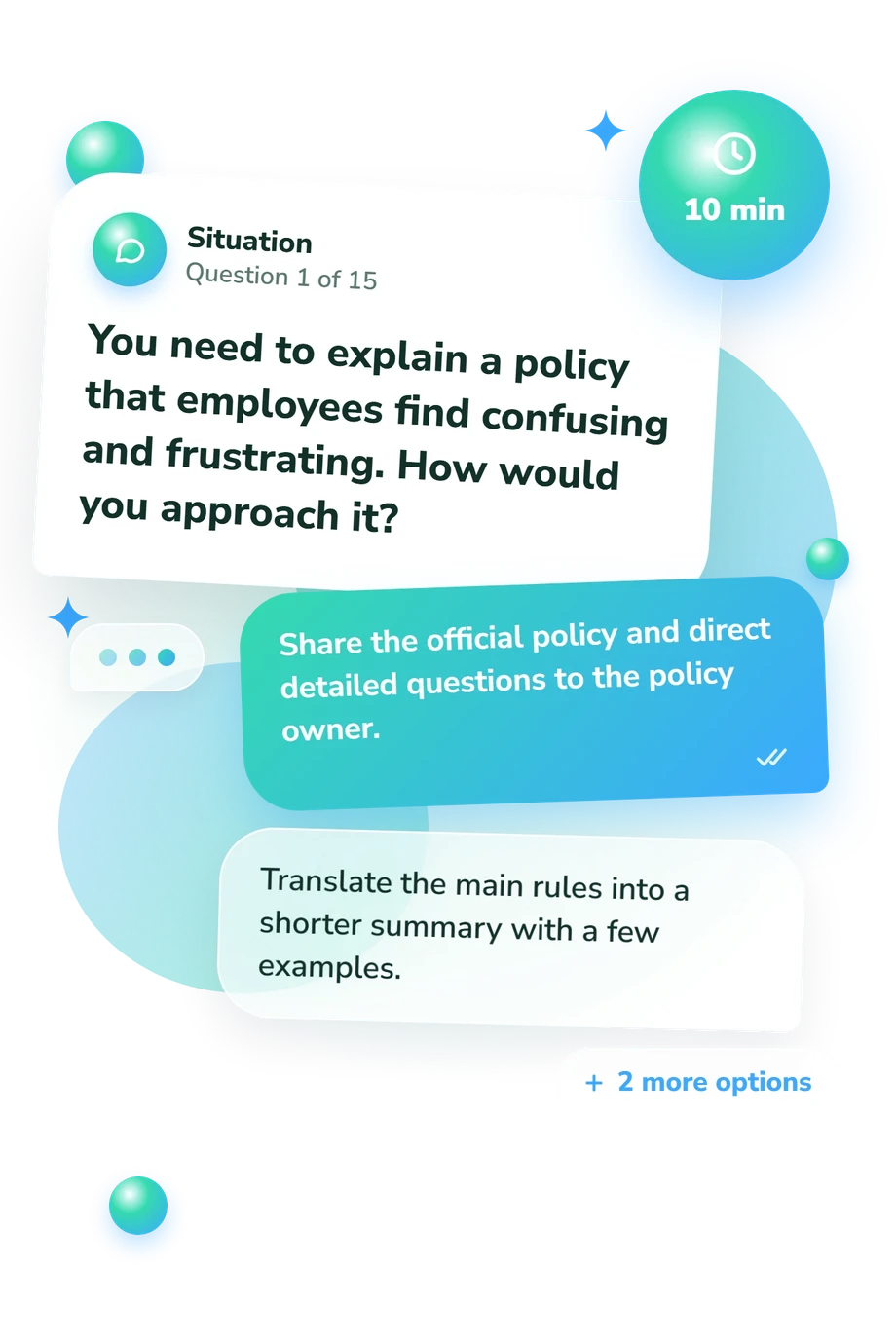
Example Questions From the Test
- Share the official policy and direct detailed questions to the policy owner.
- Translate the main rules into a shorter summary with a few examples.
- Deliver the required information first and address questions that arise afterward.
- Explain the purpose, use realistic examples, check understanding, and gather unresolved questions.
- Mostly open-ended or creative work, with minimal recordkeeping and routine follow-through.
- Varied work where structured tasks are present but usually handled through established routines.
- A balance of people requests, scheduled processes, and occasional urgent changes.
- A shifting mix of detailed administration, people support, deadlines, and process improvement.
- I would prefer to keep using familiar tools until the new system is fully established.
- I would learn the functions required for my own immediate tasks.
- I would practice common workflows and keep notes on errors or questions.
- I would test realistic workflows, learn the system's limits, and help refine shared instructions.
Is Human Resources Right for Me Quiz - Description and methodology of the test
For people considering an HR career, the Is Human Resources Right for Me Quiz offers a structured way to examine how their preferences may meet common people, process, and judgment demands. It can be a useful Should I Work in HR Quiz when the decision feels broader than interest alone. The profile supports reflection on current strengths, preferred work conditions, and skills that may need practice before choosing a direction.
What This Assessment Explores
Scenarios sample policy ambiguity, fairness, confidentiality, deadlines, emotional conversations, system changes, and incomplete information. They represent demands for consistency, discretion, documentation, and follow-through.
The profile groups these situations into three areas, helping answer what part of HR is right for me as a quiz-taker:
- Fair Judgment and Professional Boundaries (0-15) shows how you weigh fairness, context, access, and boundaries: Prefer clearer decisions (0-5), Developing judgment readiness (6-10), or Strong judgment readiness (11-15).
- HR Process and Operational Adaptability (0-15) shows comfort with accuracy, systems, priorities, and follow-through: Prefer less process-centered work (0-5), Developing operational readiness (6-10), or Strong operational readiness (11-15).
- People Communication and Conflict Navigation (0-15) shows comfort with listening, clarification, inclusion, and conflict: Prefer a different focus (0-5), Developing people readiness (6-10), or Strong people-work readiness (11-15).
Bands show where preferences fit these demands and where practice may help.
Methodology and Scientific Basis
Each item presents a workplace situation with four response options. This competency-based situational self-report asks how you would handle ambiguity, confidentiality, competing priorities, system changes, distress, and disagreement rather than testing HR law or technical knowledge. Responses are grouped into the three profile areas and shown as descriptive bands, not a pass/fail decision.
The scoring display does not document item weights, normative comparisons, or validated cutoffs. Results show how stated preferences align with these situations, rather than certifying competence or forecasting performance. A Should I Work in Human Resources Quiz interpretation is most useful alongside experience and opportunities to observe HR work.
The framework is conceptually consistent with the IPMA-HR Competency Model (Zhang et al., 2012), and it connects with HR competency research by Ulrich et al. (1995) and ethical competency work by Dutta et al. (2022). These sources support relevance, but do not make this questionnaire a validated adaptation of any of them.
Self-report can shift with stress, self-awareness, emotional carryover, and impression management. Treat the result as reflection, not a diagnosis or proof of ethical fitness.
- Zhang, Jin, Quanquan Zheng, Li Linda Sun, and Lu Zheng. 2012. "Reliability and Validity Testing and Analysis of IPMA-HR Competency Model in China." Public Personnel Management 41(1): 173-197. 10.1177/009102601204100110
- Ulrich, Dave, Wayne Brockbank, Arthur K. Yeung, and Dale G. Lake. 1995. "Human Resource Competencies: An Empirical Assessment." Human Resource Management 34(4): 473-495. 10.1002/hrm.3930340402
- Dutta, Debolina, Sushanta Kumar Mishra, and Pawan Budhwar. 2022. "Ethics in competency models: A framework towards developing ethical behaviour in organisations." IIMB Management Review 34(3): 208-227. 10.1016/j.iimb.2022.10.002
Updated: