
IV Calculation Quiz
How the Scales are Structured
Who Usually Takes This Test?
See How You Compare
Below is a preview of how scores are typically distributed across each scale.
Example Questions From the Test
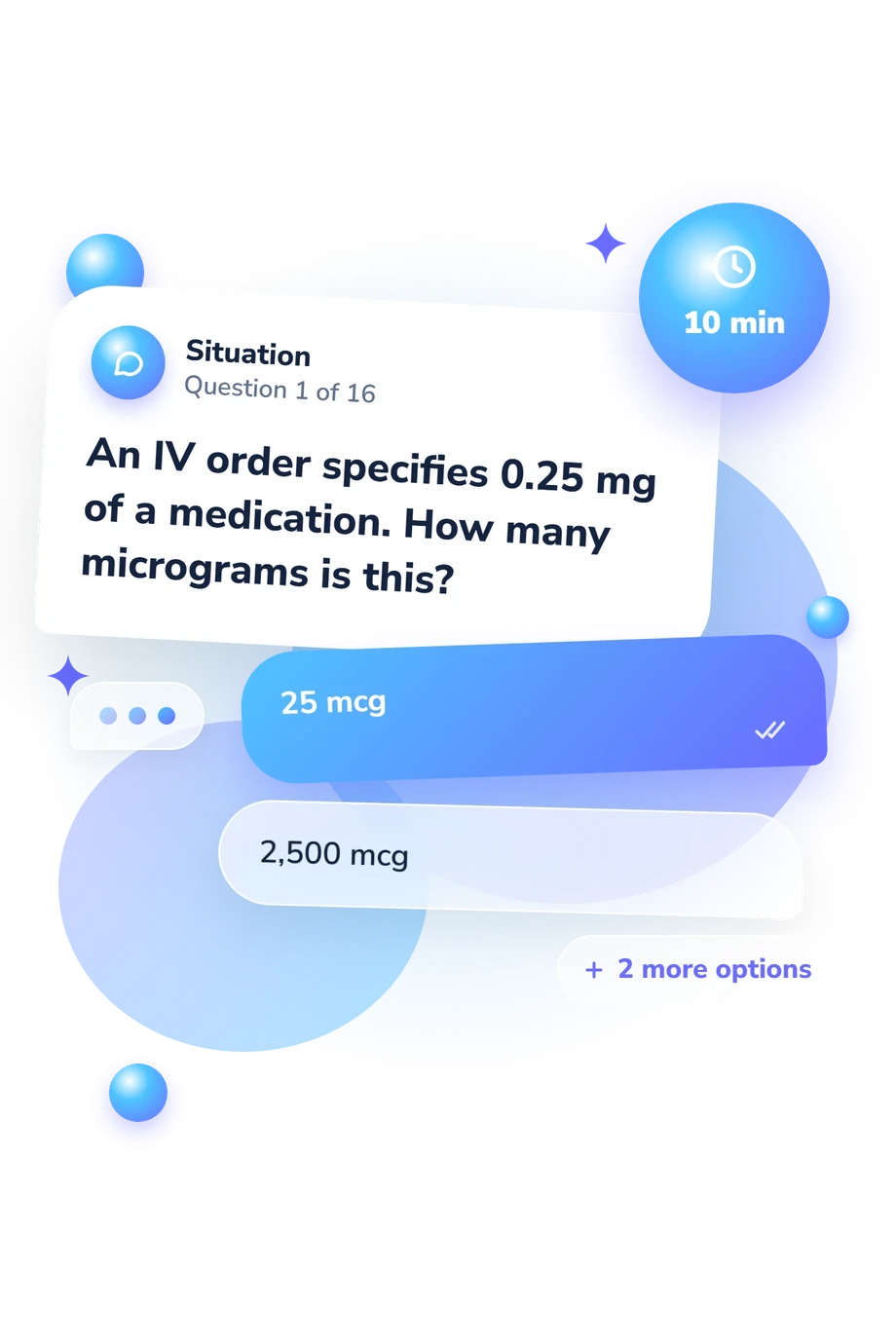
- 25 mcg
- 2,500 mcg
- 250 mcg
- 00025 mcg
- 45 minutes
- 40 minutes
- 30 minutes
- 75 minutes
- 30 mL/hour
- 60 mL/hour
- 75 mL/hour
- 1,800 mL/hour
IV Calculation Quiz - Description and methodology of the test
Medication and fluid-order problems can expose arithmetic gaps that routine study leaves unnoticed. Learners may use the calculation practice here to examine how they reason through dose, volume, conversion, and infusion-rate work, as IV drug calculations quiz items require, before relying on those methods in study or supervised practice. The IV Calculation Quiz gives learners a structured checkpoint for examining the steps behind an answer, not merely recalling a formula.
What This Assessment Explores
These questions test practical arithmetic rather than pharmacological recall. They cover metric conversions, dose calculations, reconstituted volumes, pump and gravity rates, remaining fluid, percentage solutions, and continuous infusions.
The calculation groups are:
- Unit conversion shows whether you move accurately among grams, milligrams, micrograms, and millilitres.
- Dose and volume show whether you turn a prescribed amount and concentration into a usable volume.
- Weight-based dosing shows whether patient mass is incorporated correctly.
- Infusion rate and time show whether volume, duration, drop factor, and pump rate are connected accurately.
The result reports dose-and-volume performance, showing how well the learner handles the practical work that IV dosage calculations quiz items require, rather than testing pharmacological recall. The IV Calculation Knowledge scale runs 0-16: “Foundations to review” (0-6), “Developing knowledge” (7-12), or “Strong knowledge” (13-16). The bands describe performance on these methods.
Methodology and Evidence Base
Each item presents a medication or fluid scenario with four answer choices. The questionnaire presents one educational total; no item-weighting rule is provided, and it is an unvalidated educational score with no clinical cutoff.
Gravity- and pump-rate problems link dose, concentration, volume, time, pump settings, and gravity tubing, which IV drip rate quiz items require learners to connect. These problems require conversions, dose-volume formulas, dimensional reasoning, and rounding. A higher total indicates better performance across the tested calculation types; missed items point to steps needing review.
Evidence is conceptually consistent with Wennberg-Capellades and colleagues on drug-dose calculation errors. Koohestani and Baghcheghi examine formula and dimensional-analysis approaches to IV rate calculations, while Dilles and colleagues connect pharmacological knowledge with calculation skills. These studies provide comparison points; this questionnaire is not their adaptation or validation.
Read results alongside missed items and the conditions under which the questionnaire was completed. Slips, notation, time pressure, and rounding assumptions can affect performance. It does not establish clinical competence or justify setting up or altering an infusion; unclear calculations require current protocols and a qualified clinician or pharmacist.
- Wennberg-Capellades, Laia, Pilar Fuster-Linares, Encarnación Rodríguez-Higueras, Alberto Gallart Fernández-Puebla, and Mireia Llaurado-Serra. "Where do nursing students make mistakes when calculating drug doses? A retrospective study." BMC Nursing, 21, 309 (2022). 10.1186/s12912-022-01085-9
- Koohestani, Hamidreza, and Nayereh Baghcheghi. "Comparing the effects of two educational methods of intravenous drug rate calculations on rapid and sustained learning of nursing students: Formula method and dimensional analysis method." Nurse Education in Practice, 10(4), 233-237 (2010). 10.1016/j.nepr.2009.11.011
- Dilles, Tinne, Robert R. Vander Stichele, Lucas Van Bortel, and Monique M. Elseviers. "Nursing students' pharmacological knowledge and calculation skills: Ready for practice?" Nurse Education Today, 31(5), 499-505 (2011). 10.1016/j.nedt.2010.08.009
Updated: