
Gandhi Jayanti Quiz
How the Scales are Structured
Who Usually Takes This Test?
See How You Compare
Below is a preview of how scores are typically distributed across each scale.
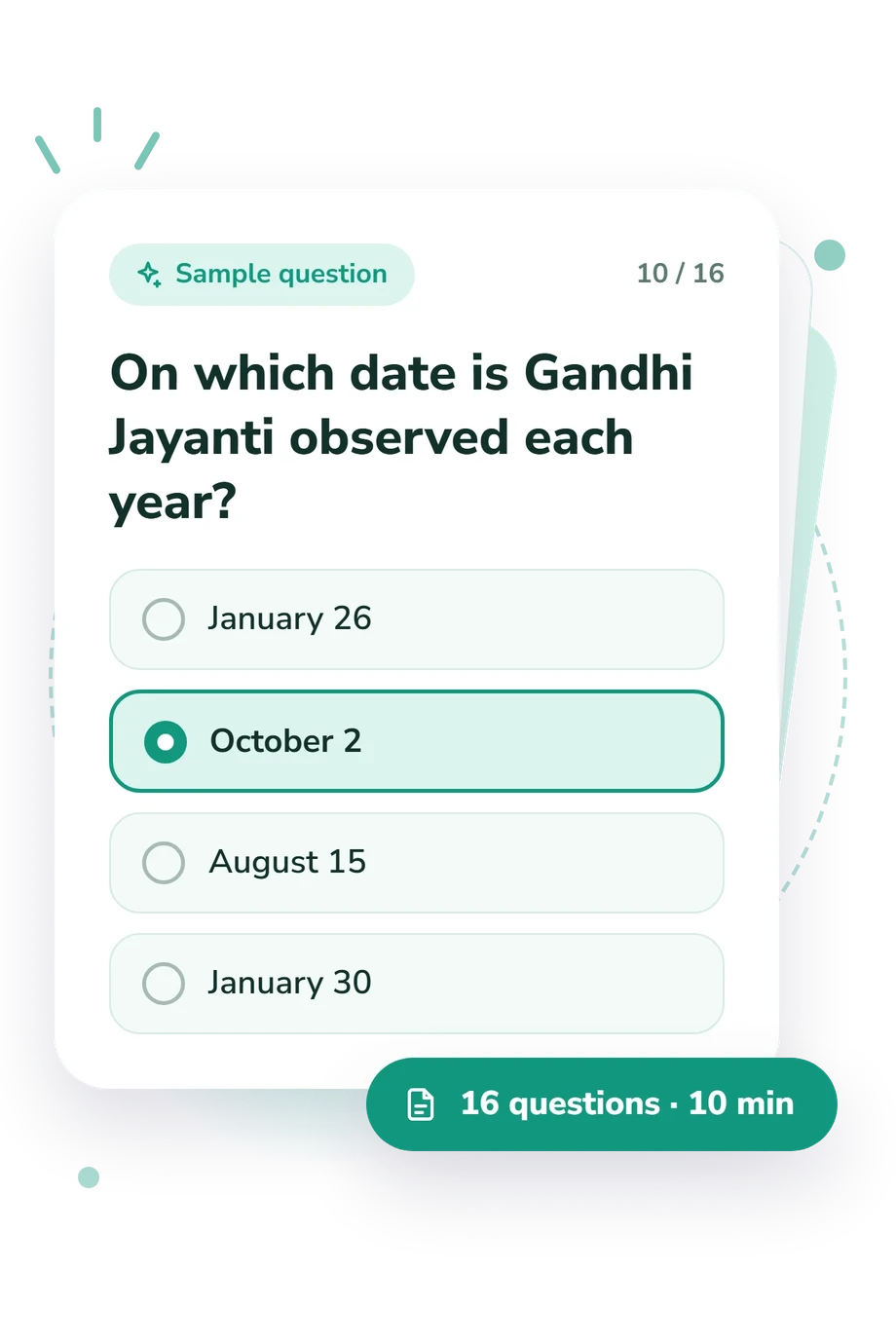
Example Questions From the Test
- The Champaran campaign
- His removal from a train at Pietermaritzburg
- His studies in law in London
- His first civil-rights work in South Africa
- Swaraj is my birthright
- Do or Die
- Inquilab Zindabad
- Jai Jawan, Jai Kisan
- International Day of Peace
- Human Rights Day
- World Day of Social Justice
- International Day of Non-Violence
Gandhi Jayanti Quiz - Description and methodology of the test
Readers who want to check their understanding of Gandhi’s public life, ideas, and the meaning of October 2 can use the Gandhi Jayanti Quiz as a focused history exercise. It suits learners, teachers, and curious adults who prefer questions that connect dates with causes and principles. This quiz on Gandhiji offers a focused way to review the tested themes and decide whether broader reading or discussion would help.
What This Assessment Explores
It tests historical and conceptual knowledge, not opinion. Questions cover Gandhi’s campaigns, key dates, satyagraha, ahimsa, swaraj, khadi, Hind Swaraj, and October 2. It suits readers who want to work through quiz questions on Mahatma Gandhi and connect events with ideas.
The test organizes its questions into four areas:
- Chronology shows whether campaigns and turning points are placed accurately.
- The movements section shows the aims of Champaran, the Salt March, Non-Cooperation, Civil Disobedience, and Quit India.
- The concepts section measures understanding of satyagraha, ahimsa, swaraj, and self-reliance.
- Commemoration connects Gandhi Jayanti with his birth anniversary and nonviolent civic action.
The result is reported as Gandhi Jayanti Knowledge (0-16), with three bands: Foundation to Build (0-6), Developing Knowledge (7-12), and Strong Knowledge (13-16). The score indicates overall performance across tested themes and may signal further review.
Methodology and Evidence Base
Each item presents a historical or interpretive prompt with four answer choices. Selecting the best-supported option tests chronology, significance, and terminology rather than personality or opinion. As a Gandhi history quiz, it produces one subject-specific knowledge result.
The result is displayed as a subject-specific knowledge score, with interpretation tied to the three bands above. Read it as performance on the tested material rather than intelligence, character, or political identity; prior study, attention, wording, and guessing can also affect it.
The content is conceptually consistent with Ramachandra Guha’s historical account, Bipan Chandra and colleagues’ history of the independence movement, Gandhi’s discussion of swaraj in Hind Swaraj, and United Nations resolution A/RES/61/271. These works provide historical context for the facts and ideas tested in this questionnaire.
It is a standalone online knowledge exercise about Gandhi’s history, campaigns, ideas, and the meaning of the observance. Its questions connect dates, movements, principles, and civic observance through selected-answer knowledge prompts. Use the score to guide further reading or discussion and check disputed details against authoritative scholarship.
- Guha, Ramachandra. Gandhi: The Years That Changed the World, 1914-1948. New York: Alfred A. Knopf, 2018.
- Chandra, Bipan; Mukherjee, Mridula; Mukherjee, Aditya; Mahajan, Sucheta; Panikkar, K. N. India's Struggle for Independence, 1857-1947. New Delhi: Penguin Books, 1989.
- Gandhi, Mohandas K. “Hind Swaraj, or Indian Home Rule.” In On Violence: A Reader, edited by Bruce B. Lawrence and Aisha Karim, 111-126. New York: Duke University Press, 2007. 10.1515/9780822390169-014.
- United Nations General Assembly. International Day of Non-Violence: Resolution A/RES/61/271. New York: United Nations, 2007.
Updated: