
Research Methodology Quiz
How the Scales are Structured
Who Usually Takes This Test?
See How You Compare
Below is a preview of how scores are typically distributed across each scale.
Example Questions From the Test
- A sampling frame
- A dependent variable
- A placebo effect
- A confounding variable
- Assuming the null hypothesis and model assumptions, the probability of results at least as extreme as those observed
- The probability that an identical study will produce the same result
- The probability that the null hypothesis is true after seeing the data
- The size or practical importance of the observed effect
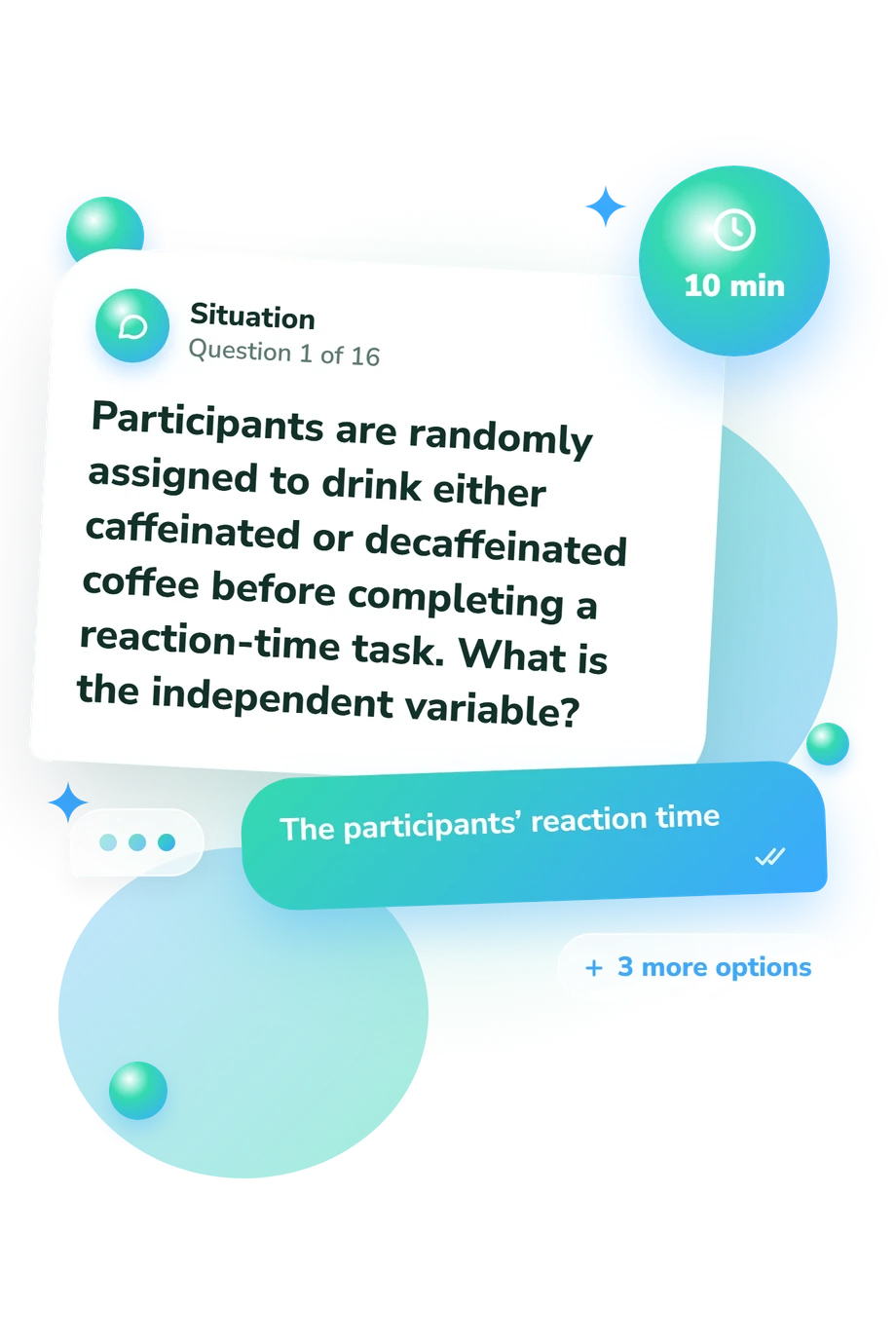
- The participants’ reaction time
- The number of participants in each group
- The type of coffee participants receive
- The equipment used to measure reaction time
Research Methodology Quiz - Description and methodology of the test
Students and aspiring researchers who want to check their grasp of core research practice can use this quiz on research methodology as a focused learning tool. Questions in this research methodology quiz cover concepts that often cause confusion in coursework and early projects. The result offers a broad indication of your grasp and a starting point for review, rather than reducing research competence to a single number.
What This Assessment Explores
This assessment checks whether you can apply core principles used to plan, conduct, and interpret research. It suits learners reviewing coursework, preparing a project, or locating gaps in their understanding.
The questions address variables, design, preregistration, qualitative analysis, ethics, sampling, measurement, validity, reliability, and cross-sectional research. This research method quiz brings these topics together for review.
The result uses one displayed scale: Research Methodology Knowledge measures recognition and application of major methodology concepts. It is reported from 0-16 as Foundations to build (0-6), Developing knowledge (7-12), or Strong knowledge (13-16). The questions cluster around these areas:
- Design and variables show whether you distinguish association, causation, controls, and variable roles.
- Sampling and measurement show whether you judge representation, operational definitions, validity, and reliability.
- Ethics and evidence cover consent, withdrawal, preregistration, triangulation, inference, and qualitative analysis.
Methodology and Scientific Basis
Each item presents a scenario or definition with four answer choices. You select the option that best identifies a principle, such as a confound, p-value, operational definition, thematic analysis, or test-retest reliability. The format makes this a practical research methodology test, emphasizing recognition and applied reasoning.
The assessment is conceptually consistent with Psychological Research Inventory of Concepts (Veilleux & Chapman, 2017), a published measure of research and statistical literacy. The companion validation study describes that instrument’s measurement basis, but this questionnaire is not an adaptation or direct administration of it. It is a separate quiz with its own item set and scoring display.
Scoring is presented as one total across concepts rather than a profile of research skills. Interpret it as a starting point: review missed topics and compare your reasoning with textbook definitions. The displayed bands describe performance on this questionnaire; they do not by themselves establish broader research competence. Because this is a brief online knowledge check, performance also depends on honest answering, terminology familiarity, and current study context; one score cannot capture practical competence, judgment, or experience.
- Veilleux, J. C., & Chapman, K. M. (2017). Development of a Research Methods and Statistics Concept Inventory. Teaching of Psychology, 44(3), 203-211. 10.1177/0098628317711287
- Veilleux, J. C., & Chapman, K. M. (2017). Validation of the Psychological Research Inventory of Concepts: An Index of Research and Statistical Literacy. Teaching of Psychology, 44(3), 212-221. 10.1177/0098628317711302
Updated: