
Hindu Mythology Quiz
How the Scales are Structured
Who Usually Takes This Test?
See How You Compare
Below is a preview of how scores are typically distributed across each scale.
Example Questions From the Test
- Indra
- Kartikeya
- Ganesha
- Surya
- Amrita, the nectar of immortality
- Soma, presented solely as Indra's weapon
- Halahala, the powerful poison
- Ghee, the clarified butter used in offerings
- Durga
- Sita
- Ganga
- Saraswati
Hindu Mythology Quiz - Description and methodology of the test
This assessment, built around Hindu mythology quiz questions, gives readers a focused way to revisit deities, epics, characters, and familiar story patterns. It suits learners and curious readers who want to check cultural and narrative knowledge without treating familiarity as a measure of faith. The result highlights secure areas and topics worth exploring further. An Indian mythological quiz can help distinguish remembered names from connected understanding.
What This Assessment Explores
The items sample widely recognized Hindu material: deities and their associations, divine mounts and avatars, episodes from the Ramayana and Mahabharata, and links between stories and observances such as Diwali. They ask which figure, event, or relationship fits a narrative detail.
For a reader using a Hindu mythology quiz with answers, the result maps familiar names against less secure links among characters, symbols, and plot episodes. It measures selected knowledge, not faith or cultural identity.
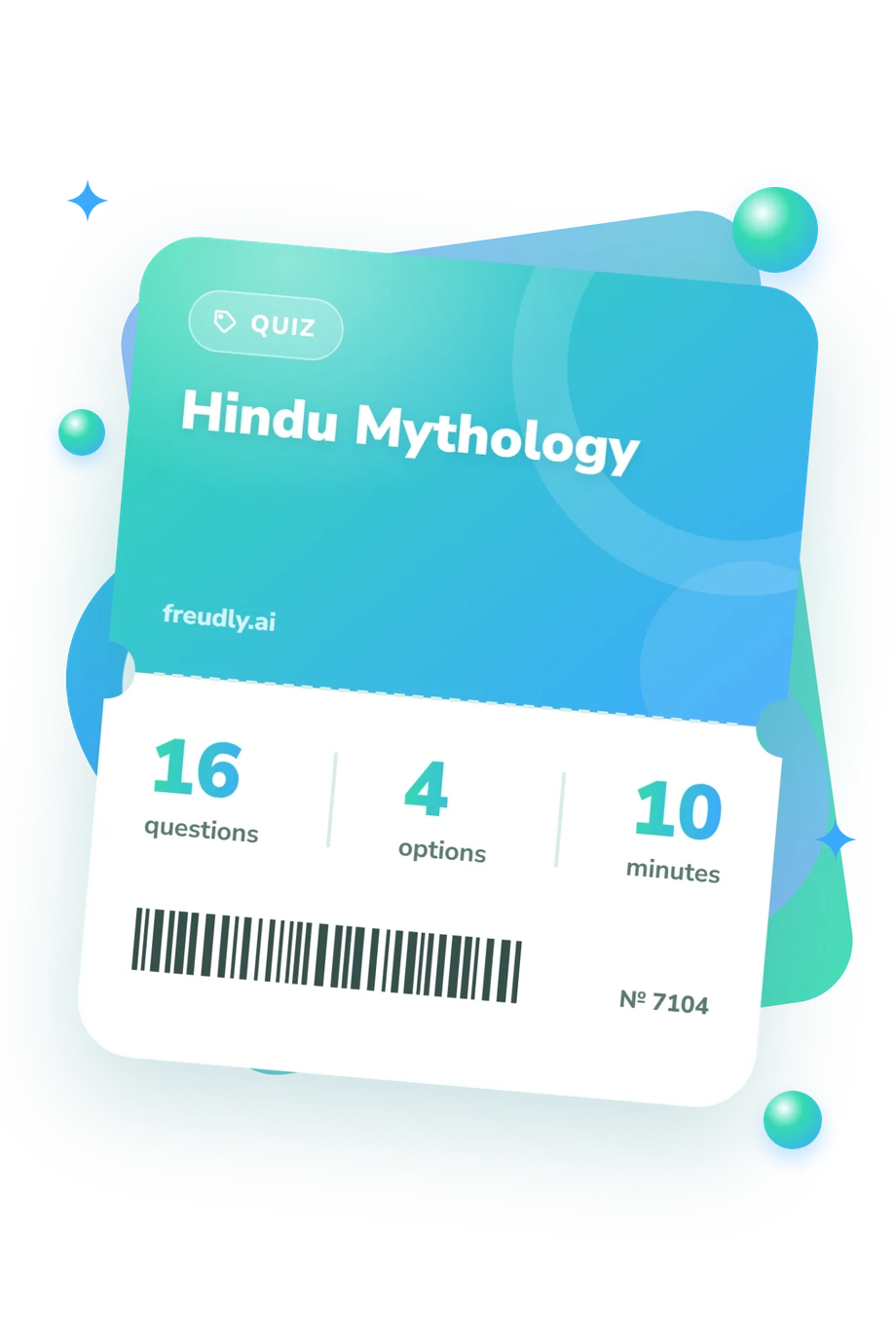
The displayed result uses one scale, Hindu Mythology Knowledge (0-16), with three bands:
- Foundations (0-6) indicates recognition of some central figures or stories and suggests starting with accessible summaries.
- Developing Knowledge (7-12) reflects broad familiarity while leaving room to connect symbols, characters, and narratives.
- Strong Knowledge (13-16) shows confident command of the widely told traditions sampled here, not every regional or textual tradition.
Methodology and Scientific Basis
Each item presents a narrative or identification prompt with four answer choices. The respondent selects the option that fits a deity, epic episode, character, or symbol. This content-based method tests recognition and recall, not attitudes or personality.
Here, quiz questions on Hindu mythology with answers function as guided recall: alternatives must be compared with story context. Results use the displayed scale; no separate weighting system is specified, so identical contribution from every item should not be assumed.
Its content is conceptually consistent with Dimmitt and van Buitenen (1978), whose work gathers Puranic narratives, and with Brockington (2003), which places the Sanskrit epics in literary context. Ramayana material also aligns with Valmiki’s epic in Robert P. Goldman’s translation. These sources support the subject matter; they do not make this questionnaire an adaptation or standardized instrument.
No norm group, reliability estimate, or validated cutoff is stated for this version. Interpret the band as a snapshot of performance on the traditions sampled; prior reading, wording familiarity, and attention can affect it. Hindu traditions vary across texts and regions, so the result cannot represent the full subject or establish specialist expertise.
- Cornelia Dimmitt and J. A. B. van Buitenen, Classical Hindu Mythology: A Reader in the Sanskrit Puranas. Temple University Press, 1978.
- John Brockington, "The Sanskrit Epics." In The Blackwell Companion to Hinduism, edited by Gavin Flood, 116-128. Blackwell Publishing, 2003. 10.1002/9780470998694.ch6
- Valmiki, The Ramayana of Valmiki: An Epic of Ancient India, Volume I: Balakanda. Introduction and translation by Robert P. Goldman. Princeton University Press, 1984.
Updated: