
IV Therapy Quiz
How the Scales are Structured
Who Usually Takes This Test?
See How You Compare
Below is a preview of how scores are typically distributed across each scale.
Example Questions From the Test
- As a sustained isotonic extracellular-volume expander
- As a colloid that remains mainly in the bloodstream
- As a hypertonic fluid that draws water out of cells
- As free water with a physiologically hypotonic effect
- 9% sodium chloride
- D5W
- Lactated Ringer's solution
- 45% sodium chloride
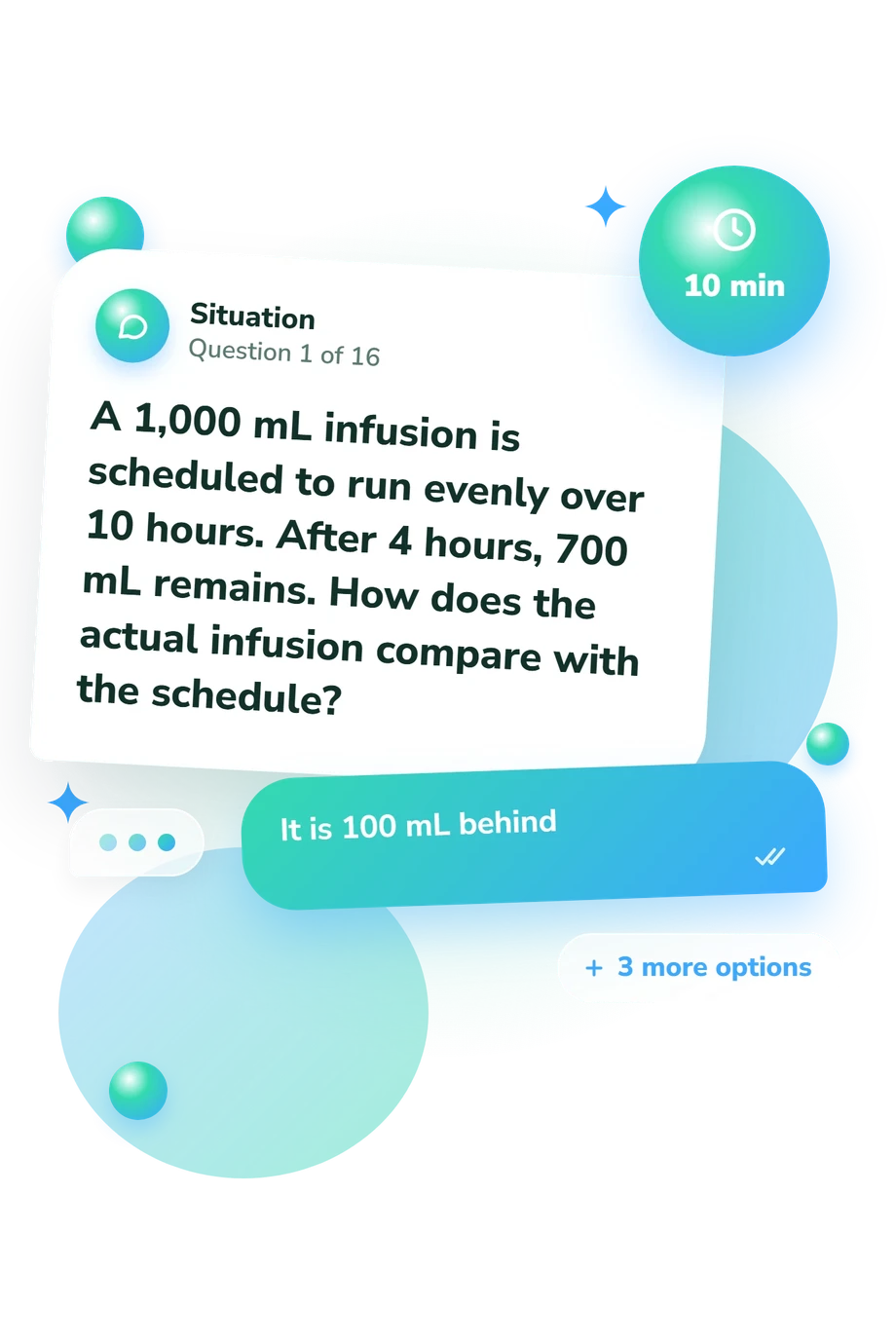
- 80 mL/hour
- 125 mL/hour
- 100 mL/hour
- 133 mL/hour
IV Therapy Quiz - Description and methodology of the test
Students, nurses in training, and clinicians refreshing foundational skills can use this iv quiz to examine how they apply intravenous-therapy knowledge to realistic bedside situations. The result identifies foundational areas needing further review, helping you choose what to study next. It also works as an IV therapy nursing quiz for coursework, skills-lab preparation, or supervised learning.
What This Assessment Measures
This questionnaire checks foundational knowledge for common peripheral and infusion-related situations. It asks you to compare rates, classify crystalloids, recognize fluid effects, and choose safe first responses when warning signs appear. As an IV therapy quiz, it tests applied understanding rather than attitudes or symptom severity.
The result uses one scale, IV Therapy Knowledge (0-16). Its bands are Foundations to review (0-6), Developing knowledge (7-12), and Strong knowledge (13-16), describing educational performance across the tested material.
The themes below show what your result covers:
- Rate calculations show whether you can translate volume, time, and drop factor into a workable infusion rate.
- Fluid concepts show whether you distinguish isotonic, hypotonic, and hypertonic effects.
- Site findings show whether you can separate infiltration, phlebitis, extravasation, and overload.
- Safety decisions show whether you can choose an immediate response to air or vesicant injury.
Methodology and Evidence Base
Each item presents a clinical scenario with four answer choices. The format tests one best response, calculation, classification, or recognition decision across infusion rates, fluid composition and tonicity, blood-compatible fluid selection, pump and gravity calculations, and early complication management. Results reflect educational performance across the tested topics, and the displayed learning bands indicate areas for review.
The educational focus is conceptually consistent with Njung'e and Kamolo (2021), who studied nurses’ knowledge of intravenous fluid therapy, and with practice recommendations in Nickel et al. (2024). This questionnaire is not presented as an adaptation, validation, or standardized administration of either publication. It is an online IV infusion quiz for learning and self-checking.
Treat the band as a review guide rather than proof of independent clinical competence. These are unvalidated learning bands, so patient-specific orders, local protocols, and qualified supervision remain decisive. Since answers are self-administered and scenario-based, attention, memory, prior teaching, and context can affect results. Use missed items to direct study; severe symptoms or a suspected infusion reaction require urgent clinical help.
- Njung'e, Winfridah Wangui, and Elizabeth Kalondu Kamolo. (2021). Nurses’ knowledge regarding intravenous fluid therapy at a County hospital in Kenya. International Journal of Africa Nursing Sciences, 14, 100305. 10.1016/j.ijans.2021.100305
- Nickel, Barbara, Lisa Gorski, Tricia Kleidon, Amy Kyes, Michelle DeVries, Samantha Keogh, Britt Meyer, Mary Jo Sarver, Rachael Crickman, Jenny Ong, Simon Clare, and Mary E. Hagle. (2024). Infusion Therapy Standards of Practice, 9th Edition. Journal of Infusion Nursing, 47(1S Suppl. 1), S1-S285. 10.1097/NAN.0000000000000532
Updated: