
Can You Read My Mind Quiz
How the Scales are Structured
Who Usually Takes This Test?
See How You Compare
Below is a preview of how scores are typically distributed across each scale.
Example Questions From the Test
- The green room, because that is where the meeting actually is.
- The hallway, because Alex must somehow sense that something changed.
- Alex may ask a teammate before going anywhere.
- The blue room, based on the information Alex has.
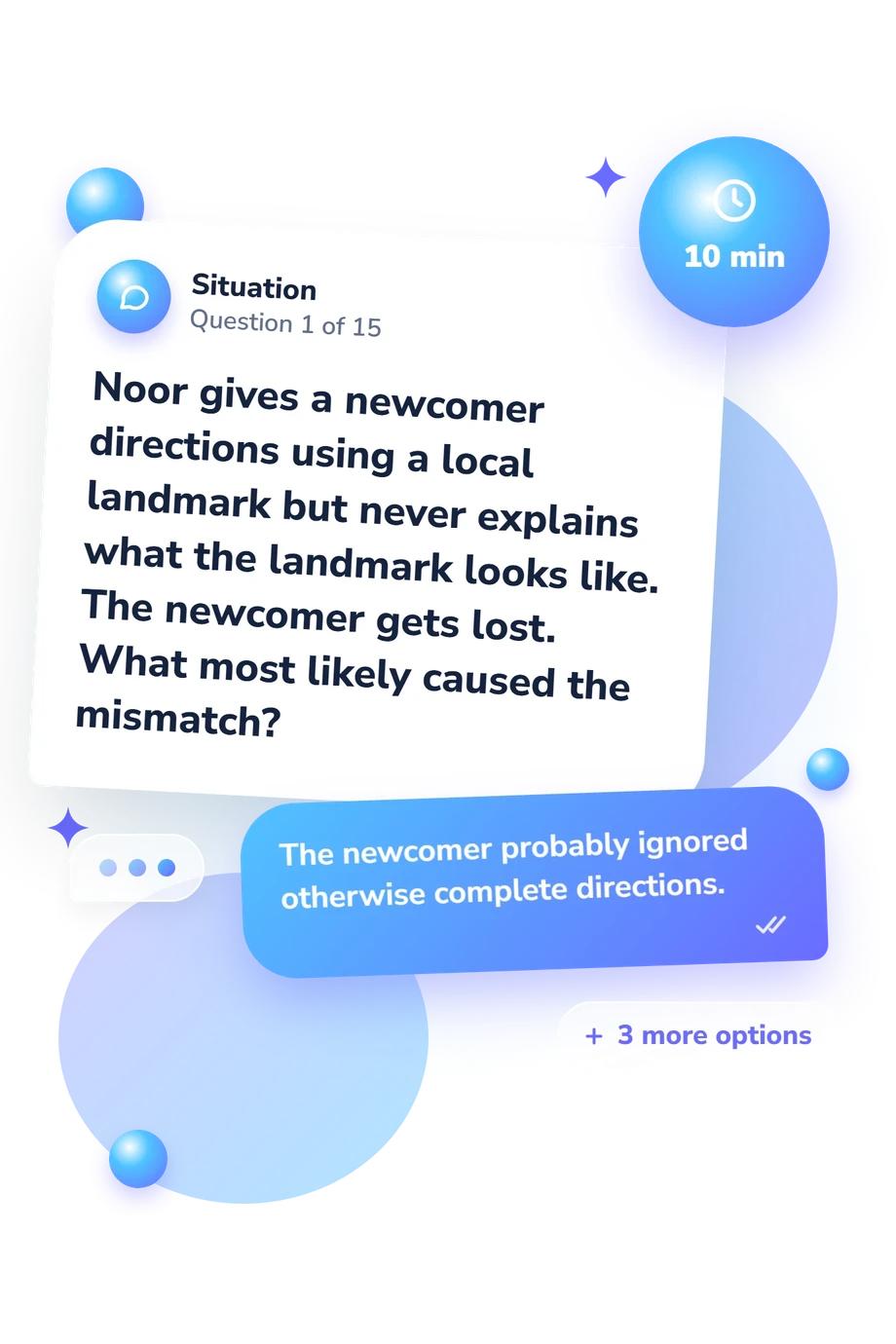
- The newcomer probably ignored otherwise complete directions.
- Noor and the newcomer must understand the word “landmark” differently.
- The route was likely too complicated for a newcomer to follow.
- Noor assumed the newcomer shared local knowledge that the newcomer did not have.
- Follow the usual Friday convention used by my team.
- Assume it means a polished draft by the end of Friday.
- Prepare it for Thursday so either likely deadline is covered.
- Confirm the deadline time and what “draft” should include.
Can You Read My Mind Quiz - Description and methodology of the test
People who want to examine how they handle unclear exchanges, competing viewpoints, and ambiguous social moments may use Can You Read My Mind Quiz as a structured self-reflection exercise. Its playful read my mind quiz framing focuses on social inference: results show how readily you check meaning, separate your knowledge from another person’s, and combine verbal and nonverbal clues. The assessment concerns everyday reasoning, not literal telepathy.
What This Assessment Explores
The questionnaire examines how a person handles ambiguity in ordinary interaction. Its scenarios ask whether you clarify unclear wording, account for information another person lacks, and interpret tone, expression, behavior, and context without treating an initial impression as certain. Here, the read your mind quiz examines communication and social understanding.
Three displayed summaries organize the result:
- Clarifying Communication: 0-15 measures identifying ambiguity and confirming shared meaning; Meaning assumed (0-5), Selective clarification (6-10), Active meaning checks (11-15).
- Perspective and Context Inference: 0-15 measures separating your knowledge from another person’s likely beliefs, preferences, and constraints; Own-view anchored (0-5), Perspective developing (6-10), Contextual perspective (11-15).
- Social-Emotional Cue Reading: 0-15 measures combining words, tone, expression, behavior, and context; Literal/Uncertain (0-5), Developing (6-10), Nuanced (11-15).
These unvalidated bands describe questionnaire patterns, not clinical status or population norms; differing scores can highlight strengths and difficulties.
Methodology and Scientific Basis
Each item presents a social situation with four response options. The alternatives distinguish literal assumptions, premature certainty, context-sensitive inference, clarification, and repair of misunderstanding. Choose the response that best matches the most reasonable interpretation or action, so the questionnaire samples judgment in defined situations rather than broad self-rating.
The response pattern is summarized into three displayed scores, each capped at 15 points. Their bands describe patterns within this questionnaire rather than population norms, percentiles, or diagnostic cutoffs. The result is an unvalidated skills profile highlighting possible strengths and practice areas.
The evidence context is TASIT (McDonald et al., 2003), a social-perception instrument using acted situations to examine emotion, intention, and context. The scenarios also overlap with theory-of-mind reasoning described by Happé (1994) and cue interpretation examined by Baron-Cohen et al. (2001). Here, the playful mind reader quiz framing means social inference, not telepathy; this questionnaire is conceptually consistent with those works but is not presented as an adaptation of them.
Forced-choice responses to imagined scenarios vary with wording, attention, mood, culture, and self-awareness. Use the bands as reflection prompts when real-life behavior is complex or changing.
- McDonald, S., Flanagan, S., Rollins, J., & Kinch, J. (2003). TASIT: A new clinical tool for assessing social perception after traumatic brain injury. The Journal of Head Trauma Rehabilitation, 18(3), 219-238. 10.1097/00001199-200305000-00001
- Happé, F. G. E. (1994). An advanced test of theory of mind: Understanding of story characters' thoughts and feelings by able autistic, mentally handicapped, and normal children and adults. Journal of Autism and Developmental Disorders, 24(2), 129-154. 10.1007/BF02172093
- Baron-Cohen, S., Wheelwright, S., Hill, J., Raste, Y., & Plumb, I. (2001). The “Reading the Mind in the Eyes” Test Revised Version: A study with normal adults, and adults with Asperger syndrome or high-functioning autism. Journal of Child Psychology and Psychiatry, 42(2), 241-251. 10.1111/1469-7610.00715
Updated: