
Life Soundtrack Quiz
How the Scales are Structured
Who Usually Takes This Test?
See How You Compare
Below is a preview of how scores are typically distributed across each scale.
Example Questions From the Test
- Silence or ordinary background sounds while I wake up
- Soft music that eases me into the day
- A steady groove that gradually gets me moving
- An energetic track that makes the morning feel fully started
- Something slow enough to let my mind wander
- No soundtrack; I would rather notice the surroundings
- A lively playlist that puts a spring in my step
- Midtempo songs that loosely match my walking pace
- A song that gives the raw feeling a powerful voice
- Neutral instrumentals that create some emotional distance
- No music while I let my thoughts settle naturally
- A sequence that starts tense and gradually shifts toward relief
Life Soundtrack Quiz - Description and methodology of the test
For anyone who treats music as more than background sound, the Life Soundtrack Quiz offers a structured way to examine listening habits. It suits curious listeners who want language for the way songs color routines, memories, transitions, and emotionally meaningful moments. By treating music as a soundtrack to my life, this quiz makes the exercise personal: its result describes preferences, not a fixed identity.
What This Assessment Explores
Music enters life through emotion, routine, and personal meaning. Scenarios cover mornings, difficult days, transitions, and songs linked to people or places. The result describes listening preferences, not mood, motivation, memory quality, or emotional health.
The displayed dimensions are:
- Emotional Resonance (0-15) shows your preference for music to echo and amplify emotion: Clear Air (0-5), Shifting Color (6-10), or Emotional Cinema (11-15).
- Morning Tempo (0-15) shows your preference for music bringing energy and momentum to mornings: Gentle Opening (0-5), Building Groove (6-10), or Full-Volume Launch (11-15).
- Personal Storytelling (0-15) shows your preference for connecting songs with memories, relationships, and life chapters: Present-Tense Listener (0-5), Memory Mixtape (6-10), or Living Archive (11-15).
Together, these bands show music across feeling, routine, and story. The result is a pattern: this song of my life quiz connects music with personal story, not reduce it to one label.
Methodology and Scientific Basis
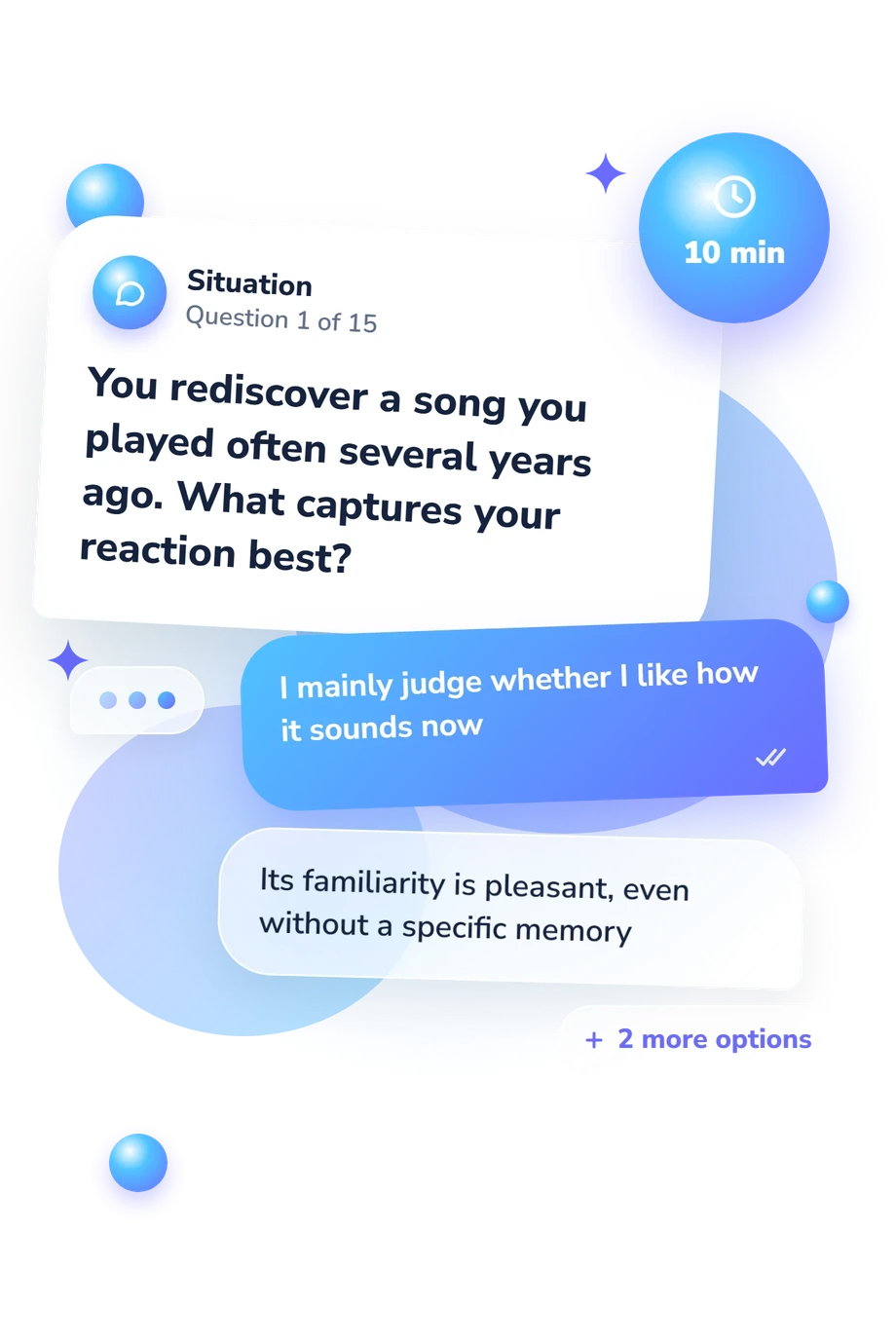
Each item presents a recognizable listening situation with four response options. The choices contrast silence, gentle background sound, steady momentum, vivid emotional matching, and explicit links to memories or life chapters. Selections are converted into three displayed profile scores, but the questionnaire does not publish a separate scoring key or claim that any response carries a universal psychological weight.
MUSEBAQ (Chin et al., 2018) is a relevant published comparison for this questionnaire’s attention to musical preferences and the reasons people turn to music. This quiz is conceptually consistent with those domains, not an adaptation of that published instrument.
Jakubowski et al. (2025) is especially relevant to memory-oriented items because it examines individual variation in music-evoked autobiographical memories. Saarikallio and Erkkilä (2007) offer a relevant account of music-related mood regulation.
The displayed scores and bands are descriptive, and established norms or standardization for this online questionnaire are not provided. Self-report results may shift with current mood, recent listening, and accessible memories. The result is a flexible snapshot of listening preferences, a life soundtrack profile rather than a complete account of musical life.
- Chin, Tan-Chyuan, Eduardo Coutinho, Klaus R. Scherer, and Nikki S. Rickard. "MUSEBAQ: A Modular Tool for Music Research to Assess Musicianship, Musical Capacity, Music Preferences, and Motivations for Music Use." Music Perception: An Interdisciplinary Journal 35, no. 3 (2018): 376-399. DOI 10.1525/mp.2018.35.3.376
- Jakubowski, Kelly, Edith Lee, Elena Bai, and Amy M. Belfi. "Individual Differences in Music-Evoked Autobiographical Memories." Musicae Scientiae 29, no. 2 (2025): 195-216. DOI 10.1177/10298649241288173
- Saarikallio, Suvi, and Jaakko Erkkilä. "The Role of Music in Adolescents' Mood Regulation." Psychology of Music 35, no. 1 (2007): 88-109. DOI 10.1177/0305735607068889
Updated: